REX Veterinary Laser
Lyra Veterinary Laser Therapy — A New Boost for Pet Wound Healing
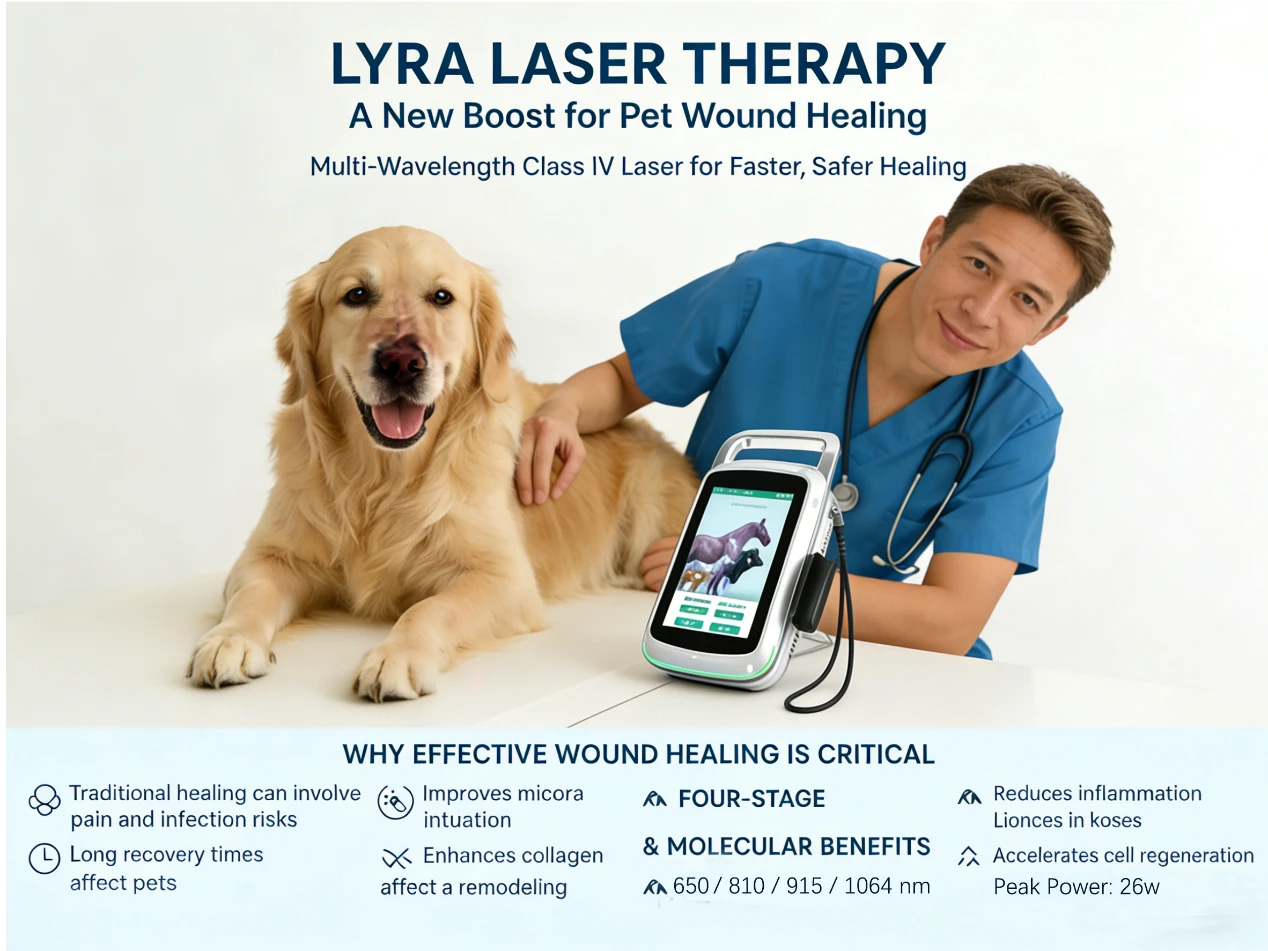
In veterinary clinical care, wound healing is a critical aspect that directly affects recovery outcomes. Traditional wound-healing processes often involve pain, infection risks, and prolonged recovery. In recent years, the new generation of Class IV laser therapy has offered an advanced solution for accelerating and optimizing wound healing in pets, thanks to its unique photobiomodulation effects.
1. Overview of the Physiological Process of Wound Healing
Wound healing in pets is a highly coordinated and dynamic biological process that typically proceeds through four stages:
Hemostasis: Blood vessel constriction and platelet aggregation form a clot.
Inflammatory Phase: Immune cells remove bacteria and necrotic tissue, often accompanied by redness, swelling, heat, and pain.
Proliferation: Fibroblast proliferation, increased collagen synthesis, and new blood vessel formation.
Remodeling: Collagen fibers reorganize, scar tissue matures, and tissue strength increases.
Within this healing rhythm, scientifically modulating inflammation, promoting cellular activity, and enhancing microcirculation are key to accelerating repair. Class IV laser therapy is designed to act precisely on these physiological mechanisms.
2. Mechanisms of Class IV Laser Therapy: Cellular and Molecular Modulation
Class IV laser therapy utilizes photon energy from specific wavelengths (red to near-infrared) to penetrate tissues and trigger photobiomodulation.
Using Lyra Veterinary Laser Therapy, which features 650 nm, 810 nm, 915 nm, and 1064 nm wavelengths, the multi-wavelength combination produces synergistic effects at multiple cellular levels:
Modulation of the Inflammatory Response
Laser therapy reduces the excessive release of pro-inflammatory mediators such as prostaglandins and TNF-α, lowering edema and pain. The 810 nm wavelength in Lyra is particularly effective for localized anti-inflammatory and analgesic action.Enhanced Cell Proliferation and Migration
Photon absorption by mitochondria increases ATP production, boosting fibroblast, keratinocyte, and endothelial cell activity. The 915 nm deep-penetration wavelength significantly improves repair efficiency in deeper tissues.Stimulation of Angiogenesis and Improved Microcirculation
Laser therapy upregulates VEGF expression, promoting capillary regeneration and improving oxygen and nutrient delivery.Optimization of Collagen Synthesis and Alignment
Laser stimulation enhances fibroblast activity and promotes more uniform and stronger type I collagen deposition, reducing scar formation. The 650 nm wavelength plays a key role in superficial tissue repair and epithelialization.Strengthened Anti-Infection Capacity
Laser therapy enhances the phagocytic abilities of immune cells, indirectly reducing the risk of infection.
3. Clinical Benefits and Expected Outcomes
Based on the above mechanisms, Class IV laser therapy brings multiple advantages to pet wound management:
Shortened healing time: Multi-wavelength synergy boosts ATP, collagen production, and angiogenesis.
Significant pain relief: Non-pharmacological analgesia improves comfort quickly.
Reduced complications: Lower risk of infection and inadequate granulation.
Improved healing quality: More organized, stronger tissue with lighter scarring.
Safe and non-invasive: No anesthesia required; gentle and widely accepted in clinical use.
4. Why More Veterinarians Are Choosing the Lyra Class IV Laser
Lyra stands out among similar laser devices and is favored by veterinary hospitals worldwide due to the following advantages:
Broader Multi-Wavelength Coverage
650/810/915/1064 nm target the epidermis, dermis, deep soft tissue, and neurovascular structures simultaneously—superior to traditional single or dual-wavelength systems.High Power Output for Shorter Treatment Time
Faster energy delivery allows veterinarians to complete an effective session in 3–6 minutes, enhancing clinical efficiency.Intelligent Treatment Modes
Touchscreen operation with preset treatment protocols lowers the learning curve and allows staff to use it with ease.Wide Clinical Application
Beyond wound healing, it is effective for inflammation, joint diseases, postoperative recovery, and pain management.
Conclusion
Class IV laser therapy represents a significant advancement in veterinary rehabilitation medicine. Through precise photobiological modulation, it influences multiple key stages of wound healing and provides veterinarians with a safe, efficient, and non-invasive treatment tool.
Lyra Laser Therapy by Ailucs not only enhances healing quality but also significantly improves the overall treatment experience for pets. For veterinarians and pet owners seeking faster recovery, reduced pain, and better clinical outcomes, Lyra is undoubtedly a leading choice worth attention.
Latest articles:
- Lyra Veterinary Laser Therapy — A New Boost for Pet Wound Healing
- Clinical Advantages of High-Intensity Laser Therapy in Treating Equine Back Pain
- The Scientific Principles of Vet Laser Anti-Inflammatory Effects:An Analysis of Cellular Cascade Effects
- Veterinary Laser Therapy in Pet CKD Management
- Ailucs Multi-Wavelength Class IV Laser Therapy: A Painless and Highly Effective Solution for Pet Skin Diseases
- Lyra veterinary Laser Therapy Device: A Magical Aid for a Kitten’s Fracture Recovery
- Laser Therapy Device: A “Light-Speed” Solution for Tendon Repair
- Laser Therapy: A Powerful Way to Boost Veterinary Clinic Revenue
- Veterinary Laser Therapy: Precise Application to Support Pet Rehabilitation
- Degenerative Joint Disease — The Silent Pain Your Dog Endures