
How to Choose a Medical High Intensity Laser Machine

Power, wavelengths and a practical buying guide for rehabilitation and physiotherapy clinics
Choosing a medical high-intensity laser machine starts with the clinical service you intend to provide. The useful comparison is whether a specific system offers suitable output control, documented performance, practical operation and support for your intended human medical use.
Maximum wattage and wavelength count are only part of that decision. A larger number does not establish better clinical results, and a claim of deep penetration does not tell you the dose received by a particular anatomical structure. This guide explains how to compare specifications, question deep-tissue claims and prepare a purchase checklist.
For an introduction to the treatment itself, read what high-intensity laser therapy is. Here, the focus is selecting equipment for professional practice.
1 Define the clinical service before comparing machines
Write a short purchasing brief covering the conditions your clinicians manage, anatomical regions, typical treatment areas, expected daily workload and staff experience. Confirm that the device’s intended use and supporting documentation match the human medical service and market in which it will operate.
A clinic working mainly with localized areas may prioritize precise adjustment and a manageable applicator. A rehabilitation center treating larger regions may place more weight on sustained output, scanning ergonomics and scheduling. These are workflow priorities, not prescriptions for particular diagnoses.
Decide whether the device stays in one room or moves between treatment spaces. Also identify who will review parameters, document treatment and train new staff. Use these requirements to shortlist systems before comparing optional features.
2 Compare average power and dose control
Power describes the rate of energy delivery: one watt equals one joule per second. Higher available power can shorten the time required to emit a selected amount of energy, but it does not by itself establish an appropriate treatment dose or a better outcome.
| Specification | What to ask the supplier |
| Maximum power | Is this continuous, time-averaged, peak pulse or combined multi-wavelength output? |
| Average power | What average output is available in each operating mode? |
| Peak pulse power | What are the pulse duration, repetition rate and associated average power? |
| Combined output | How much power comes from each wavelength, and which can operate together? |
| Measurement and stability | Where is output measured, with which applicator, and how is stability verified? |
For a calculation example only, a stable average output of 10 W emits 600 J in 60 seconds; 20 W emits the same energy in 30 seconds. This compares emitted energy and time. It does not establish equal heating, equal tissue absorption or equal clinical effects, and 600 J is not a recommended treatment dose.
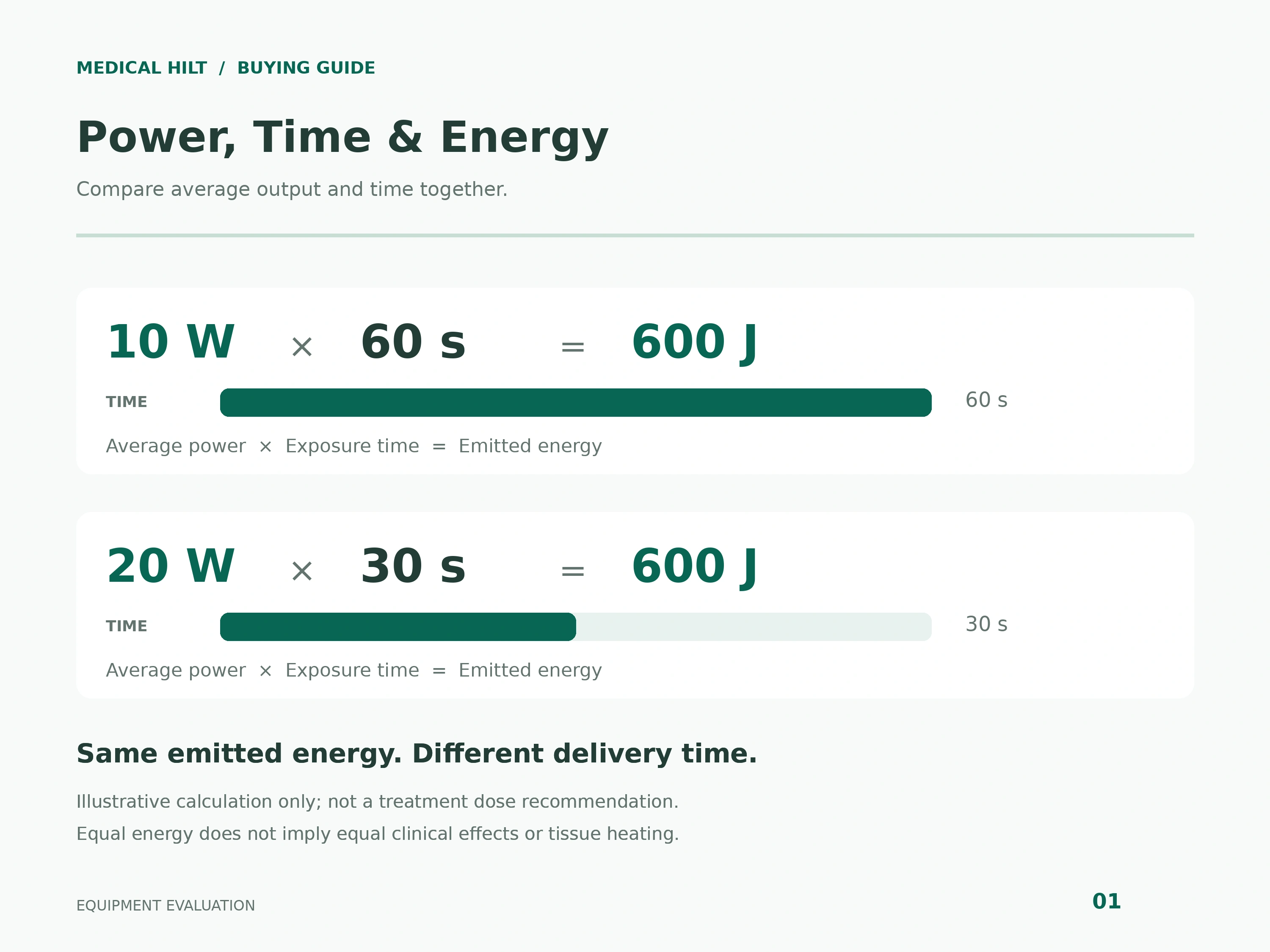
For steady average output, energy in joules equals average power in watts multiplied by time in seconds. When output changes during treatment, the calculation must account for those changes. Ask whether the screen displays selected settings, calculated energy or measurements from an output sensor; these are different forms of information.
Useful controls should make power, time and energy understandable. Check adjustment steps, parameter limits and whether a record of the delivered session can be retained. An impressive output ceiling has limited purchasing value if routine delivery is difficult to control or document.
3 Evaluate wavelengths as part of the complete configuration
Therapeutic laser platforms use different red and near-infrared wavelengths. Their interaction with tissue depends on absorption and scattering, together with pigmentation, blood, water, tissue composition and beam geometry. No wavelength specification provides a universal treatment depth.
The four wavelengths below illustrate a configuration used in the AILUCS human HILT discussion. They are not an exhaustive list of medical laser wavelengths or a ranking of effectiveness.
| Wavelength | Purchasing interpretation |
| 650 nm | Red light generally associated with more superficial optical delivery. Confirm its output and role in the selected program |
| 808 nm | Near-infrared option. Evaluate the full protocol and supporting evidence rather than assigning a fixed depth. |
| 905 nm | Used in some pulsed therapeutic systems. The wavelength alone does not establish a super-pulsed output architecture. |
| 1064 nm | Used in HILT systems. Its presence alone does not prove delivery of an effective dose to a deep target. |
For multi-wavelength machines, ask whether channels operate simultaneously or sequentially, whether individual output is adjustable and how total power is divided. A combined 26 W specification does not mean 26 W from each wavelength.
Single-wavelength systems may fit a defined service and protocol. Multi-wavelength systems may offer additional configuration choices, but wavelength count is not evidence of superior outcomes. Compare the relevant clinical evidence and actual controls available on each model.
4 Check what deep tissue claims actually demonstrate
When a brochure advertises penetration in centimeters, ask what was measured. Detectable light at a depth, absorbed energy in a target and a clinically meaningful patient outcome are different endpoints. A measurement of one does not establish the others.
An experimental study comparing 905 and 1064 nm examined transmission through ex vivo porcine skin and bovine muscle. It provides optical information under its test conditions; it does not demonstrate that every 1064 nm device treats deep human structures more effectively.
Request the test method, tissue or model used, beam dimensions, measurement location and output settings. For clinical claims, ask whether the study concerns the same device or a meaningfully comparable configuration, the intended diagnosis and a complete treatment protocol.
Assess endpoints such as pain and function separately from claims of structural healing. A favorable study using another laser cannot automatically validate the machine being offered. When evidence is limited, the supplier should explain that limitation rather than substitute a penetration graphic for clinical evidence.
5 Compare pulse modes and the actual beam
Continuous and pulsed operation
Continuous-wave operation emits while activated. Modulated output changes emission over time. For pulsed systems, request pulse duration, frequency, duty cycle, peak power and average power. These describe delivery more meaningfully than a mode name alone.
For ideal rectangular pulses with zero output between pulses, average power equals pulse power multiplied by duty cycle. Other pulse shapes require their actual time profile. Changing frequency does not necessarily change average power in the same way on every device.
A super-pulsed claim needs supporting pulse specifications. A wide adjustable frequency range alone does not prove super-pulsed operation or superior treatment. Ask the supplier to demonstrate what changes on the screen and in the output when a mode is selected.
Treatment heads and skin level spot size
Applicator diameter, beam diameter at the skin and the overall scanned treatment field are different measurements. Do not assume an 8, 30 or 50 mm treatment-head label is the actual optical spot diameter at every working distance.
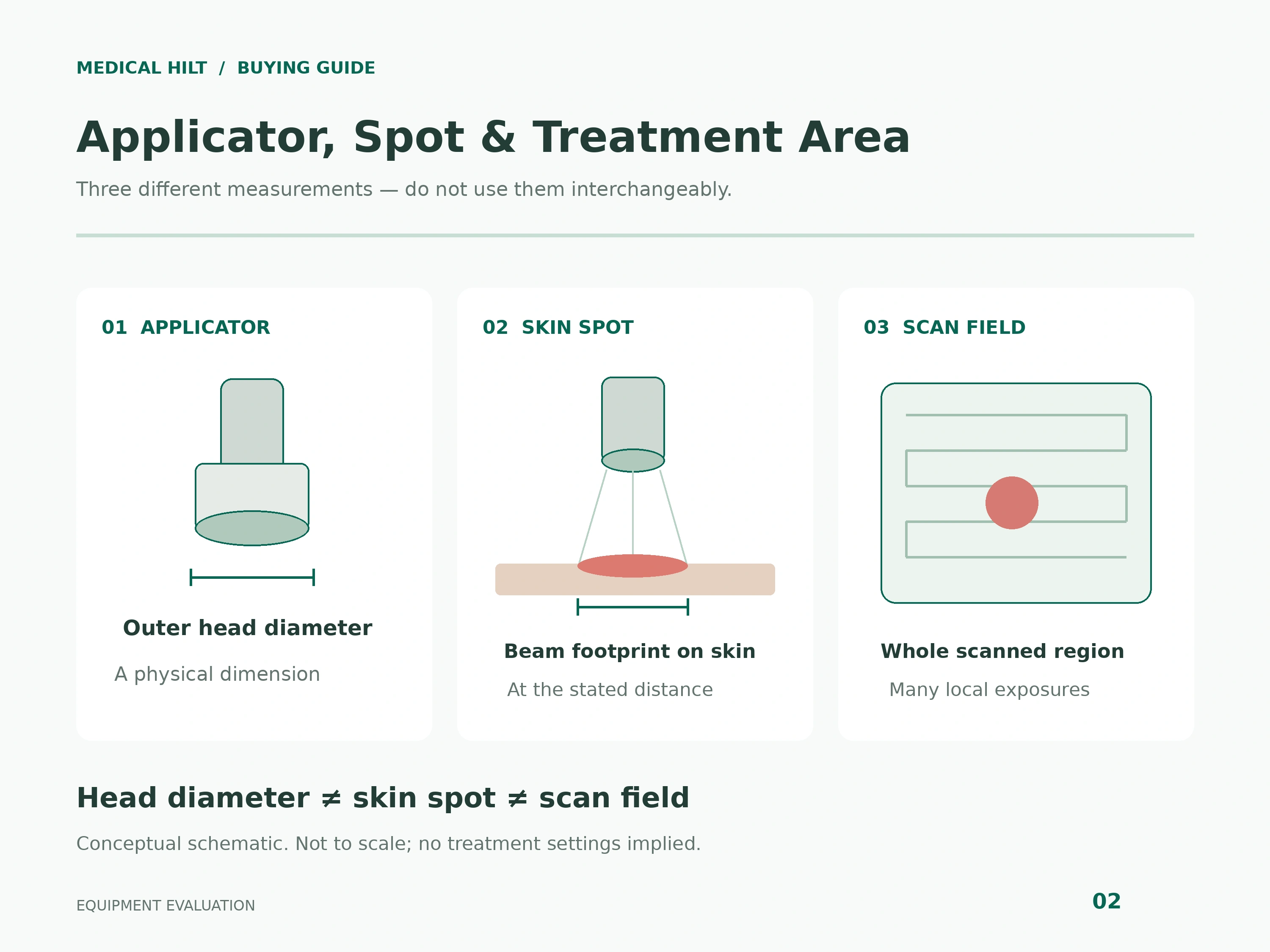
Irradiance is optical power per unit illuminated area, usually W/cm². Fluence is energy per unit area, usually J/cm². During scanning, dividing total energy by the entire field does not describe each point’s local exposure unless delivery is appropriately characterized. Ask for beam size at the specified distance, beam profile and application instructions.
During a demonstration, check grip comfort, cable drag, head changes and cleaning requirements. Confirm whether changing an applicator updates the software automatically or requires manual selection. These details affect repeatability and staff workload.
6 Test software and everyday usability
Request a demonstration using a relevant human clinical workflow, from program selection to parameter review and session documentation. Evaluate the clarity of displayed settings, manual adjustment, saved programs and the ability to recognize an incorrect selection.
Preset count alone is a weak comparison. Ask which presets are for human use, what they contain, how their sources are documented and whether clinicians can review the underlying parameters. Veterinary protocols or species-based software should not be presented as human clinical guidance.
For portable systems, compare weight with the battery installed, charging arrangements, cable storage and operating time under defined settings. Battery runtime without an output level or duty cycle is difficult to interpret. Confirm whether AC and battery operation offer the same specified performance and what happens when charge becomes low.
7 Verify safety and market documentation
Class 4 is a laser hazard classification, not proof of clinical effectiveness. Review the exact model’s instructions, training requirements and safety features. Relevant medical laser safety standards include IEC 60601-2-22; ask which edition and national requirements the supplied documentation addresses.
Check eyewear specifications for all emitted wavelengths and the required protection, emission indicators, controlled activation, emergency stop and applicable interlocks. Ask how the supplier supports room preparation, operator training, output checks and maintenance. Safety controls should be demonstrated, not simply listed.
Regulatory documentation must identify the specific human-use device, manufacturer, intended purpose and target market. FDA establishment registration or device listing does not constitute approval, clearance or authorization. A quality-management certificate also does not by itself authorize every clinical use.
Make documentation review part of shortlisting. Resolve discrepancies between the quoted model, manual and certificates before ordering, particularly when similar product names are used for human and veterinary configurations.
8 Compare total ownership cost and acceptance terms
Request itemized quotations using the same scope. Include the device, applicators, protective eyewear, training, delivery, applicable taxes or import costs, software charges, calibration, consumables and expected service. Avoid comparing a fully supported package with a bare-unit price.
Choose a common ownership period, such as three years, and calculate purchase cost plus expected operating and service costs. Ask separately about battery replacement, handpiece or fiber repairs, warranty exclusions, freight for repairs and loan equipment. Do not assume future patient demand or reimbursement is guaranteed.
Agree on acceptance checks before payment milestones are finalized. These may cover the delivered model and accessories, software functions, safety controls, supplier-provided output verification and completion of training. Any optical measurements should be performed by qualified personnel with suitable equipment.
Record who handles faults, expected response times, local service availability and whether updates are included. Clear service terms often make a comparison more useful than another headline specification.

9 Apply the checklist to a LYRA configuration
AILUCS describes a LYRA configuration in its human HILT materials with 650, 808, 905 and 1064 nm wavelengths and a maximum combined output of 26 W. This is a manufacturer-described configuration, not evidence that every LYRA version has identical specifications or authorization.
Use the same purchasing questions for this configuration as for any alternative: request output by wavelength and mode, average and peak definitions, skin-level beam specifications, human-use software details and market-specific documentation.
Ask for a quotation and demonstration that identify the exact human configuration, included treatment heads, battery performance, training and service package. Clinical studies using different equipment should not be presented as direct validation of the four-wavelength platform.
10 Use a practical purchase checklist
| Decision area | Evidence or demonstration to request |
| Clinical fit | Intended human use, relevant evidence and application instructions. |
| Optical output | Average and peak power, channel allocation and output verification. |
| Dose control | Clear power, time and energy display; accessible adjustment and records. |
| Deep tissue claims | Test methods and results, with optical and clinical findings distinguished. |
| Applicators | Actual beam specifications, working distance, handling and cleaning. |
| Software and mobility | Human workflow demonstration and defined battery test conditions. |
| Safety and market status | Model-matched documents, protective equipment and operator training. |
| Ownership and delivery |
Choose the system whose documented capabilities match your service, whose settings your clinicians can use and record clearly, and whose supplier can support it throughout its working life. Resolve missing evidence before treating two headline specifications as equivalent.
Frequently asked questions
How many watts should a clinic choose
There is no universal wattage for every clinic. Compare usable average output, treatment area, beam characteristics, required energy delivery and workflow. The maximum number alone cannot determine suitable patient settings.
Is 1064 nm always the best option for deep tissue
No universal ranking applies to every target and device. Evaluate the complete optical configuration and evidence relevant to the intended application. A wavelength does not establish a fixed depth or guarantee a clinical outcome.
Are more wavelengths or presets worth paying for
They may be useful when they support relevant, understandable choices. Check actual channel control and human protocol content. Counts without a clear application or documentation are insufficient grounds for a higher price.
What should a clinic request before ordering
Request the exact configuration, full specifications, human-use instructions, relevant market documentation, demonstration, itemized quotation, training plan, warranty and acceptance terms. Keep the agreed scope in writing.
References
1. AILUCS. What Is High-Intensity Laser Therapy (HILT)? Manufacturer description of the four-wavelength platform.
2. Comparison of the Penetration Depth of 905 nm and 1064 nm Laser Light in Surface Layers of Biological Tissue Ex Vivo. 2023. PubMed PMID 37239026.
3. IEC 60601-2-22:2019+AMD1:2026. Medical electrical equipment requirements for surgical, cosmetic, therapeutic and diagnostic laser equipment.
4. US FDA. Important Reminders about Registration and Listing.
This guide supports professional equipment evaluation. It does not prescribe treatment settings or replace device instructions, clinical assessment or applicable local requirements.