
Laser Therapy for Athletes & Sports Medicine
Introduction
Sports medicine covers far more than one type of injury or one stage of recovery. A clinic may see an acute ankle sprain in the morning, a runner with persistent Achilles pain at noon, an overhead athlete rebuilding shoulder capacity in the afternoon, and a postoperative patient preparing for return-to-sport testing later the same day.
Laser therapy can fit into this environment as a complementary modality. Its role is not to replace diagnosis, exercise therapy, progressive loading, strength training, or sport-specific retraining. Instead, it may help clinicians manage pain or exercise-related symptoms and support selected stages of rehabilitation when the treatment parameters and clinical indication are appropriate.
That distinction matters. The useful question is not whether laser therapy is a universal solution for athletes. It is where it may add value within a structured rehabilitation plan, what the evidence actually supports, and how clinicians can use it without overstating recovery or performance benefits.
Where Laser Therapy Fits in Sports Rehabilitation
Athletic rehabilitation is progressive. Early management may focus on irritability, pain, swelling, mobility, and protection of injured tissue. Later phases place greater emphasis on strength, loading tolerance, neuromuscular control, power, speed, and sport-specific movement.
Laser therapy may be considered at selected points along that pathway, particularly when symptom control helps the athlete participate more comfortably in active rehabilitation. The central intervention, however, remains the rehabilitation program itself. An athlete who feels less pain but has not restored strength, control, tissue capacity, or confidence is not necessarily ready to return to sport.
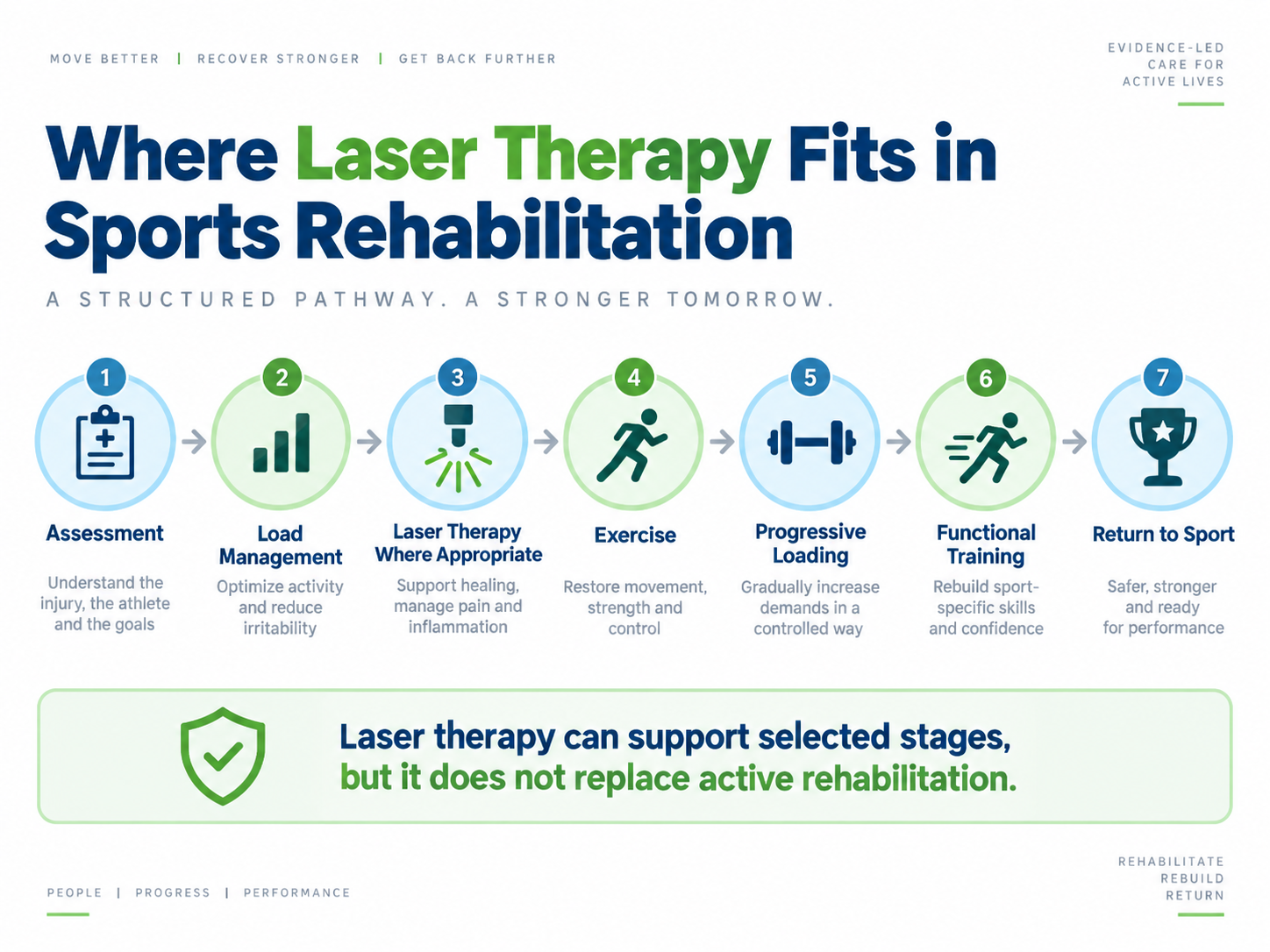
A practical pathway remains:
Assessment → Load Management → Laser Therapy Where Appropriate → Exercise → Progressive Loading → Functional Training → Return to Sport
This framework keeps laser therapy in proportion. It can support the process, but progression should still be based on clinical findings and functional criteria rather than on symptom relief alone.
How Photobiomodulation May Work
Therapeutic red and near-infrared light can interact with cellular photoreceptors and signaling pathways. One widely discussed mechanism involves mitochondrial cytochrome c oxidase, with downstream changes in cellular energy metabolism, reactive oxygen species signaling, nitric oxide pathways, and intracellular calcium. These effects may influence inflammatory signaling, tissue repair, and cellular responses to physical stress.
The mechanism should not be reduced to "more ATP equals faster healing." Photobiomodulation is dose dependent and biologically complex. Wavelength, irradiance, total energy, treatment time, target tissue, and timing relative to exercise can all affect the response. A dose that is useful in one tissue or clinical stage cannot automatically be transferred to another.
This is particularly important in sports medicine, where the treatment goal may change from reducing pain during an irritable phase to supporting exercise tolerance during later rehabilitation. The biological rationale is therefore best viewed as a basis for carefully selected adjunctive treatment, not as proof that every laser protocol will improve every injury.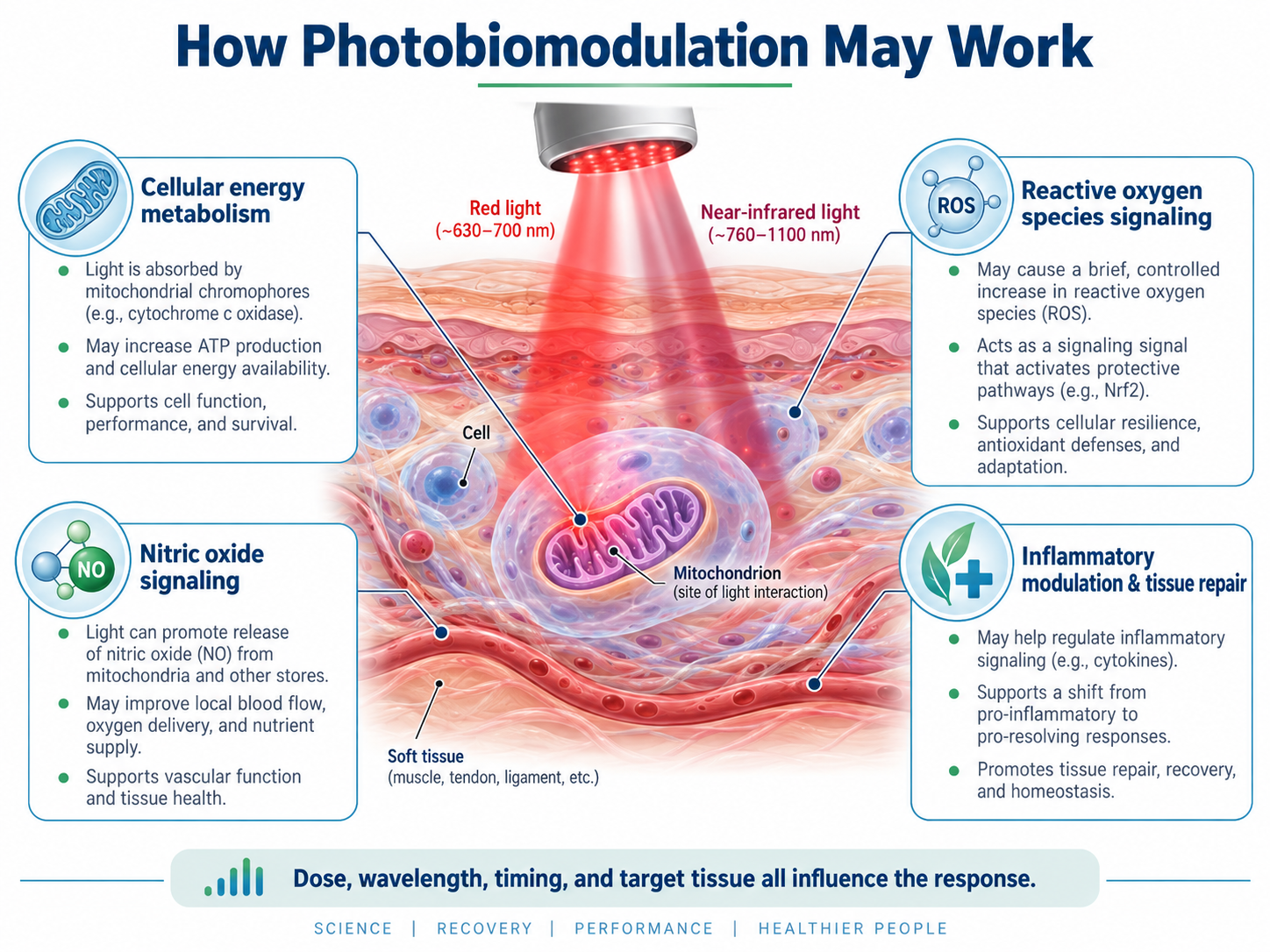
What Does the Evidence Show?
The evidence is promising in some areas but remains uneven across diagnoses, protocols, and outcomes. A 2024 systematic review and meta-analysis of injured competitive and recreational athletes found that photobiomodulation was associated with reduced musculoskeletal pain. However, the limited studies that measured time to return to play did not show that athletes returned to sport faster.
Evidence for exercise recovery also depends on how and when treatment is delivered. A 2025 systematic review reported low-certainty evidence that photobiomodulation applied before exercise reduced muscle soreness at 24 hours, while evidence for improved post-exercise performance remained very low certainty.[3] This suggests that a recovery effect cannot automatically be translated into a guaranteed performance advantage.
Tendon-related research is another example of why condition-specific interpretation matters. A 2025 meta-analysis found short-term pain benefits for low-level laser therapy in chronic tendinopathy compared with minimal intervention, while also emphasizing the influence of treatment parameters and session number.[4] Results from individual tendon sites and long-term outcomes are still variable, so loading-based rehabilitation remains essential.
Overall, current evidence supports a cautious clinical position: laser therapy may help with selected symptoms and recovery outcomes, but it should not be presented as a shortcut to tissue healing, a replacement for progressive rehabilitation, or a proven way to accelerate return to competition.
Recovery Is Not the Same as Performance Enhancement
The words recovery and performance are often used together in sports marketing, but they describe different outcomes.
Recovery refers to the restoration of function after exercise, overload, or injury. Relevant outcomes include soreness, pain, strength recovery, range of motion, swelling, and the athlete's ability to resume planned training or rehabilitation. Laser therapy may have a role here as an adjunct, although effect sizes and certainty vary by protocol and population.
Performance enhancement is a stronger claim. It implies that a healthy athlete becomes faster, stronger, more powerful, or more enduring because of the intervention. Current evidence does not consistently support that conclusion. A 2024 meta-analysis of randomized trials found no significant improvement in running time-trial or time-to-exhaustion performance with photobiomodulation, either alone or combined with training.
For clinical communication, the distinction is useful: supporting recovery is not the same as directly improving athletic performance. Any performance claim should be tied to a specific outcome, population, protocol, and level of evidence rather than generalized from pain or recovery studies.
Sports Injury Categories and Clinical Applications
Tendon-Related Conditions
Lateral elbow tendinopathy, Achilles tendinopathy, patellar tendinopathy, and other overuse tendon problems are common in active populations. Laser therapy may be used alongside load modification and progressive tendon loading when pain limits participation. It should not replace eccentric, heavy-slow resistance, or other exercise strategies selected for the athlete. This category can support future condition-specific articles on tennis elbow, Achilles pain, patellar tendon pain, and rotator-cuff-related tendon disorders.
Muscle Strains and Exercise-Related Muscle Soreness
Hamstring, calf, quadriceps, and adductor injuries require staged restoration of force production, length tolerance, sprint exposure, and sport-specific capacity. Laser therapy may be considered for symptom management or recovery support, while the rehabilitation plan addresses the actual demands that caused or followed the injury. A separate topic cluster can later cover muscle strains, delayed-onset muscle soreness, post-training recovery, and return to sprinting.
Ankle Sprains and Ligament Injuries
After an ankle sprain, the athlete may move from pain and swelling management to mobility, strength, balance, hopping, running, cutting, and change-of-direction work. Laser therapy can sit within the early or middle phases when clinically appropriate, but it cannot restore proprioception or mechanical stability by itself. Ankle sprain rehabilitation is therefore a natural downstream topic from this page.
Shoulder and Overhead-Sport Rehabilitation
Throwers, swimmers, racket-sport athletes, and other overhead athletes often need a combination of symptom control, mobility, rotator cuff strength, scapular control, kinetic-chain training, and gradual re-exposure to sport. Laser therapy may be one adjunct among these components. Future articles can address rotator cuff pain, shoulder overuse, throwing-related pain, and staged return to overhead sport.Shoulder and arm symptoms may sometimes overlap with cervical conditions, so appropriate assessment is important when cervical radiculopathy is suspected.
Foot and Lower-Limb Overuse Problems
Runners and field-sport athletes frequently present with plantar heel pain, load-related foot pain, shin symptoms, and other overuse complaints. These conditions require careful differential diagnosis and workload management. Where laser therapy is used, it should be integrated with footwear, strength, mobility, running-load, or technique interventions as appropriate. This section can later branch into plantar fasciitis, runner recovery, and lower-limb overuse topics without duplicating the present page.
Postoperative Rehabilitation
Following procedures such as ACL reconstruction, meniscal surgery, tendon repair, or other orthopedic operations, rehabilitation is governed by tissue-healing constraints, surgical protocols, strength recovery, and functional testing. Laser therapy should only be used when compatible with the surgeon's plan and device indications. It cannot substitute for staged loading or return-to-sport criteria, but it may be considered as an adjunct within the broader postoperative program.
From Symptom Control to Return to Sport
The athlete's needs change across rehabilitation. Early improvement in pain or swelling may make movement easier, but later decisions depend on whether the athlete can tolerate the loads, speeds, forces, and movement patterns required by the sport.The same rehabilitation-first principle also applies to other musculoskeletal conditions, including discogenic low back pain, where symptom relief should support rather than replace active rehabilitation.
This is why laser therapy should not become the endpoint of treatment. Its most practical role is to help create conditions in which active rehabilitation can progress. Clinicians should reassess symptoms, function, loading response, and sport-specific capacity rather than repeating the same protocol simply because it was used earlier in the rehabilitation process.
Wavelength, Power, and Dose: What Matters Clinically?
When clinics evaluate Class IV laser therapy systems, specifications should be interpreted in relation to clinical use rather than as isolated marketing numbers.
Wavelength
Wavelength influences how light interacts with tissue chromophores and how strongly it is absorbed or scattered. Red and near-infrared wavelengths are commonly used in photobiomodulation, but "deeper wavelength" should not be treated as a guarantee of better results. The practical question is whether the available wavelengths are suitable for the clinic's treatment sites and intended protocols.
Power
Higher maximum power can shorten delivery time or make it easier to deliver a selected amount of energy over a larger area, but more power is not automatically more therapeutic. Clinicians need controllable output, appropriate technique, and the ability to match treatment to the tissue, area, and goal. With higher-power medical lasers, safety controls and operator training become especially important.
Dose
Dose is not determined by one number. Total energy, energy density, power, irradiance, treatment area, and exposure time interact. Reproducible settings matter because photobiomodulation has a dose-response relationship: an effective protocol depends on delivering an appropriate amount of energy to the intended target rather than simply selecting the highest available setting.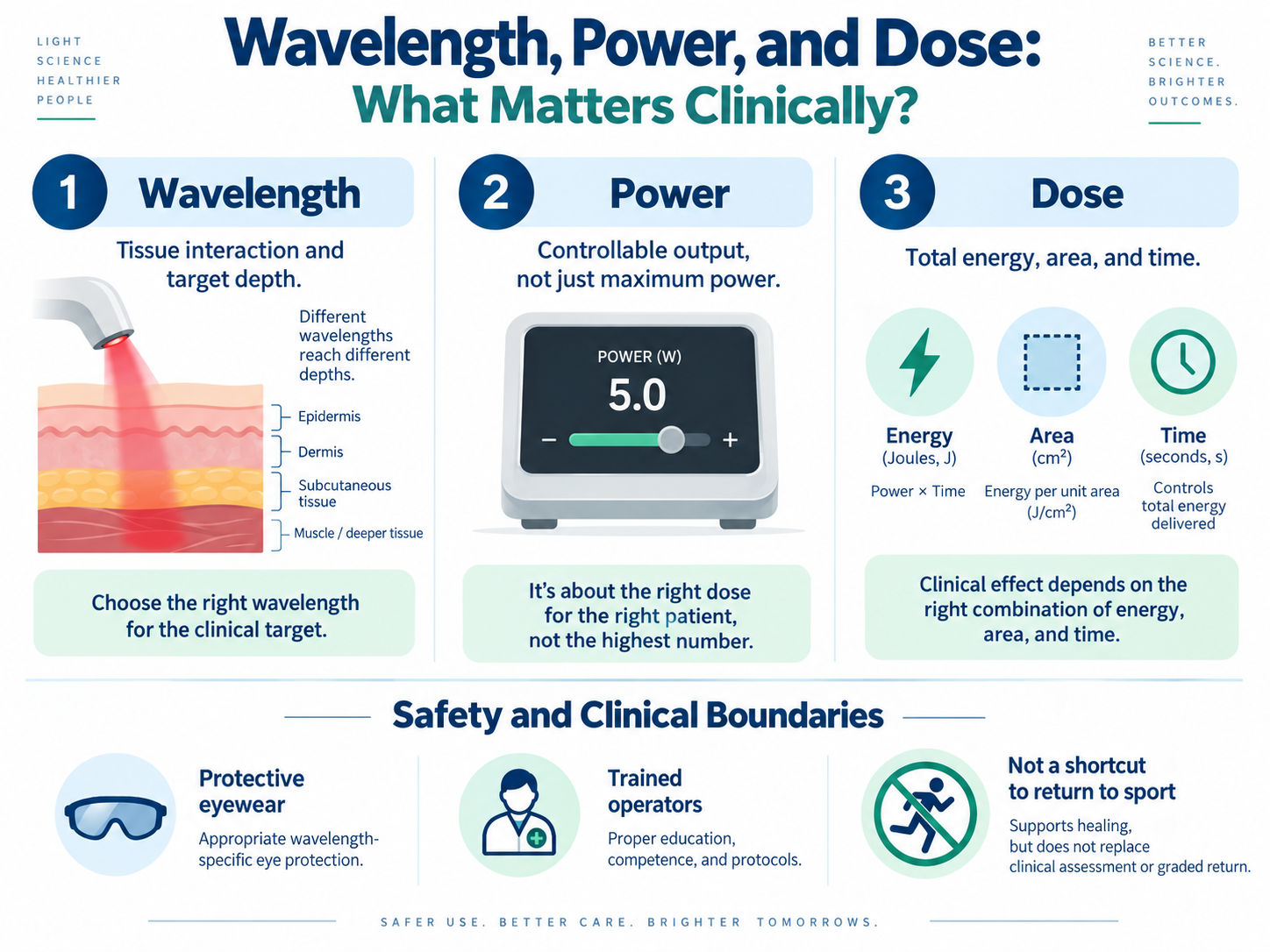
Practical System Selection
For a sports medicine clinic, useful selection criteria include clinically relevant wavelength options, adjustable power, reproducible dose settings, clear protocol control, treatment heads suitable for different anatomical areas, and a workflow that clinicians can use consistently. The system should be flexible enough for a diverse caseload without making treatment unnecessarily complicated.
The purchasing decision should begin with the clinic's actual patients and services: which injuries are treated most often, which anatomical areas require treatment, how large the treatment areas are, and how laser therapy will fit around exercise-based care. A specification is valuable only when it improves clinical control or workflow. Also review ergonomics, preset management, documentation, maintenance, and whether clinicians can save or modify protocols. In a busy practice, these workflow details may matter more than a small difference in headline output.
Safety and Clinical Boundaries
Laser therapy should be delivered by trained personnel using the device according to its labeling, local regulations, and clinical indications. High-powered Class 4 lasers can present immediate eye and skin hazards from direct or reflected exposure; appropriate wavelength-specific protective eyewear and a controlled treatment environment are core safety requirements.
Clinical boundaries are just as important as laser-safety controls. New or unexplained severe pain, suspected fracture, major instability, progressive neurological symptoms, infection, or other red-flag findings require appropriate assessment rather than symptom-masking treatment. A reduction in pain should not be used to justify premature loading or return to play.
Contraindications and precautions can vary by device, wavelength, treatment site, and jurisdiction. Clinicians should follow the manufacturer's instructions and professional safety standards rather than relying on generic internet protocols. In sports medicine, the goal is not to treat every painful area with a laser; it is to use the modality only when the diagnosis, rehabilitation stage, and treatment objective are clear.
Frequently Asked Questions
Can laser therapy replace exercise-based rehabilitation?
No. Exercise, progressive loading, strength development, neuromuscular retraining, and sport-specific preparation remain central to sports rehabilitation. Laser therapy is best used as a complementary modality when it helps address symptoms or recovery barriers that interfere with active rehabilitation.
Is a higher-power laser always better?
No. Maximum power is only one device characteristic. Treatment quality also depends on wavelength, irradiance, dose, treatment area, exposure time, delivery technique, and the clinician's ability to control those parameters. Higher power may improve workflow in some settings, but it does not remove the need for appropriate dosing or safety controls.
Why consider a multi-wavelength laser?
Different wavelengths interact differently with tissue, so a multi-wavelength system may give clinicians more protocol options across superficial and deeper treatment sites. The benefit is practical only if the wavelengths are clinically relevant and can be dosed appropriately. More wavelengths should not be treated as automatic evidence of better outcomes.
What should a sports medicine clinic look for when buying a laser therapy system?
A sports medicine clinic should look beyond maximum power alone. Important factors include clinically relevant wavelengths, adjustable power and dose control, reproducible settings, practical applicators, safety features, an efficient workflow, training, and reliable after-sales support. The system should also match the clinic's typical treatment areas and rehabilitation workload. AILUCS describes a human LYRA configuration combining 650, 808, 905, and 1064 nm wavelengths with a maximum combined output of 26 W. This gives clinicians multiple wavelength options within one platform, but the practical value still depends on appropriate parameter selection, dose control, and the exact human-use configuration supplied. Before purchasing, clinics should verify output by wavelength and mode, treatment heads, human-use software, safety documentation, training, warranty, and service support. For a more detailed purchasing checklist, see our guide on how to choose a medical high-intensity laser machine.
Conclusion
Laser therapy can have a useful place in sports medicine, particularly as an adjunct for selected pain and recovery goals. The evidence, however, is not uniform across injuries or performance outcomes. Current research supports a more disciplined message: use laser therapy to complement assessment and active rehabilitation, not to replace them or promise faster return to sport.
For clinics, the practical value of a medical laser lies in appropriate parameters, reproducible dosing, safe operation, and the ability to integrate treatment into a clear rehabilitation pathway. That framework also creates a strong foundation for more specific content on tendinopathy, muscle recovery, ankle injuries, shoulder rehabilitation, running-related conditions, and postoperative return to sport.
Selected References and Safety Standard
1. Maghfour J, Ozog DM, Mineroff J, et al. Photobiomodulation CME part I: Overview and mechanism of action. Journal of the American Academy of Dermatology. 2024;91(5):793-802. doi:10.1016/j.jaad.2023.10.073.
2. Morgan RM, Wheeler TD, Poolman MA, et al. Effects of Photobiomodulation on Pain and Return to Play of Injured Athletes: A Systematic Review and Meta-analysis. Journal of Strength and Conditioning Research. 2024;38(6):e310-e319. doi:10.1519/JSC.0000000000004752.
3. Canez MS, da Silva LI, Ferreira GD, de Araújo FX, Luza LP. Effects of photobiomodulation, intermittent pneumatic compression and neuromuscular electrical stimulation on muscle recovery: Systematic review with meta-analysis. Journal of Bodywork and Movement Therapies. 2025;44:570-584. doi:10.1016/j.jbmt.2025.06.021.
4. Yap BWD, Lim ECW. Shedding more light on the short-term effect of low-level laser therapy on pain in tendinopathy: A systematic review with meta-analysis. Journal of Back and Musculoskeletal Rehabilitation. 2025;38(6):1232-1256. doi:10.1177/10538127251339104.
5. do Nascimento AP, da Silva AV, Casonatto J, Aguiar AF. A Meta-Analysis of Randomized Controlled Trials on the Effects of Photobiomodulation Therapy on Running Performance. International Journal of Exercise Science. 2024;17(4):327-342. doi:10.70252/BUWB9550.
6. ANSI Z136.3-2024. Safe Use of Lasers in Health Care. American National Standards Institute / Laser Institute of America; 2024.