Treatment Area Assessment: The First Critical Decision in Veterinary Laser Therapy Outcomes
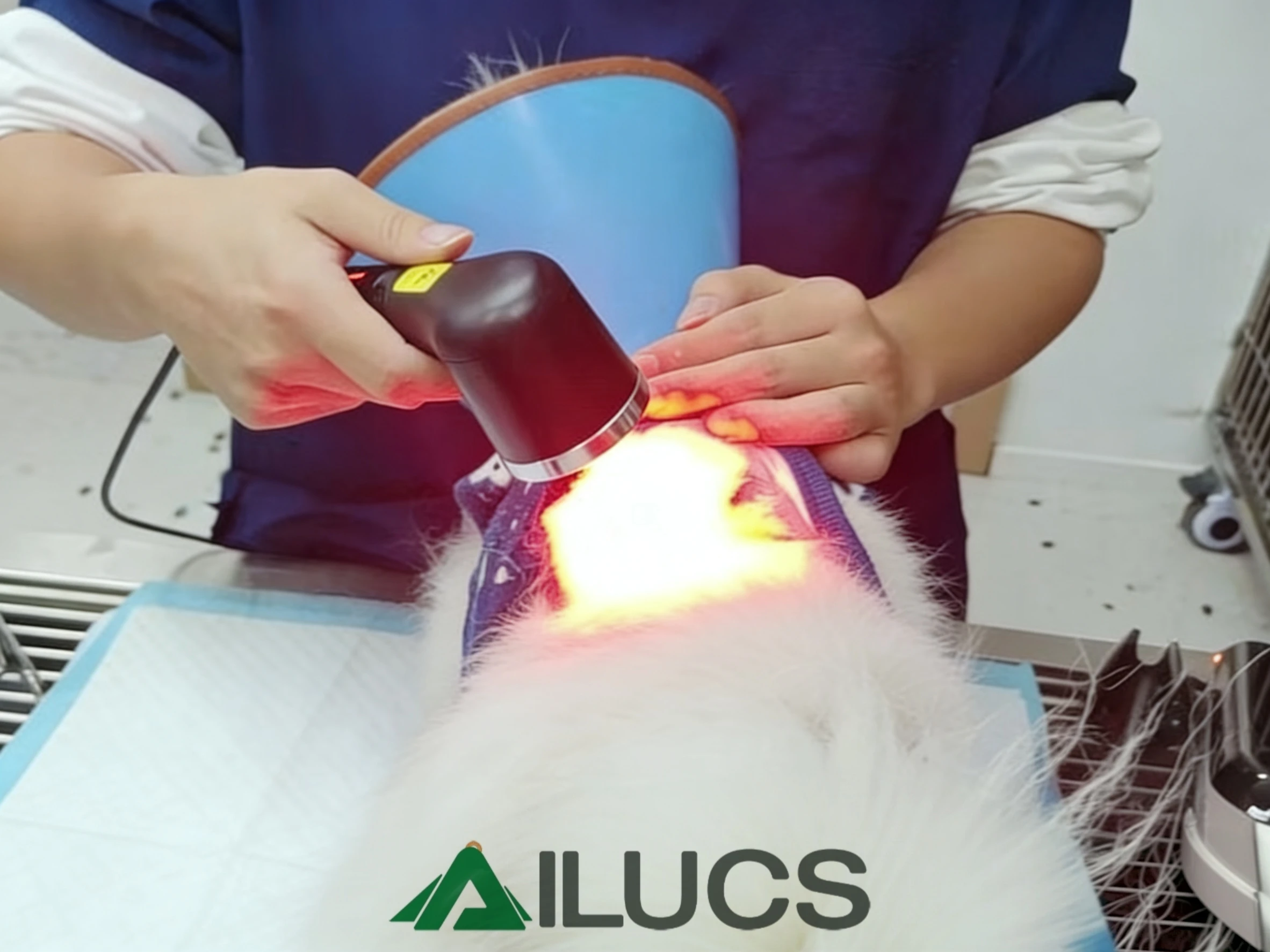
Introduction: Why Assessment Is the Foundation of Laser Therapy Effectiveness
The essence of laser therapy lies in delivering light energy at specific wavelengths to target tissues, triggering photobiomodulation (PBM). This process promotes blood circulation, reduces inflammation, relieves pain, and accelerates tissue repair. However, the therapeutic effect of laser therapy does not occur automatically. Its effectiveness depends on a critical prerequisite: the delivered light energy must be effectively absorbed by specific chromophores within the target tissue, such as cytochrome c oxidase in mitochondria. If a significant portion of the energy is absorbed, reflected, or scattered before reaching the target cells, the clinical outcome will be compromised.
In this article, Ailucs Laser will guide you through the key assessment factors before laser therapy, helping veterinarians and pet owners make more scientific and effective decisions, and ultimately maximize the clinical value of pet laser therapy.
1. Skin and Coat Pigmentation — The First Competitor for Light Energy
In biological tissues, melanin is a major absorber of near-infrared light, particularly at shorter wavelengths in the 600–800 nm range. Studies have shown a strong positive correlation between melanin concentration and light absorption in this spectrum.
Light-colored skin / low pigmentation: Less energy is absorbed at the surface, allowing more photons to penetrate deeper tissues.
Dark-colored skin / high pigmentation: A greater proportion of laser energy is absorbed in the superficial layers, reducing the effective dose delivered to deeper target tissues.
When skin or coat color is dark, a significant portion of laser energy is “consumed” at the surface, negatively affecting therapeutic efficacy in deeper structures.
To address this, the LYRA laser therapy device by Ailucs is equipped with an intelligent guidance system. In beginner mode, clinicians can select the animal species, body size, skin color, and treatment area, and the system will recommend a reference treatment protocol tailored to the clinical scenario—helping improve accuracy and safety.
Research Evidence
A study involving dogs with different coat colors demonstrated that as coat and skin pigmentation increased, photon transmission through tissue decreased significantly, resulting in lower effective energy reaching the target tissue. The study also indicated that longer wavelengths (such as 810 nm and 980 nm) combined with higher output power (Class IV laser device) can partially improve penetration in darkly pigmented areas.
(Source: https://pubmed.ncbi.nlm.nih.gov/32255908/)
Clinical Principles
In treatment areas with dark skin or pronounced pigmentation, energy deficiency should not be compensated simply by extending the irradiation time. This approach not only fails to effectively increase the dose delivered to deep tissues, but also raises the risk of excessive heat accumulation in superficial tissues.
More effective strategies include:
Selecting appropriate wavelengths: Choose wavelengths with stronger tissue penetration based on pigmentation and target depth.
Optimizing treatment technique: Proper probe angle and contact technique help reduce reflection and scattering losses.
Adjusting power density appropriately: Increase power density within safe limits to compensate for surface absorption rather than extending exposure time.
Using contact probes with applied pressure (critical technique): Contact pressure temporarily displaces superficial blood (hemoglobin is also a strong absorber) and shortens the optical path, improving deep tissue energy delivery.
Avoid: Simply and indiscriminately extending the irradiation time can easily lead to excessive heat accumulation in superficial tissues, increasing discomfort and even the risk of burns.
2. Coat Length and Density — The Overlooked Optical Scattering Field
Animal coat characteristics are often underestimated but play a critical role in laser energy transmission. Hair affects laser therapy in several ways:
Reflection: Energy is reflected off the hair surface
Scattering: Beam direction becomes dispersed, reducing focus
Absorption: Dark hair absorbs more energy
In animals with long, dense, or dark coats, the amount of laser energy reaching the skin and deeper tissues can be significantly reduced. Multiple animal studies and clinical observations consistently show that laser penetration is significantly greater in shaved areas compared to unshaved areas. As a result, most clinical guidelines recommend shaving the treatment area whenever possible to enhance effective energy delivery.
Clinical Recommendations
Shave the treatment area whenever feasible
Ensure full contact between the probe and the skin
Minimize energy loss caused by reflection and scattering
Alternative approach (when shaving is not possible):
Part, moisten, and flatten the coat thoroughly
Use dynamic scanning mode
Clearly inform pet owners that treatment efficacy may be reduced and variability may increase
3. Target Tissue Depth and Type — The Ultimate Guide for Treatment Planning
Laser energy attenuates exponentially as it penetrates tissue, and different tissues (muscle, fat, tendon, ligament, bone) exhibit distinct optical properties. Therefore, target tissue depth and type are the core determinants of laser therapy strategy.
Different Depths, Different Strategies
Superficial tissues (skin, superficial soft tissue)
Lower energy requirement
Low to medium power
Non-contact scanning or light contact
Common wavelengths: 600–810 nm
Deep tissues (muscle, joints, tendons, ligaments)
Higher energy density required
High power, contact mode with pressure
Preferred wavelengths: 980 nm or 1064 nm
Tissue-Specific Considerations
Muscle tissue: Highly responsive; widely used for pain relief and rehabilitation
Tendons / ligaments: Dense structure, often requiring higher total energy
Joint areas: Require consideration of anatomy and overlying tissue thickness
Disease stage also matters:
Acute inflammation / edema: Start with low doses, focus on anti-inflammatory effects
Chronic fibrosis / scar tissue: Higher total energy may be required to stimulate remodeling
Nerve treatment: Precise localization with medium to high static dosing
With multiple integrated wavelengths, the LYRA multifunctional laser therapy system enables clinicians to adapt treatment parameters across a wide range of clinical applications, making one device suitable for diverse animal species, tissue depths, and therapeutic goals.
Conclusion: Scientific Assessment Is the First Step Toward Effective Laser Therapy
Laser therapy is not a “plug-and-play” solution. Systematic evaluation of skin pigmentation, coat characteristics, and target tissue depth is essential to ensure that therapeutic energy reaches the intended tissue and produces consistent clinical outcomes. Through proper assessment and parameter optimization, laser therapy technology can fully realize its value in veterinary rehabilitation, pain management, and post-operative recovery.
If you are looking for a veterinary laser therapy device that offers multiple wavelength options, high power output, and clinical flexibility, we invite you to explore the Ailucs Laser Therapy Device—designed to support more precise and efficient clinical treatments.