
How Long Does Veterinary Laser Therapy Take?
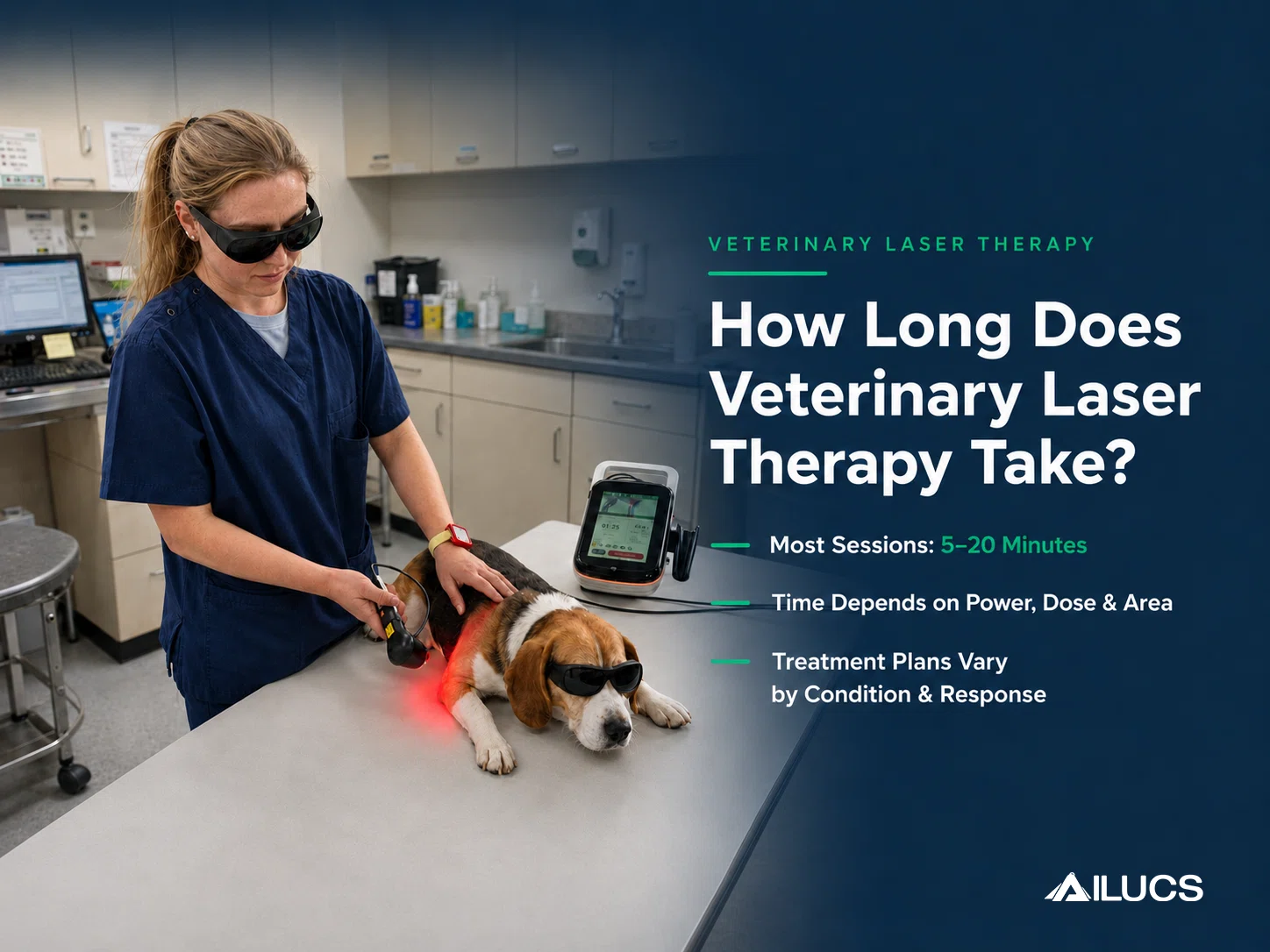
Veterinary laser therapy is a non-invasive treatment method, but how long it takes is one of the questions most frequently asked by pet owners and veterinary clinicians.
Unlike administering a single medication dose, laser therapy is parameter-driven. The duration of each session depends on the condition being treated, the anatomical site, the device's power output, and the target dose selected by the clinician.
This article explains typical session length, the factors that affect treatment time, and how treatment courses may vary by condition. It can help pet owners know what to expect before a first appointment and help veterinary teams develop practical, patient-specific treatment protocols.
For pet owners, understanding treatment duration can make appointment planning easier and provide a clearer picture of the process their animal may experience.
Common questions include:
• How long does one laser therapy session take?
• How many treatments will my pet need?
• How long will it take to see improvement?
There is no single fixed treatment time. The appropriate duration depends on the type of condition, the treatment site, the size of the area being treated, and the protocol developed by the veterinarian.
Typical Session Length: A Quick Overview
Most veterinary laser therapy sessions last between 5 and 20 minutes.
This is a practical range across many companion-animal and equine applications. For a small, localized treatment area, the actual irradiation time may be shorter. The complete treatment time still depends on the size of the area, the target dose, and the individual patient's condition. Total appointment time may also include positioning, assessment, and clinical documentation.
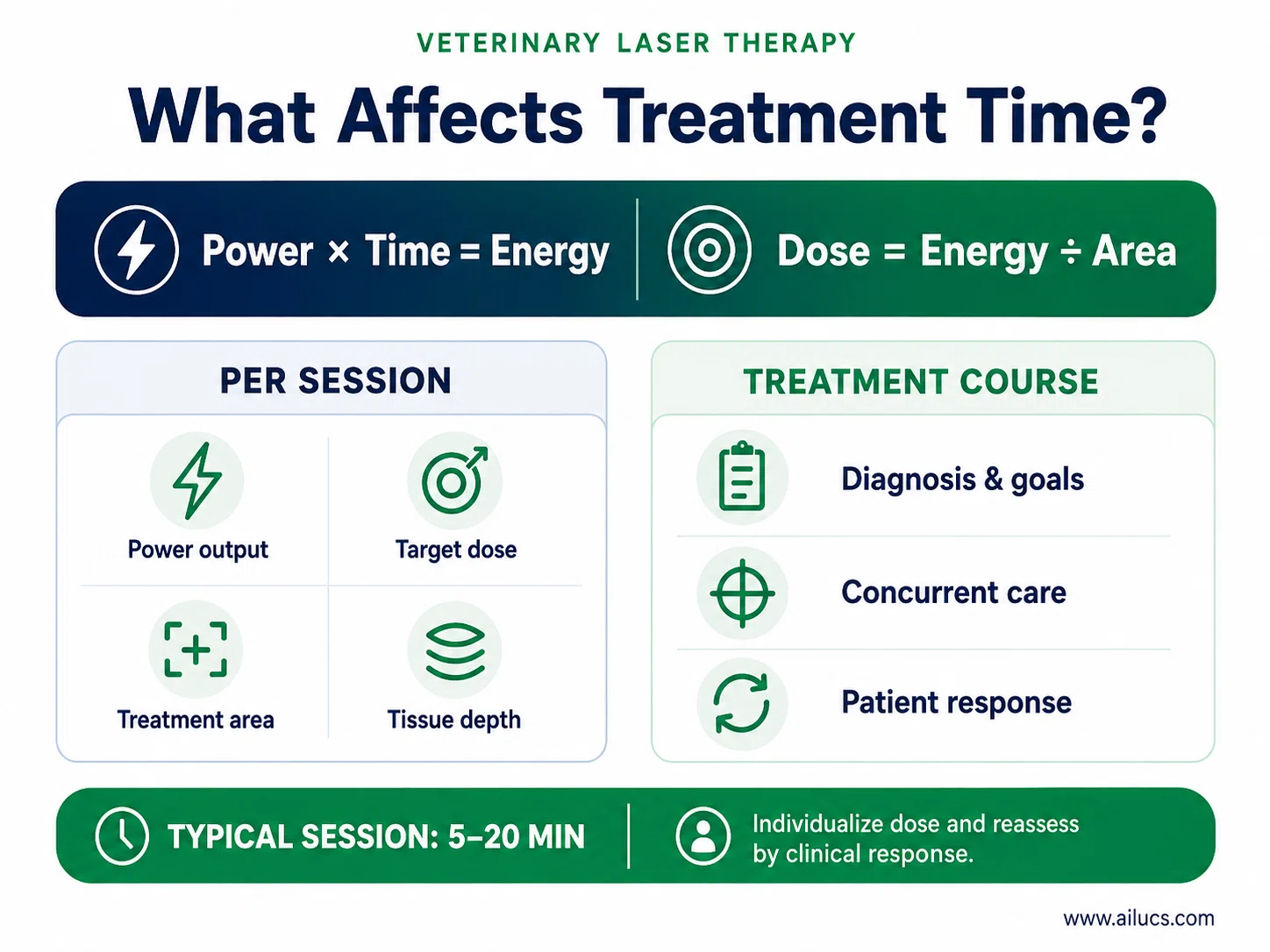
Three variables directly affect treatment duration:
• Power (W) - how quickly energy is delivered
• Dose (J/cm²) - the amount of energy required by the target tissue
• Treatment area size - the number of scans or treatment points needed to cover the area
Higher power delivers energy more quickly and can shorten treatment time. A larger treatment area or a higher target dose generally requires a longer session.
Typical Treatment Times by Area
| Treatment Area | Typical Time Range |
| Small wounds, skin, or superficial tissues | Usually less than 5 minutes |
| Localized soft tissue areas | Usually 5-15 minutes |
| Joints, muscles, or spinal areas | Usually 10-20 minutes |
| Large treatment areas, such as those in large dogs or horses | Adjusted according to area size and target dose |
The Relationship Behind Every Session: Power × Time = Energy
To understand why session length varies, it helps to begin with the basic relationships that determine energy delivery:
Energy (J) = Power (W) × Time (seconds)
Dose (J/cm²) = Energy (J) ÷ Treatment Area (cm²)
In simple terms, to deliver a given dose over a defined area, a clinician can use a lower-power device for a longer time or a higher-power Class IV device for a shorter time. This is why Class IV veterinary laser systems can reduce treatment time and the length of time a patient must remain still without changing the target dose.
Treatment Duration by Condition: How Treatment Courses May Vary
Treatment duration has two meanings: how long each session takes and how treatment may be scheduled over time. The number and frequency of sessions should be individualized according to the diagnosis, treatment goals, concurrent care, and the patient's response.
Important: The schedules and ranges below are general examples, not fixed treatment recommendations or guarantees of outcome. The veterinarian should determine and adjust the plan for each patient.
Acute Conditions: Treatment Courses Are Often Shorter
Recent injuries, acute flare-ups, and early postoperative inflammation may be managed with shorter treatment courses than long-standing conditions, although responses vary between patients.
• Acute soft tissue injuries or sprains: Some treatment plans schedule 1-3 sessions during the first week, followed by reassessment and adjustment according to recovery.
• Postoperative incision or wound support: Treatment may begin during the early postoperative period when considered appropriate by the veterinarian. Some clinical plans use a short initial course, but timing and frequency depend on the procedure, incision status, and overall recovery plan.
• Acute joint problems or mild arthritis flare-ups: Some clinical plans use a short initial course, such as 3-6 sessions, with reassessment based on inflammation, comfort, and function.
• Simple wound healing: Treatment may be scheduled several times per week over 1-3 weeks in some cases, depending on wound status and the broader care plan.
Chronic Conditions: Longer or Staged Plans May Be Needed
Chronic conditions may require longer or staged plans because they involve long-term tissue changes. Some patients may also move to a maintenance phase based on clinical response.
• Osteoarthritis or degenerative joint disease: Some protocols use an initial course of 6-12 sessions, sometimes beginning 2-3 times per week, followed by reassessment and lower-frequency maintenance when clinically appropriate.
• Tendon and ligament injuries: Because these structures have a limited blood supply, some patients may follow a staged plan over 4-8 weeks or longer, with the schedule adjusted to tissue healing and rehabilitation progress.
• Intervertebral disc disease (IVDD) recovery support: A staged protocol may be used over several weeks. Some plans begin with 2-3 sessions per week, with adjustments based on neurological function, surgical status, and rehabilitation progress.
• Chronic pain management: After an initial treatment course, some patients may move to maintenance sessions spaced from weekly to monthly, depending on comfort, function, and ongoing clinical assessment.
Clinical note: Responses vary between individual animals. Some patients may show early changes after one or two sessions, while others may require a longer period before their response can be assessed. A change observed during treatment does not establish a fixed course or guarantee an outcome. The plan should be reassessed regularly and adjusted according to the patient's response.
Common Treatment Courses by Condition
| Condition | Example Treatment Course | Possible Scheduling Approach |
| Postoperative recovery suppor | Some protocols use 3-6 sessions | May begin in the early postoperative period when clinically appropriate; adjusted to the procedure, incision, and overall recovery plan |
| Acute soft tissue injury or sprain | Some protocols use 3-6 sessions | Some plans use 1-3 sessions during the first week, followed by reassessment and adjustment |
| Acute joint problem or inflammatory flare-up | Some protocols use 3-6 sessions | Reassessed according to inflammation, comfort, and functional recovery |
| Osteoarthritis or degenerative joint disease | Some protocols use 6-12 sessions or more | May begin 2-3 times per week, followed by reassessment and maintenance when clinically appropriate |
| Tendon or ligament injury | Staged plan over several weeks or longer | Frequency adjusted according to tissue healing and rehabilitation progress |
| IVDD recovery support | Individualized staged protocol | Some plans begin 2-3 times per week; adjusted to neurological, surgical, and rehabilitation progress |
| Chronic pain management | Initial course; maintenance may follow | Maintenance may be spaced from weekly to monthly, based on comfort, function, and clinical reassessment |
Note: These examples are not prescriptions. Session number and frequency should be determined by the veterinarian according to the diagnosis, treatment goals, patient response, concurrent care, and applicable device instructions.
Treatment Duration by Area: Why Anatomy Matters
Different anatomical sites require different treatment times because tissues lie at different depths and may require different doses.
Superficial Areas: Shorter Sessions
Skin, superficial wounds, surgical incisions, and oral tissues usually require shorter treatment times.
• Surgical incisions or small wounds: Often less than 5 minutes.
• Feline oral or gingival treatment: Point-based treatment; a full-mouth session typically takes 5-10 minutes.
Deep Musculoskeletal Areas: Longer Sessions
Muscles, joints, tendons, ligaments, and spinal regions are deeper treatment areas.
• Osteoarthritis in large joints, such as the hip or stifle: A complete treatment typically takes 10-20 minutes.
• Canine elbow or carpal joints: These smaller joints may require less time than the hip, but adequate dose delivery to deeper tissues is still needed.
• Spine or IVDD: Point-by-point treatment along the affected vertebral segments commonly takes 10-20 minutes.
• Equine tendons or suspensory ligaments: The larger treatment area may require a longer session.
Large Treatment Areas: More Time for Complete Coverage
A larger area requires more scanning passes or treatment points to achieve even coverage, which increases session length.
• Full back or hip region in a large dog: Approximately 15-20 minutes.
• Small localized points, including acupuncture-style or trigger points: Often less than 1 minute per point.
How Long Does It Take to See Improvement?
The timeline for improvement after laser therapy is influenced by several factors:
• The type of condition
• How long the condition has been present
• The animal's age and overall health
• The treatment protocol
Some animals may show improved comfort or mobility early in the treatment course, but responses vary between patients.
Acute Conditions
Several treatments may be needed before a clear recovery trend can be assessed.
Postoperative Recovery
Laser therapy is typically used as one part of a broader recovery plan alongside wound care, rest, and other appropriate therapeutic measures.
Chronic Conditions
Conditions such as joint degeneration and long-term pain may require a longer, staged treatment plan and, in some cases, maintenance therapy.
Why Higher Power Can Mean Faster Treatment
One practical advantage of Class IV veterinary laser systems is their ability to deliver a therapeutic dose in less time than older low-power Class III devices.
At the same target dose, a higher-power device can shorten treatment time because it delivers more joules per second. In clinical practice, this may mean:
• Less time for the patient to remain still
• Greater treatment workflow efficiency
• The ability to manage multiple treatment areas during one visit
When comparing power, wavelength, and dose, remember that faster does not automatically mean better. The dose must still be appropriate for the patient and treatment goal. Higher power improves treatment efficiency, but it does not, by itself, determine clinical efficacy.
Frequently Asked Questions
How long does one veterinary laser therapy session take?
Most sessions last 5-20 minutes. Small, superficial areas may take less than 5 minutes, while deep musculoskeletal regions or large treatment areas may take 15-20 minutes.
How many treatments will my pet need?
It depends on the condition and the patient's response. Acute problems often require a shorter course, while osteoarthritis, tendon injuries, and other chronic conditions may require a longer staged plan followed by maintenance therapy.
Why does treatment time vary, and can higher power shorten it?
Treatment time depends on the target dose, the size and depth of the treatment area, and the device's power output. A higher-power system can deliver energy more quickly and may reduce the time needed to reach the target dose, but the treatment parameters must still be appropriate for the patient.
Can a 10-minute laser therapy session be effective?
It can be appropriate in some treatment situations. Clinical suitability is not determined by time alone; it depends on the dose, treatment area, patient factors, and the veterinarian's treatment goals.
Is veterinary laser therapy painful for pets?
Usually not. Veterinary laser therapy is non-invasive, and most animals tolerate treatment without showing obvious discomfort.
Can cats and horses also receive laser therapy?
Yes. Veterinary laser therapy is used not only in dogs but also in cats, horses, and other animals when clinically appropriate.
Conclusion
A typical veterinary laser therapy session lasts 5-20 minutes, but the appropriate duration for any patient depends on the condition, the treatment area, the target dose, and the device's power output. Acute conditions may involve a shorter treatment course, whereas chronic conditions may require a longer, staged plan with periodic reassessment and, in some cases, maintenance sessions.
For clinicians, understanding the relationship among power, dose, and time is essential for efficient and effective treatment delivery. This is one reason high-power Class IV laser systems are increasingly used in veterinary rehabilitation and pain-management settings.
Learn More About the AILUCS LYRA Veterinary Laser
The LYRA Veterinary Laser is a portable Class IV platform that combines five therapeutic wavelengths, more than 4,000 expert treatment protocols, and intelligent 3D guidance. It helps veterinary clinicians develop treatment plans more efficiently while optimizing clinical workflow without compromising treatment quality.
Designed for applications including pain management, rehabilitation, joint conditions, soft tissue injuries, and wound support, LYRA provides the flexibility needed for a wide range of veterinary patients.
Contact AILUCS to learn how precise, time-efficient laser therapy can be integrated into your clinic's rehabilitation and pain-management workflow. Visit www.ailucs.com or email sales@ailucs.com.
Related Research
Wardlaw JL, Gazzola KM, Wagoner A, et al. (2019). Laser Therapy for Incision Healing in 9 Dogs. Frontiers in Veterinary Science, 5, 349.
DOI: 10.3389/fvets.2018.00349
Millis DL, Bergh A. (2023). A Systematic Literature Review of Complementary and Alternative Veterinary Medicine: Laser Therapy. Animals, 13(4), 667.
DOI: 10.3390/ani13040667
Hochman L. (2018). Photobiomodulation Therapy in Veterinary Medicine: A Review. Topics in Companion Animal Medicine, 33(3), 83–88.
DOI: 10.1053/j.tcam.2018.06.004