
Multi-Wavelength Laser Therapy in Veterinary Rehabilitation

Introduction
Multi-wavelength veterinary laser therapy gives clinicians several wavelength options within one treatment platform. Its clinical value lies in treatment planning: wavelength can be considered together with tissue depth, dose, treatment area, clinical objective, and patient characteristics. Treatment parameters can then be adjusted according to the target tissue and clinical situation.

Multi-Wavelength Veterinary Laser Therapy
A multi-wavelength laser system combines two or more therapeutic wavelengths within one platform. This can be useful when a clinic treats conditions involving different tissue structures, treatment depths, or clinical objectives.
A superficial treatment target, for example, differs from an orthopedic rehabilitation case involving muscle, connective tissue, and joint-associated structures. A multi-wavelength system allows clinicians to select from different wavelengths within the same treatment platform when treatment targets, tissue depths, or clinical objectives differ.
How Should Wavelength Be Selected?
Wavelength selection is one component of treatment planning. Clinicians can consider:
Target tissue and anatomical location
Approximate treatment depth
Clinical objective
Patient size and tissue characteristics
Treatment area and duration
Energy dose and irradiance
Application technique
Patient response during reassessment
Light transmission can also be affected by laser power, wavelength, coat color, and whether the treatment area is shaved. In a study of 47 dogs, laser transmission was significantly affected by laser power, wavelength, coat color, and shaving, whereas coat length was not a significant predictor.
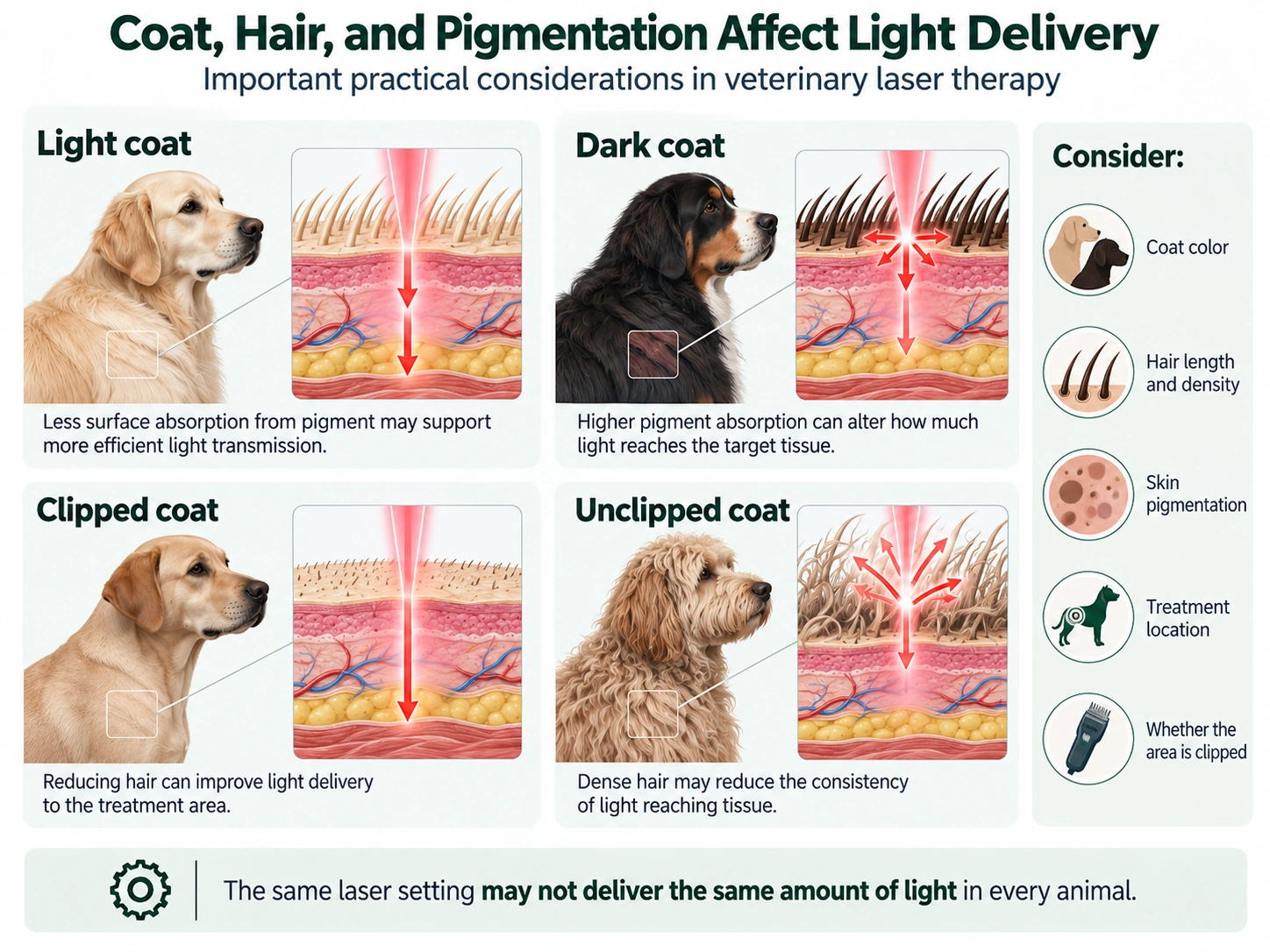
These findings support considering patient and treatment-site characteristics when selecting treatment parameters.
For a focused explanation of wavelength selection and tissue interaction, see Why Wavelength Is Critical in Veterinary Laser Therapy.
Five Wavelengths for Clinical Treatment Planning
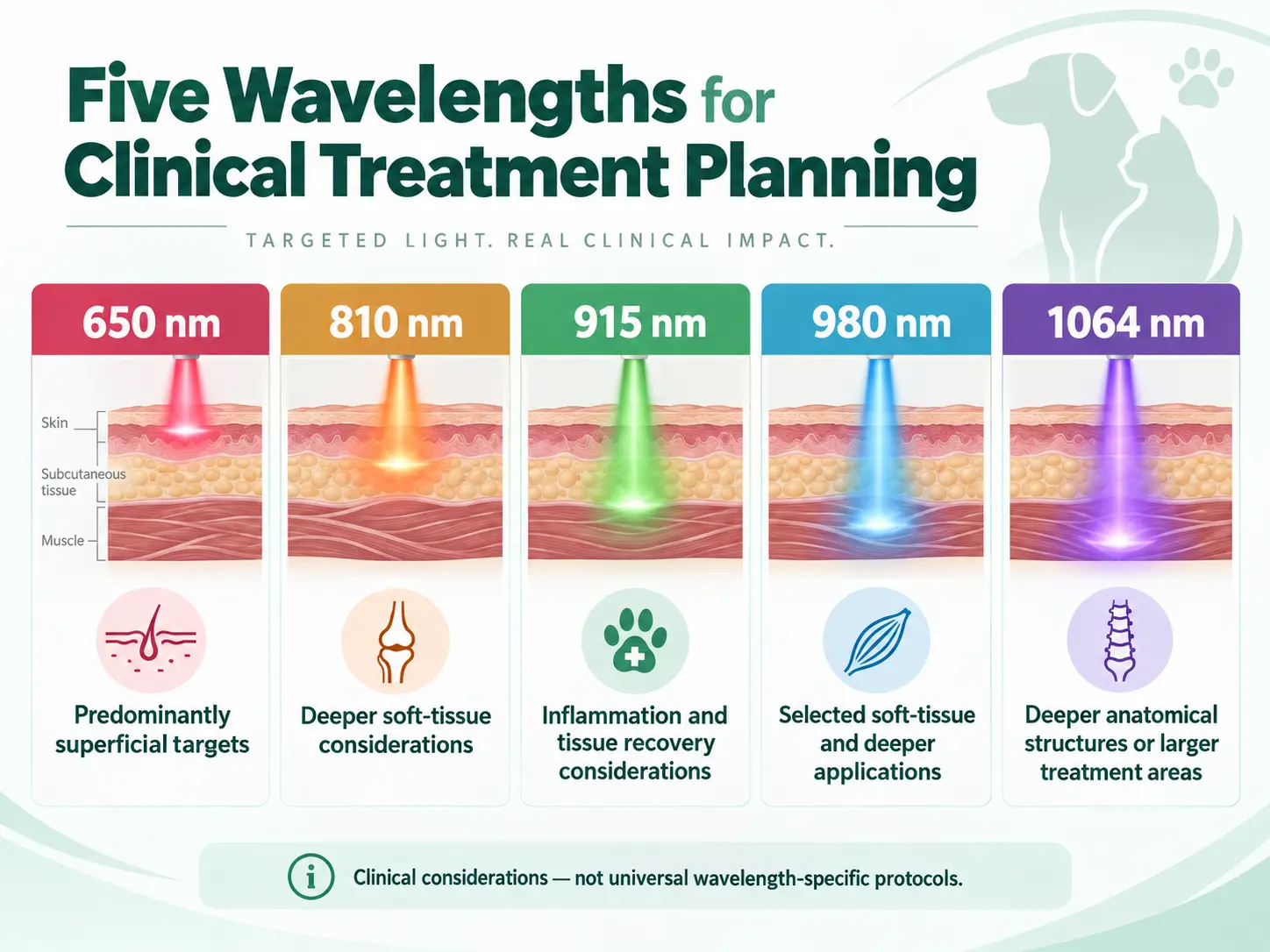
The five wavelengths available in LYRA provide different options for clinical treatment planning:
| Wavelength | Clinical consideration |
| 650 nm | May be considered when the treatment target is predominantly superficial |
| 810 nm | May be considered for deeper soft-tissue applications, including muscle and joint-associated structures |
| 915 nm | May be considered when inflammation and tissue recovery are clinical considerations |
| 980 nm | May be considered for selected soft-tissue and deeper treatment applications |
| 1064 nm | May be considered when deeper anatomical structures or larger treatment areas are being considered |
These descriptions represent clinical considerations rather than universal wavelength-specific protocols.
Wavelength, Dose, and Treatment Parameters
Treatment parameters may include wavelength, irradiance, energy density, treatment time, treatment area, and emission mode. Wavelength alone should not be used to define a treatment protocol.

Published veterinary research illustrates why individual study parameters need to be interpreted within their original clinical or experimental context.
In a prospective, masked, placebo-controlled study of 10 healthy female dogs, a 980 nm laser was applied at 5 J/cm² once daily for five days to surgically closed incisions and experimentally created open wounds. The study did not find a significant improvement in wound healing with this treatment protocol.
A systematic review of veterinary laser therapy found no consensus on optimal treatment protocols and reported variation in treatment parameters, study quality, and clinical outcomes across indications.
When evaluating a laser system, clinics should therefore consider whether wavelength, power, dose, treatment time, and emission mode can be appropriately controlled for different clinical situations.
For a broader overview of how these variables work together, see Power, Wavelength, and Dose in Class IV Veterinary Laser Therapy.
Clinical Evidence
Current veterinary literature supports photobiomodulation as a potential adjunctive modality in selected clinical situations, although evidence varies among indications.
Reviews of veterinary PBM describe applications in pain, inflammation, tissue repair, and rehabilitation while also highlighting differences in treatment parameters and evidence quality.
Photobiomodulation Therapy in Veterinary Medicine provides an overview of the clinical literature, while Photobiomodulation (Therapeutic Lasers): An Update and Review of Current Literature provides a broader review of applications and current evidence.
Postoperative evidence also illustrates why individual trials should be interpreted within their specific treatment conditions. In a randomized study of 54 client-owned dogs undergoing TPLO, PBMT was compared with sham treatment. No statistically significant differences were found for CRP, percentage weight bearing, or CMPS-SF outcomes, although the authors reported potentially promising findings regarding surgical site infection.
Clinical Applications Across Veterinary Patients
Multi-wavelength laser therapy may be incorporated into treatment planning for different veterinary patients when supported by the clinical indication and available evidence.
Examples include:
l Osteoarthritis and degenerative joint conditions
l Muscle and soft-tissue injuries
l Tendon and ligament rehabilitation
l Selected wound and incision management
l Mobility-related rehabilitation
Treatment planning also involves selecting the treatment target, parameters, application technique, and schedule for the individual patient.
Post-Surgical Recovery
Laser therapy may be incorporated as an adjunct to postoperative rehabilitation rather than as a replacement for surgery, medication, wound management, or other veterinary care.
Evidence from postoperative studies remains mixed, so treatment decisions should consider the specific procedure, patient, treatment parameters, and clinical outcomes being monitored.
For a focused discussion of postoperative soft-tissue recovery, see Veterinary Laser Therapy After Soft Tissue Surgery.
Key Criteria for Evaluating a Multi-Wavelength Laser
The number of wavelengths is only one factor when evaluating a veterinary laser system.
Clinics should also consider:
Wavelength configuration
Parameter control
Treatment guidance
Application flexibility
Clinical evidence
Workflow
A useful multi-wavelength system should therefore combine wavelength options with practical parameter control and clinically relevant treatment guidance.
Frequently Asked Questions
Is a multi-wavelength laser always better than a single-wavelength laser?
No. Multiple wavelengths primarily provide greater treatment flexibility. Clinical outcomes depend on the complete treatment protocol, patient condition, indication, and clinical application.
Should multiple wavelengths always be used in the same treatment?
Not necessarily. Wavelength selection should be based on the treatment target, clinical objective, dose, treatment technique, device configuration, and patient response rather than on a fixed rule.
What is the difference between wavelength and dose?
Wavelength describes the spectral characteristics of the light. Dose describes the amount of energy delivered to the treatment area. Both are relevant to treatment planning, but they are not interchangeable.
For calculation examples and the distinction between energy and surface exposure, see Veterinary Laser Therapy Dosage: Power, Time & Area.
How should treatment parameters be selected with a multi-wavelength laser?
Parameters should be selected according to the treatment target, clinical objective, patient characteristics, treatment area, and available evidence. Published study parameters can provide useful reference points but should not automatically be treated as universal protocols.
Can laser therapy replace postoperative care or medication?
No. Laser therapy is an adjunctive modality and should be integrated with diagnosis, surgical care, medication, wound management, rehabilitation, and other treatments when clinically indicated.
Conclusion
Multi-wavelength veterinary laser therapy gives clinicians more options when developing treatment plans for different clinical situations.
The 650 nm, 810 nm, 915 nm, 980 nm, and 1064 nm wavelengths available in systems such as LYRA can be considered alongside treatment dose, tissue characteristics, application technique, patient factors, and clinical objectives.
The clinical value of a multi-wavelength system therefore lies in treatment flexibility rather than simply the number of wavelengths available.
References
1. Hochman L. Photobiomodulation Therapy in Veterinary Medicine: A Review. Topics in Companion Animal Medicine. 2018;33(3):83–88. doi:10.1053/j.tcam.2018.06.004.
2. Bunch J. Photobiomodulation (Therapeutic Lasers): An Update and Review of Current Literature. Veterinary Clinics of North America: Small Animal Practice. 2023;53(4):783–799. doi:10.1016/j.cvsm.2023.02.010.
3. Millis DL, Bergh A. A Systematic Literature Review of Complementary and Alternative Veterinary Medicine: Laser Therapy. Animals. 2023;13(4):667. doi:10.3390/ani13040667.
4. Gammel JE, Biskup JJ, Drum MG, Newkirk K, Lux CN. Effects of Low-Level Laser Therapy on the Healing of Surgically Closed Incisions and Surgically Created Open Wounds in Dogs. Veterinary Surgery. 2018;47(4):499–506. doi:10.1111/vsu.12795.
5. Chavez OA, Renberg W, Cernicchiaro N. Photobiomodulation Therapy in Dogs Undergoing TPLO After Cranial Cruciate Ligament Rupture Shows Promise but No Statistically Significant Difference in a Randomized Trial. American Journal of Veterinary Research. 2024;85(2). doi:10.2460/ajvr.23.06.0138.