
HILT vs LLLT (Low-Level Laser): Differences, Dosage & Clinical Choice
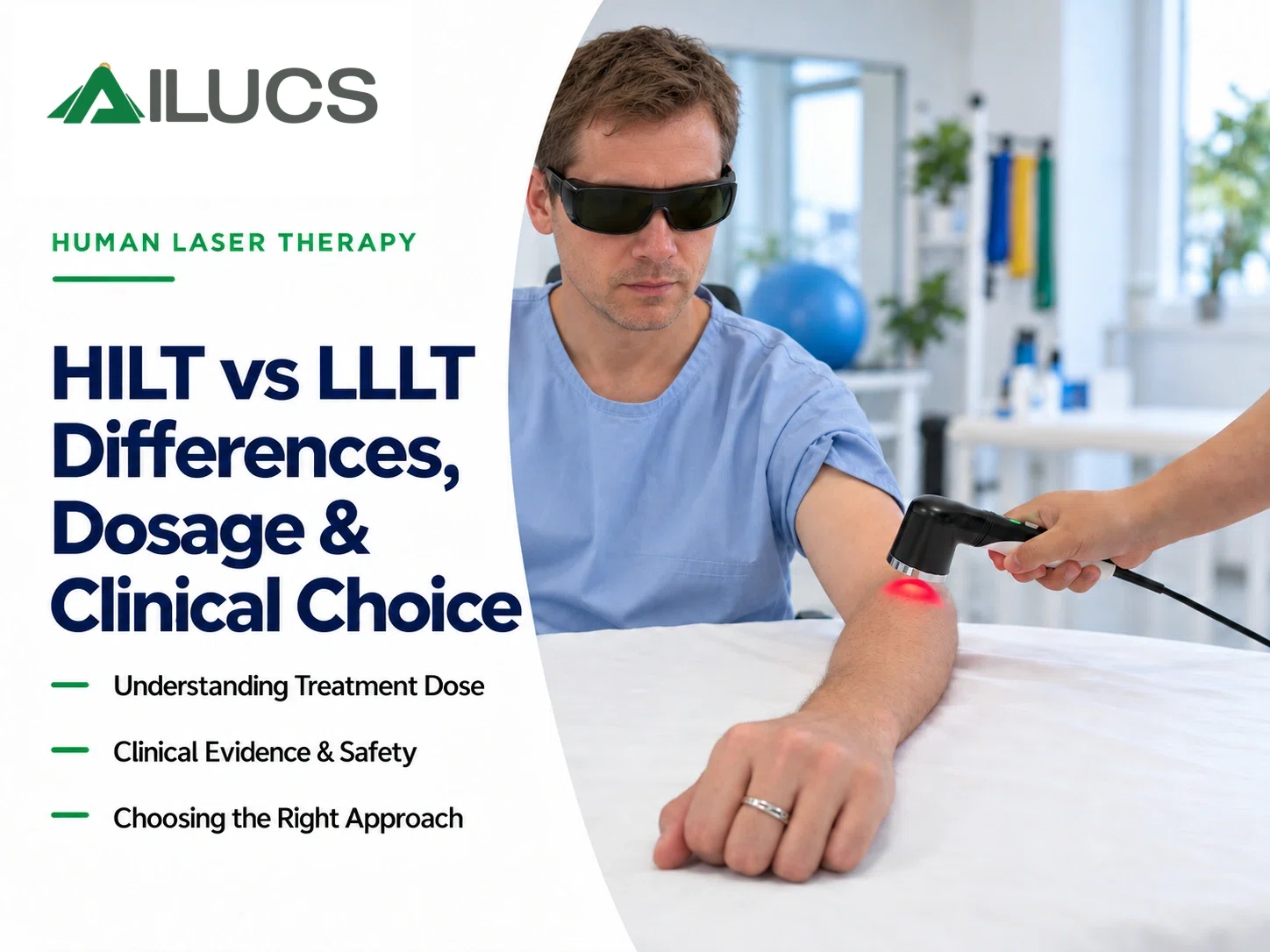
Choosing between high-intensity laser therapy (HILT) and low-level laser therapy (LLLT) involves more than comparing power ratings. A treatment needs to suit the diagnosis, the tissue being targeted, and the outcome the patient hopes to achieve.
Both approaches have been studied for musculoskeletal pain and rehabilitation. Neither should be assumed to work equally well across all conditions, and higher output does not automatically produce a better clinical result.
The useful questions are more specific: What evidence supports treatment for this condition? How was the laser applied? And does any improvement help the patient move, exercise, or manage daily activities more comfortably?
Key Takeaways
HILT and LLLT differ in energy-delivery capability, but power alone does not define the dose received by tissue.
A clinically meaningful comparison should include wavelength, average power, irradiance, radiant exposure, pulse settings, treatment area, time, and application technique.
Higher output can shorten the time needed to deliver a planned amount of energy, but it does not prove deeper effective treatment or better clinical outcomes.
The best-supported choice is the protocol that matches the diagnosis, evidence, treatment goal, patient response, and safety requirements.
What Do HILT and LLLT Mean?
Low-level laser therapy, often called cold laser therapy, uses light at settings intended to produce biological effects without substantial tissue heating. The word “cold” does not mean that the device cools the body.
LLLT is commonly discussed within photobiomodulation (PBM), a broader term describing biological responses to light. PBM can involve lasers or light-emitting diodes, so the terms are related but not interchangeable.
High-intensity laser therapy generally refers to therapeutic laser systems using higher output, often with pulsed or continuous near-infrared light. Depending on the settings and application technique, treatment may also produce noticeable warmth.
These labels describe broad treatment categories. They do not specify a complete protocol or guarantee a particular response. Wavelength, average power, beam area, exposure time, and pulse characteristics still need to be considered.
Laser safety class is a separate issue. Class 4 is a hazard classification, not a measure of clinical effectiveness. The FDA identifies Class 4 lasers as potential eye and skin hazards from direct or reflected exposure. A higher safety class should never be interpreted as a higher grade of treatment.
For a broader introduction to the modality, see What Is High-Intensity Laser Therapy (HILT)?.
HILT vs LLLT at a Glance
| Clinical consideration | LLLT / cold laser | HILT |
| General approach | Usually lower average output, with minimal intended heating | Higher output capability; heating depends on the protocol |
| Energy delivery | May require longer exposure to deliver a given amount of energy | Can deliver the same energy in less time at higher average power |
| Treatment sensation | Often little or no noticeable warmth | Warmth may occur; excessive heating requires attention |
| Application | Often uses defined treatment points or applicator arrays | Often uses scanning techniques, although protocols vary |
| Main selection issue | Whether the device and protocol match the evidence for the condition | Whether the protocol offers a useful clinical benefit with appropriate thermal control |
These are typical patterns, not universal specifications. Two devices carrying the same treatment label may deliver substantially different exposures.
Understanding Dose
A device’s maximum power rating is not the dose received by the patient. To understand treatment, clinicians need to know what the device actually delivers and how that light is distributed.
The most useful parameters are:
| Parameter | What it describes |
| Wavelength, in nanometers (nm) | The light used and its interaction with tissue |
| Average power, in watts (W) | Energy delivered per second, averaged over time |
| Energy, in joules (J) | The total energy delivered during an exposure |
| Irradiance, in W/cm² | Power distributed over the illuminated area |
| Radiant exposure, often called fluence, in J/cm² | Energy delivered per unit area |
| Pulse settings | How delivery changes over time |
| Application technique | Where and how the beam is applied |
A reproducible treatment record also needs the anatomical location, number of sessions, and interval between treatments. Recording only “10 minutes of laser” or a total joule value leaves essential information missing.
The Same Energy Can Be Delivered in Different Ways
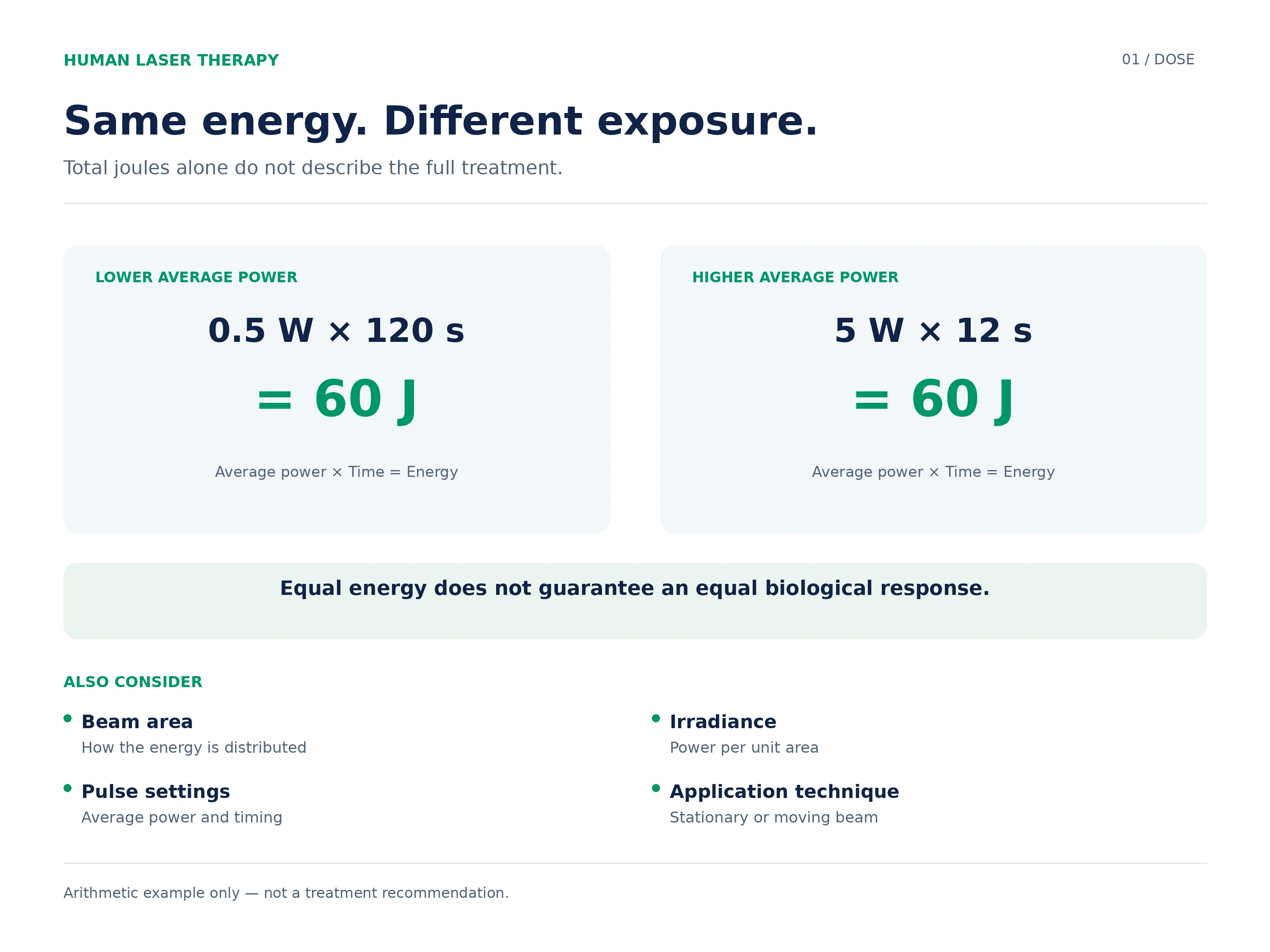
For a constant average output:
Energy (J) = Average power (W) × Time (seconds)
For example:
0.5 W for 120 seconds delivers 60 J.
5 W for 12 seconds also delivers 60 J.
This is an arithmetic example, not a treatment recommendation.
The energy totals are identical, but the exposures may differ in irradiance, tissue heating, and biological response. Beam size and technique matter too: holding a beam over one point is different from moving it across a larger region.
Likewise, peak power in a pulsed system is not the same as average power. A high peak value alone cannot tell a clinician how much energy reaches the treatment area over a session.
More Energy Does Not Reliably Produce More Benefit
PBM responses depend on the combination of treatment parameters. Increasing exposure may fail to improve the response and can increase unwanted heating.
There is therefore no single dose that can be applied confidently to every joint, tendon, or muscle. A published protocol is useful only when its wavelength, delivery method, treatment area, and patient population are sufficiently relevant to the clinical situation.
Does HILT Reach Deeper Tissue?
Higher output can increase the amount of light entering tissue, but it does not establish a fixed treatment depth.
Absorption and scattering reduce the light available as it travels through tissue. Wavelength, skin characteristics, the thickness of overlying tissue, and beam geometry all affect delivery. The energy measured at the skin is therefore different from the energy reaching a deeper target.
“Deeper penetration” also needs a clinical definition. Detecting some light at depth does not prove that enough reaches the target to produce a meaningful treatment effect.
For this reason, a power rating alone cannot establish that a laser will effectively treat a deep joint or a particular spinal structure. That claim needs support from relevant clinical evidence.
What Does the Clinical Evidence Show?
The evidence is best considered by diagnosis and outcome. A reduction in pain, an improvement in walking ability, and structural tissue repair are different findings.
Knee Osteoarthritis
A randomized trial published in 2024 compared HILT, LLLT, and a control group in 98 patients with knee osteoarthritis. The investigators reported better WOMAC scores in the HILT group at the one-month follow-up. WOMAC measures pain, stiffness, and physical function.
This supports a possible benefit for the studied protocol. It does not establish lasting superiority or demonstrate cartilage regeneration.
Other findings have been less clear. In a 2022 trial involving 50 participants, adding LLLT to strength training did not produce significant between-group differences in the primary pain outcomes compared with placebo laser plus strength training. Some secondary outcomes favored LLLT at later follow-up.
Guideline recommendations also need to be acknowledged. NICE’s guidance for osteoarthritis advises against offering laser therapy because it considers the evidence of benefit insufficient. It recommends tailored therapeutic exercise as part of core management. [5]
For clinicians and patients, this means laser therapy should not be presented as an established replacement for exercise or other recommended care.
For a diagnosis-specific review of the evidence, see Does Laser Therapy Work for Knee Osteoarthritis? Evidence & Relief.
Comparisons Across Musculoskeletal Conditions
A 2026 systematic review and network meta-analysis included 22 randomized trials comparing HILT and LLLT approaches for musculoskeletal disorders.
Some pain comparisons favored HILT. However, the differences were generally modest and often below thresholds considered clinically important. Evidence certainty was predominantly very low, and the findings did not establish clear, meaningful advantages for disability or range of motion.
The practical interpretation is cautious: certain HILT protocols may offer additional pain relief, but current evidence does not support choosing HILT for every patient simply because it delivers more power.
How Should Clinicians Choose?
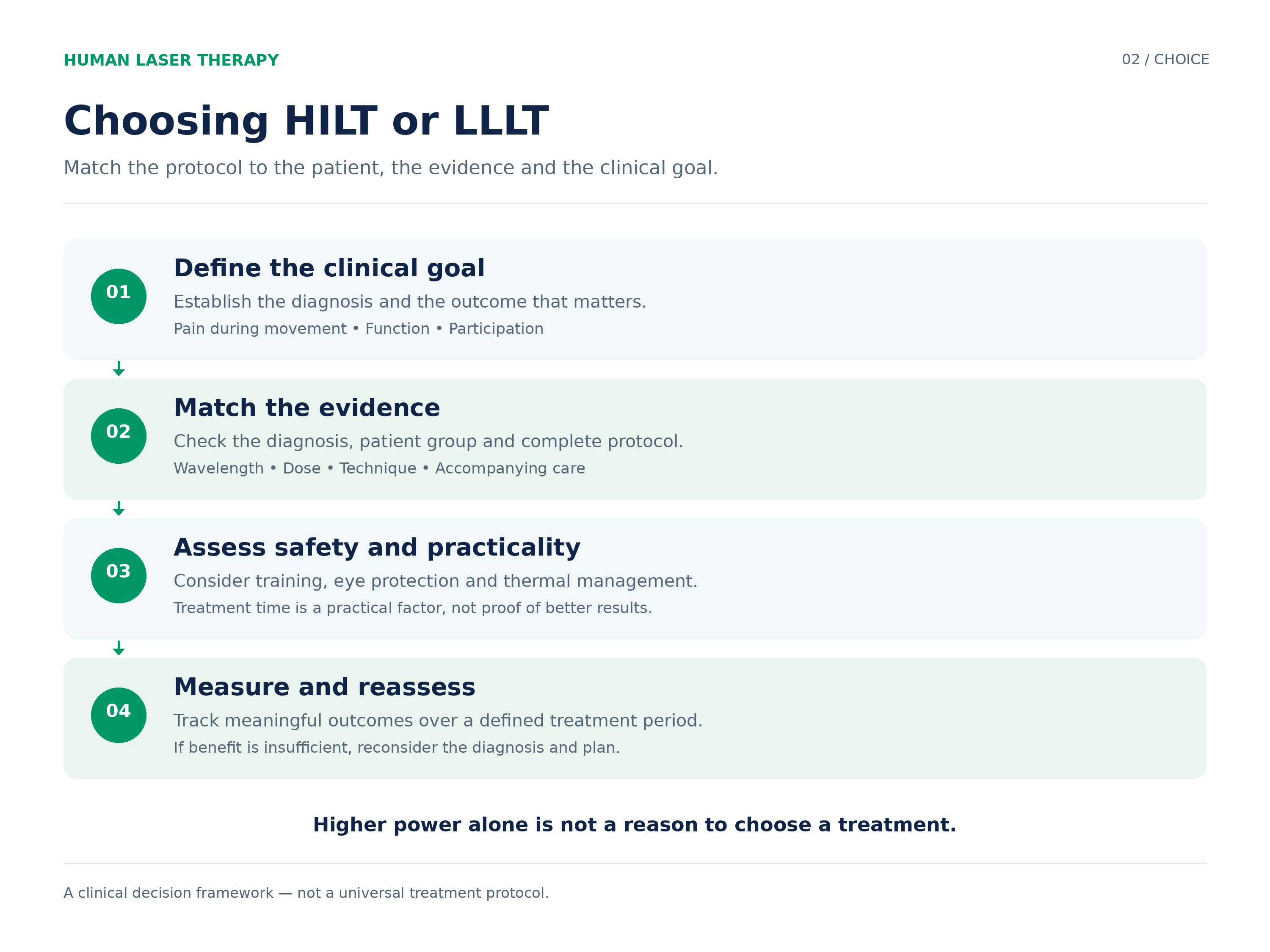
The following questions provide a practical way to evaluate either approach. They are a decision framework, rather than a universal treatment protocol.
1. Is There a Clear Diagnosis and Treatment Goal?
“Shoulder pain” or “back pain” is not enough to select a laser protocol.
The assessment should identify the likely source of symptoms and the intended outcome. For example, the goal might be less pain during a strengthening program, improved walking tolerance, or easier participation in daily activities.
A claim of tissue repair requires different evidence from a claim of short-term pain relief.
2. Does the Evidence Match the Proposed Treatment?
Look for studies involving a similar diagnosis and patient population. Then examine the actual treatment parameters and any accompanying exercise or other care.
A favorable result for one protocol should not be transferred automatically to another device, wavelength, or delivery technique. Similarly, a study of laser combined with exercise does not show that laser alone produces the same outcome.
3. What Practical Advantage Does the Proposed Approach Offer?
LLLT may be a reasonable option to evaluate when a relevant protocol is available and treatment time is acceptable.
HILT may offer a practical advantage when higher average output allows a planned exposure to be delivered efficiently. That advantage must be balanced against thermal management, operator training, and the evidence for the particular indication.
Convenience matters in clinical practice, but a shorter appointment is a workflow benefit. It is not proof of faster recovery.
4. How Will Benefit Be Measured?
Agree on a small number of meaningful outcomes before treatment starts. These might include pain during a specific movement, walking distance, exercise tolerance, or a validated disability score.
Reassess after a defined treatment period. If the patient has no worthwhile improvement, reconsider the diagnosis and treatment plan rather than automatically increasing power or adding sessions.
Safety Belongs in the Treatment Plan
Lower output does not remove the need for laser safety precautions. With higher-powered systems, control of direct and reflected exposure becomes especially important.
Eye protection must be suitable for the device’s wavelengths and required protection level. Treatment should follow the device’s instructions, with appropriate training and control of the treatment area. Class 4 equipment can pose skin, eye, and fire hazards. [7]
For HILT, monitoring the tissue response is also part of dose delivery. Beam area, movement, and exposure time influence local heating. Warmth should not be used as a target to pursue, and increasing heat should not be interpreted as evidence that treatment is working better.
Questions to Ask Before Starting Treatment
Patients do not need to interpret every technical setting, but they should be able to understand the reason for treatment.
Useful questions include:
What benefit is realistic for my condition?
What evidence supports this particular approach?
How will laser treatment fit with exercise or other care?
When will we review whether it is helping?
What would lead us to change or stop treatment?
What will the full course cost?
The Bottom Line
A sound treatment recommendation should connect the proposed laser protocol to a specific clinical goal. Whether the device is described as HILT or LLLT, the measure of success is a worthwhile improvement in the patient’s symptoms and function.
If you are comparing equipment specifications rather than treatment protocols, see How to Choose a Medical High Intensity Laser Machine for a separate purchasing-focused framework.
For an overview of the AILUCS platform, explore our Class IV laser therapy system.
Frequently Asked Questions
Is HILT better than LLLT?
Not universally. A 2026 systematic review found that some pain comparisons favored HILT, but the differences were generally modest and the certainty of evidence was predominantly very low. The appropriate choice still depends on the diagnosis, protocol, treatment goal, and safety considerations.
Is LLLT the same as cold laser therapy or photobiomodulation?
LLLT is commonly called cold laser therapy and is often discussed within photobiomodulation (PBM). PBM is a broader term and can include laser or LED sources, so the terms are related but not fully interchangeable.
Does higher laser power mean deeper treatment?
No fixed treatment depth can be inferred from power alone. Wavelength, beam geometry, tissue absorption and scattering, skin characteristics, and the thickness of overlying tissue all affect how much light is available at deeper structures.
Does higher power mean a better clinical result?
No. Higher power can deliver a planned amount of energy more quickly, but clinical effect depends on the complete exposure, the treatment technique, and the evidence for the specific condition and protocol.
Can HILT or LLLT replace exercise and rehabilitation?
They should not be presented as replacements for recommended active care. For knee osteoarthritis, NICE advises against laser therapy because it considers the evidence of benefit insufficient and recommends therapeutic exercise as part of core management.
Medical Disclaimer
This article is intended for general educational purposes and does not replace diagnosis, individualized treatment planning, or medical advice from a qualified healthcare professional. Treatment decisions should be based on appropriate clinical assessment, the evidence for the specific indication and protocol, and the device manufacturer’s instructions for use.
References
1. Jenkins PA, Carroll JD. How to report low-level laser therapy (LLLT)/photomedicine dose and beam parameters in clinical and laboratory studies. Photomedicine and Laser Surgery. 2011;29(12):785–787. PubMed
2. Ezzati K, et al. The effects of high-intensity laser therapy vs. low-level laser therapy on functional ability and quadriceps architecture in patients with knee osteoarthritis: a single-blinded randomized clinical trial. Journal of Lasers in Medical Sciences. 2024;15:e66. PubMed
3. Stausholm MB, et al. Short- and long-term effectiveness of low-level laser therapy combined with strength training in knee osteoarthritis: a randomized placebo-controlled trial. Journal of Clinical Medicine. 2022;11(12):3446. PubMed
4. de la Barra Ortiz HA, Parizotto NA, Liebano RE. Comparison of the effectiveness of high-intensity laser therapy versus low-level laser therapy in musculoskeletal disorders: a systematic review and network meta-analysis. Lasers in Medical Science. 2026;41:30. Full text
5. National Institute for Health and Care Excellence (NICE). Osteoarthritis in over 16s: diagnosis and management. NG226. Recommendations
6. Zein R, Selting W, Hamblin MR. Review of light parameters and photobiomodulation efficacy: dive into complexity. Journal of Biomedical Optics. 2018;23(12):120901. Full text
7. U.S. Food and Drug Administration. Laser Products and Instruments. FDA guidance
8. Tunér J, Jenkins PA. Parameter Reproducibility in Photobiomodulation. Photomedicine and Laser Surgery. 2016;34(3):91–92. PubMed