
Does Laser Therapy Work for Knee Osteoarthritis? Evidence & Relief
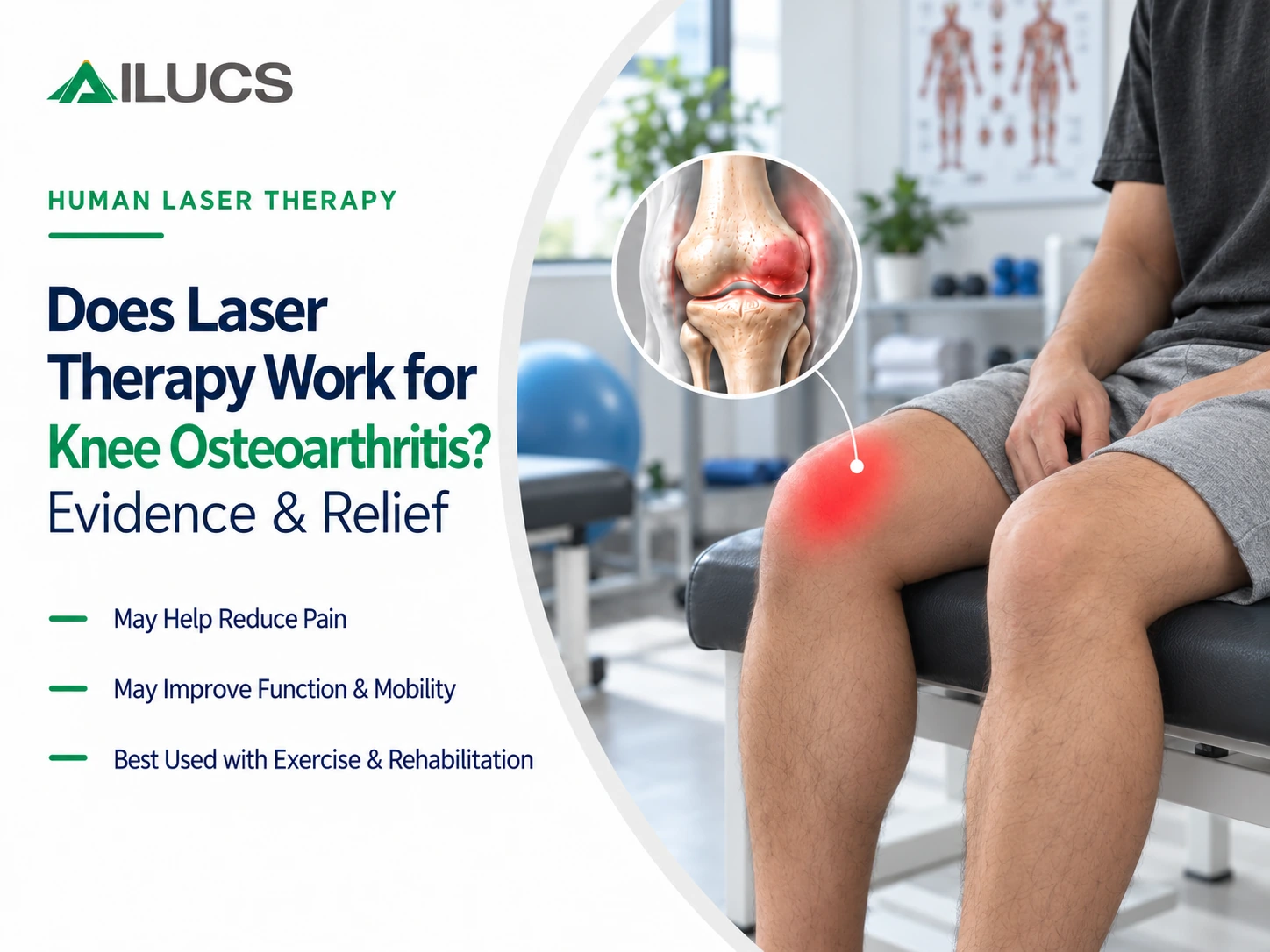
Knee osteoarthritis can make everyday activities surprisingly difficult. Walking downstairs, getting up from a chair, exercising, or even standing for long periods may trigger pain, stiffness, and a sense that the knee does not move as freely as it once did.
For many people, first-line care includes exercise, weight management when appropriate, pain medication, physical therapy, education, and other conservative treatments. When symptoms persist, some patients and clinicians also consider non-invasive options such as therapeutic laser treatment.
So, does laser therapy actually work for knee osteoarthritis?
The evidence is mixed. Clinical studies suggest that photobiomodulation and high-intensity laser therapy may reduce pain in some people with knee osteoarthritis, while effects on function are less consistent. Treatment protocols vary substantially between studies, and laser therapy should not be viewed as a cure or a replacement for active rehabilitation.
Understanding what the research actually shows can help patients and clinicians make more realistic treatment decisions.
What Is Knee Osteoarthritis?
Knee osteoarthritis, often abbreviated as knee OA, is a chronic joint condition involving more than simply “worn-out cartilage.”
Changes can occur throughout the joint, including the cartilage, subchondral bone (the bone beneath the cartilage), synovium (the tissue lining the joint), ligaments, muscles, and surrounding tissues. These changes may contribute to pain, stiffness, reduced mobility, swelling, and difficulty with daily activities.
Symptoms do not always match what appears on an X-ray. Some people with significant structural changes experience relatively little pain, while others with mild radiographic osteoarthritis have considerable symptoms.
For this reason, modern knee OA treatment generally focuses not only on joint structure, but also on pain control, movement, muscle strength, physical function, and quality of life.
Laser therapy is mainly being investigated within this symptom-management and rehabilitation framework.
Does Laser Therapy Work for Knee Osteoarthritis?
The most accurate answer is:
It may reduce pain for some patients, but the size and consistency of benefit remain uncertain. Laser therapy is best considered an adjunct to a broader knee osteoarthritis management plan rather than a stand-alone treatment.
A 2024 systematic review and meta-analysis published in Physical Therapy evaluated 10 placebo-controlled studies involving 542 participants with knee osteoarthritis. Photobiomodulation was associated with lower resting pain than placebo, and some disability-related outcomes improved. However, the authors rated the overall certainty of the evidence as very low because of differences between treatment protocols and limitations in the included trials.
Research specifically examining high-intensity laser therapy (HILT) has also reported favorable findings. A 2023 systematic review and meta-analysis found short-term pain reductions in several comparisons, including studies in which HILT was combined with exercise. The review also noted important limitations in the quality and size of the available studies.
More recent trials show why these findings should be interpreted cautiously.
A double-blind randomized controlled trial published in 2025 compared six sessions of HILT plus exercise with sham laser plus exercise in patients with mild-to-moderate knee osteoarthritis. A sham laser is a simulated treatment used for comparison without the intended therapeutic laser exposure. Pain and WOMAC scores improved within both groups, but there were no statistically significant between-group differences in pain, WOMAC outcomes, or the Timed Up and Go test. WOMAC is a questionnaire used to assess osteoarthritis-related pain, stiffness, and physical function. Under this specific protocol, adding HILT did not provide an additional benefit over the exercise program.
Another 2025 randomized trial compared low-level photobiomodulation with sham treatment and a no-treatment control. The study reported a significant reduction in pain in the photobiomodulation group compared with both control groups. WOMAC pain, stiffness, and functional limitation scores also improved from before to after treatment within the photobiomodulation group; these within-group changes should not be described as proof that every WOMAC outcome was superior between groups.
Taken together, the evidence suggests a possible role for laser therapy in symptom management, particularly pain, but the magnitude of benefit depends on the protocol and is not consistent across trials. A study in which both treatment groups improve cannot by itself determine how much of that improvement came from exercise, natural symptom fluctuation, placebo effects, or other factors.
What Do Clinical Guidelines Say?
Clinical guidelines do not completely agree on laser therapy for knee osteoarthritis.
The American Academy of Orthopaedic Surgeons (AAOS) states that FDA-approved laser treatment may be used to improve pain and function in patients with knee osteoarthritis, with a Limited strength of recommendation. This statement applies specifically to the evidence and devices considered by the guideline; it should not be interpreted as an endorsement of every laser system or wavelength configuration.
In contrast, the UK National Institute for Health and Care Excellence (NICE) states: "Do not offer" laser therapy for osteoarthritis because there is insufficient evidence of benefit.
The practical point is that major guidelines evaluate the evidence differently and do not make the same recommendation. Rather than assuming one position applies everywhere, clinicians should consider the guidance relevant to their country or practice setting together with the uncertainty in the evidence.
For patients, whether laser therapy is worth considering should be discussed with a qualified clinician in the context of local guidelines, treatment goals, cost, alternative options, and the role of exercise-based care.
How Might Laser Therapy Reduce Knee Pain?
Therapeutic laser treatment used for musculoskeletal rehabilitation is often described as photobiomodulation therapy, or PBM.
Instead of cutting or destroying tissue, therapeutic light is delivered at controlled wavelengths and doses to targeted tissues.
Laboratory and clinical research suggests that photobiomodulation may influence biological processes associated with pain and tissue response, including cellular energy metabolism, inflammatory signaling, local circulation, oxidative stress, and pain-related pathways.
At therapeutic doses, light interacts with biological tissue and may influence cellular signaling. In rehabilitation, the clinical aim is usually symptom management: reducing pain or irritation enough to support comfortable movement and participation in an active treatment plan.
Laser therapy may influence symptoms and local biological responses, but there is currently no strong clinical evidence that routine laser treatment can reliably rebuild damaged cartilage or permanently reverse the underlying osteoarthritic process.
Low-Level Laser Therapy vs High-Intensity Laser Therapy
One reason laser studies produce different results is that “laser therapy” is not a single standardized treatment.
Devices may vary substantially in wavelength, power, energy density (energy delivered per unit area), pulse structure, treatment time, treatment area, and application technique.
Low-Level Laser Therapy and Photobiomodulation
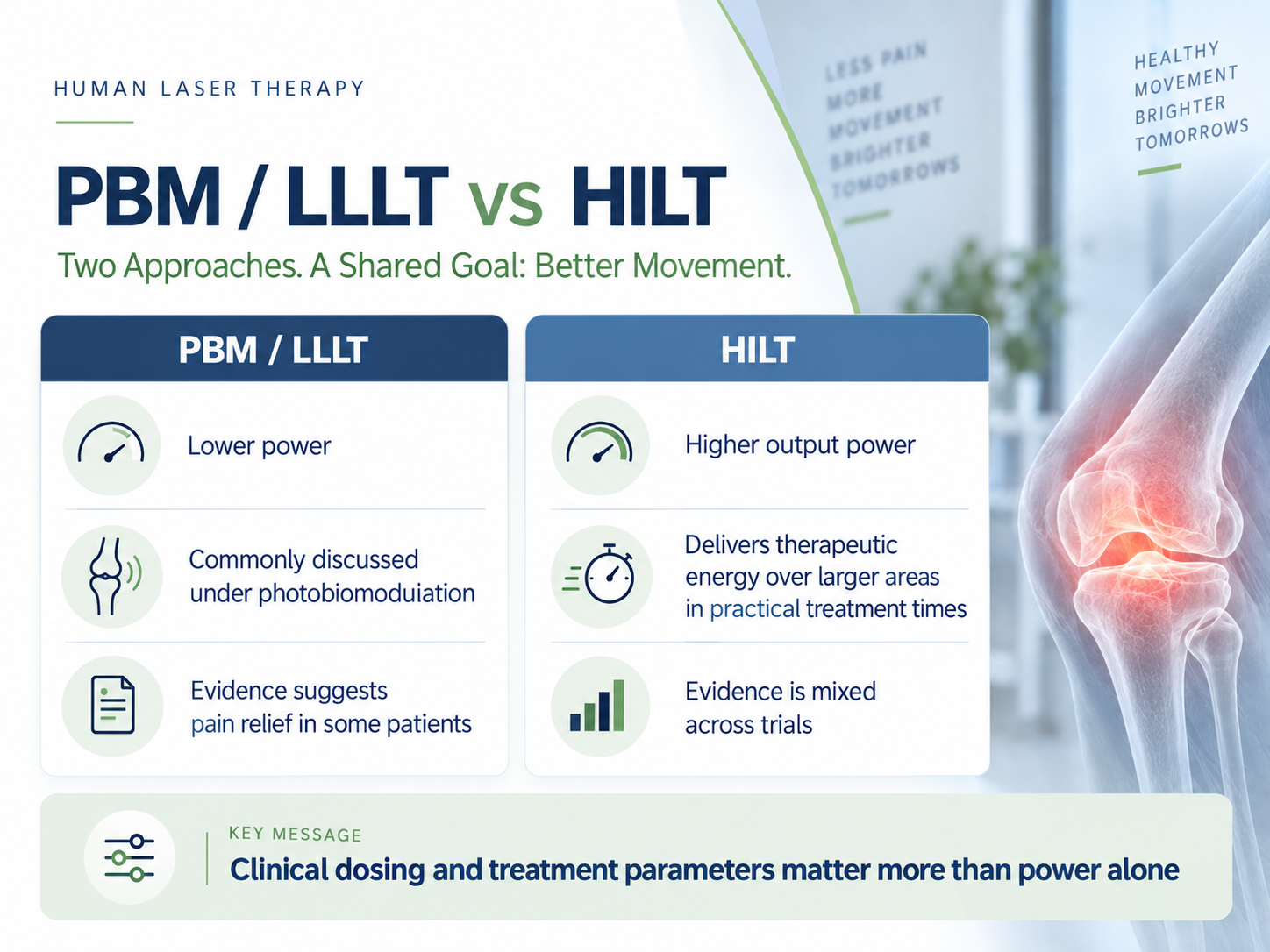
Low-level laser therapy, sometimes called LLLT, typically delivers lower optical power and has been widely studied under the broader term photobiomodulation.
A 2024 network meta-analysis involving 13 studies and 673 participants found that low-level light therapy was superior to sham treatment for pain relief overall, but it did not show a clear improvement in function or stiffness. The certainty of evidence was low for the overall pain finding.
In that analysis, 904–905 nm ranked highly for pain reduction, but a ranking analysis does not prove that this wavelength is clinically superior to all alternatives. The authors described the evidence for 904–905 nm as low certainty and called for higher-quality research.
High-Intensity Laser Therapy
High-intensity laser therapy uses higher output power, which can allow a prescribed amount of energy to be delivered over a larger treatment area or within a shorter session. Higher power alone does not guarantee deeper effective treatment, better tissue response, or better clinical outcomes.
HILT has been studied for several musculoskeletal conditions, including knee osteoarthritis.
Earlier meta-analyses have reported improvements in knee OA pain with HILT, including when it was combined with exercise, while a more recent sham-controlled trial found no additional benefit from HILT under the protocol tested.
A more powerful laser is therefore not automatically a more effective treatment.
Dose selection, treatment technique, target tissue, and integration with rehabilitation matter at least as much as maximum device power.
A well-designed treatment should consider the condition being treated, target tissue, patient characteristics, wavelength, total energy, treatment technique, and rehabilitation goals.
In clinical practice, system design can affect how easily clinicians adjust treatment parameters for different anatomical targets and treatment areas. That flexibility may be useful for protocol delivery, but it is not evidence of clinical efficacy by itself.
For example, the AILUCS LYRA medical laser system can be configured for human rehabilitation applications with 650, 808, 905, and 1064 nm wavelengths. This multi-wavelength capability is intended to provide protocol flexibility for different treatment targets. It should not be interpreted as proof that this specific wavelength combination has been clinically validated as superior for knee osteoarthritis; outcomes still depend on patient selection, dosing, technique, and the broader rehabilitation plan.
Why Treatment Parameters Matter
One of the biggest challenges in interpreting laser therapy research is the wide variation between treatment protocols.
Two studies may both describe their intervention as “laser therapy” while using very different:
wavelengths
output powers
pulse frequencies
energy densities
treatment areas
session durations
treatment schedules
This makes direct comparison difficult.
For knee osteoarthritis, clinicians may treat more than a single isolated point. Depending on the protocol and the patient's presentation, treatment areas may include the medial or lateral joint line and selected periarticular soft tissues associated with pain or movement limitation.
A clinically practical HILT system therefore needs more than high peak power. It also needs sufficient parameter control to deliver a defined protocol consistently.
Adjustable settings and protocol-based workflows can help clinicians reproduce treatment plans across sessions, but presets should support rather than replace clinical judgment.
Treatment parameters may still need to be adjusted according to factors such as symptoms, tissue depth, skin characteristics, treatment response, and the overall rehabilitation plan.
Why Exercise Still Matters
Laser therapy should not replace movement-based rehabilitation.
Exercise remains a core component of knee osteoarthritis management.
Strengthening the quadriceps and surrounding muscles can improve joint control and physical function. Aerobic activity can support cardiovascular health, weight management, and overall mobility, while range-of-motion and functional exercises can help patients stay active in daily life.
Laser therapy may be considered as an adjunct when symptoms make exercise difficult, but current evidence does not establish that patients with exercise-limiting pain are a uniquely responsive subgroup.
A practical treatment goal may be:
reduce symptoms → improve movement tolerance → support participation in exercise.
This is a rehabilitation goal rather than a proven long-term causal chain. Laser therapy should not be presented as a passive treatment that can solve osteoarthritis on its own.
Who Might Consider Laser Therapy?
Laser therapy may be discussed with adults who have symptomatic knee osteoarthritis and continue to experience pain or stiffness despite appropriate conservative management.
It may appeal to patients seeking a non-invasive adjunct, but the decision should account for local clinical guidelines, the uncertain size of benefit, cost, other treatment options, and the patient's rehabilitation goals.
However, treatment should still begin with an appropriate clinical assessment.
Knee pain is not always caused by osteoarthritis. Meniscal injuries, ligament disorders, inflammatory arthritis, referred pain, fractures, infection, or other conditions may produce similar symptoms.
Persistent swelling, severe night pain, joint locking, sudden inability to bear weight, fever, significant trauma, or rapidly worsening symptoms warrant medical evaluation rather than simply starting laser treatment.
How Many Laser Treatments Are Usually Needed?
There is currently no universally accepted laser protocol for knee osteoarthritis.
Clinical trials have used different treatment schedules, sometimes ranging from several sessions over a few weeks to longer rehabilitation programs involving repeated treatment.
The 2025 HILT randomized trial, for example, used six sessions over three weeks, while other photobiomodulation studies have used different frequencies, wavelengths, doses, and treatment schedules.
This variability is one reason it is difficult to tell patients that a specific number of sessions will work for everyone.
Response should be monitored over time using meaningful outcomes such as:
pain during activity
walking tolerance
stair climbing
range of motion
sleep disruption
WOMAC scores
ability to perform rehabilitation exercises
If a patient shows no meaningful improvement after an appropriate treatment period, clinicians should reassess the diagnosis, treatment parameters, and overall rehabilitation strategy rather than simply continuing the same protocol indefinitely.
Is Laser Therapy Safe?
When properly performed, therapeutic photobiomodulation is generally described as non-invasive, but safety still depends on the device, dose, treatment site, and operator technique.
However, medical lasers must still be treated as medical devices rather than ordinary light sources.
Eye protection is particularly important because direct or reflected laser radiation can damage ocular tissue. Appropriate wavelength-specific protective eyewear should be used by the patient, clinician, and anyone else within the treatment environment.
Higher-powered Class IV laser systems also require appropriate operator training, controlled treatment technique, and correct dosing to reduce the risk of excessive tissue heating or skin injury.
Patients taking photosensitizing medications or those with conditions that may alter their response to light should discuss these factors with their healthcare provider before treatment.
The treatment area should also be assessed carefully before each session, particularly when sensation is impaired or when the patient cannot reliably report excessive warmth or discomfort.
What Laser Therapy Cannot Do
Realistic expectations are essential.
Laser therapy should not be presented as a treatment that “regrows the knee,” permanently reverses arthritis, or guarantees avoidance of joint replacement.
Current evidence is more supportive of a possible role in symptom management than of any disease-modifying effect.
For some patients, symptom relief may still be clinically meaningful.
If treatment helps a patient walk more comfortably, climb stairs with less difficulty, or participate more consistently in strengthening exercises, that improvement can matter even though the structural osteoarthritis remains.
The Bottom Line
So, does laser therapy work for knee osteoarthritis?
Some studies suggest that laser therapy may reduce knee osteoarthritis pain, but the evidence is mixed and results are not consistent across trials. Evidence for functional improvement is less certain.
Photobiomodulation and high-intensity laser therapy have both produced positive findings in published studies, but differences in wavelength, dose, power, treatment schedule, patient selection, co-interventions, and study quality make it difficult to define one universally effective protocol.
Laser therapy is therefore best viewed, when used, as one possible component of a multimodal management plan rather than as a stand-alone cure.
Exercise, physical activity, weight management when appropriate, patient education, medications when indicated, and other evidence-based treatments remain central to knee OA care.
Patients interested in laser therapy should discuss the expected benefits, uncertainties, costs, alternatives, and rehabilitation plan with a qualified healthcare professional.
Frequently Asked Questions
Can laser therapy cure knee osteoarthritis?
No. Current evidence does not show that therapeutic laser treatment can reliably reverse established osteoarthritis or restore severely damaged cartilage. Its possible clinical role is symptom management rather than structural cure.
Can laser therapy help knee pain?
Several randomized trials and meta-analyses have reported reductions in knee OA pain following photobiomodulation or high-intensity laser therapy, but not all trials have shown superiority over sham treatment or exercise-based care. Individual responses can vary. [1–4]
Is high-intensity laser therapy better than low-level laser therapy?
There is not enough high-quality evidence to say that one is universally superior. HILT can deliver a prescribed amount of energy over larger areas or within shorter treatment times, while low-level photobiomodulation also has evidence for pain reduction. Higher device power should not be treated as a proxy for better clinical outcomes.
Should laser therapy replace physical therapy or exercise?
Generally, no. Exercise and rehabilitation remain fundamental components of knee osteoarthritis management. Laser therapy, when used, is better considered an adjunct rather than a replacement for active care.
Is laser therapy painful?
Therapeutic laser treatment is generally non-invasive. Depending on the system and treatment technique, patients may feel little or no sensation or mild warmth during treatment. Excessive heat or discomfort should be reported immediately to the clinician.
References
1. Oliveira S, Andrade R, Valente C, et al. Effectiveness of Photobiomodulation in Reducing Pain and Disability in Patients With Knee Osteoarthritis: A Systematic Review With Meta-Analysis. Physical Therapy. 2024;104(8):pzae073. doi:10.1093/ptj/pzae073. https://doi.org/10.1093/ptj/pzae073
2. Cai P, Wei X, Wang W, Cai C, Li H. High-intensity laser therapy on pain relief in symptomatic knee osteoarthritis: A systematic review and meta-analysis. Journal of Back and Musculoskeletal Rehabilitation. 2023;36(5):1011–1021. doi:10.3233/BMR-220228. https://doi.org/10.3233/BMR-220228
3. Laotammateep C, Champaiboon J, Surarangsit T, Likhitphithak W, Boonhong J. Efficacy of high intensity laser therapy versus sham laser in symptomatic knee osteoarthritis: a double-blind randomized controlled trial. Lasers in Medical Science. 2025;40(1):87. doi:10.1007/s10103-025-04352-8. https://doi.org/10.1007/s10103-025-04352-8
4. Maciel TDS, Chamy NCL, Maciel MDS, Marques AP. Effect Of Photobiomodulation (Low-Level Laser Therapy) In Patients With Knee Osteoarthritis: A Randomized Controlled Trial. Lasers in Medical Science. 2025;40(1):293. doi:10.1007/s10103-025-04542-4. https://doi.org/10.1007/s10103-025-04542-4
5. American Academy of Orthopaedic Surgeons. Management of Osteoarthritis of the Knee (Non-Arthroplasty), 3rd Edition. 2021. Laser Treatment recommendation. https://www.aaos.org/OAK3CPG
6. National Institute for Health and Care Excellence. Osteoarthritis in over 16s: diagnosis and management (NG226). 2022. Recommendation 1.3.9, Electrotherapy. https://www.nice.org.uk/guidance/ng226/chapter/Recommendations
7. Fan T, Li Y, Wong AYL, et al. A systematic review and network meta-analysis on the optimal wavelength of low-level light therapy (LLLT) in treating knee osteoarthritis symptoms. Aging Clinical and Experimental Research. 2024;36(1):203. doi:10.1007/s40520-024-02853-0. https://doi.org/10.1007/s40520-024-02853-0
Medical Disclaimer
This article is intended for general educational purposes and does not replace diagnosis or individualized medical advice from a qualified healthcare professional.