
Laser Therapy for Cats with Osteoarthritis: A Gentle Approach to Supporting Feline Joint Health
Cats are experts at hiding discomfort.
Unlike dogs, which may show obvious signs such as limping, reluctance to walk, or visible pain behaviors, cats often demonstrate much more subtle changes when experiencing chronic joint problems. A senior cat may gradually stop jumping onto familiar furniture, become less active, sleep more frequently, or avoid certain movements without showing obvious signs of pain.
These behavioral changes are sometimes mistaken as normal aging. However, they may indicate underlying joint discomfort.
Feline osteoarthritis treatment has become an increasingly important topic in modern veterinary medicine because osteoarthritis is one of the most common chronic conditions affecting middle-aged and senior cats. The disease is often difficult to identify in its early stages because cats naturally conceal pain. Common signs may include reduced jumping ability, slower movement, stiffness after rest, decreased interaction, and difficulty using litter boxes.
Although osteoarthritis cannot currently be completely reversed, appropriate long-term management can help maintain comfort, mobility, and quality of life. A multimodal approach may include weight management, nutritional support, activity modification, medication when appropriate, and rehabilitation strategies.
Among these approaches, laser therapy for cats with osteoarthritis has gained attention as a non-invasive supportive therapy. Also known as photobiomodulation (PBM), therapeutic laser uses specific wavelengths of red and near-infrared light to influence biological responses at the cellular level. Research suggests that PBM may influence cellular metabolism, inflammatory responses, and tissue recovery processes, although clinical outcomes depend on treatment parameters and individual patient factors.
Understanding Feline Osteoarthritis: Why Joint Pain Develops
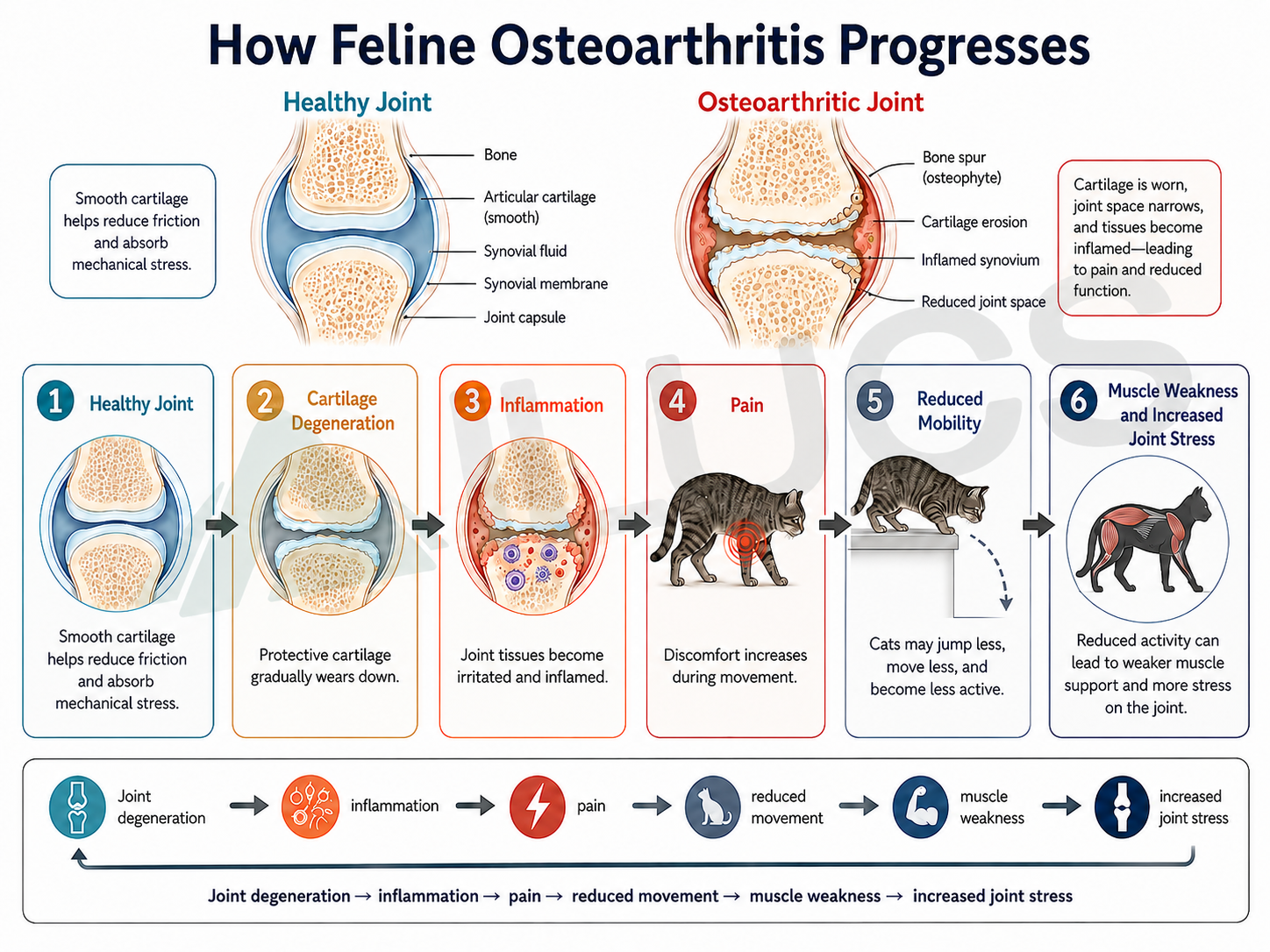
A healthy joint contains smooth cartilage that helps reduce friction and absorb mechanical stress during movement.
With osteoarthritis, this protective cartilage gradually becomes damaged. The joint environment changes, leading to a combination of inflammation, discomfort, and reduced function.
The progression of feline osteoarthritis can involve:
| Stage of Joint Changes | Impact on Cats |
| Cartilage degeneration | Reduced cushioning between joint surfaces |
| Inflammatory response | Increased sensitivity and discomfort around the joint |
| Pain during movement | Cats may avoid jumping or physical activity |
| Reduced activity | Muscle weakness and further joint stress may develop |
This creates a cycle:
Joint degeneration → inflammation → pain → reduced movement → muscle weakness → increased joint stress
Therefore, the goal of osteoarthritis management is not simply reducing discomfort temporarily. It is to support a better functional balance by addressing pain, inflammation, mobility, and daily activity.
A central principle of feline osteoarthritis care is that the condition requires ongoing management rather than a one-time intervention.
Can Laser Therapy Help Cats With Osteoarthritis?
Laser therapy for cats with osteoarthritis is generally considered a supportive modality within a broader treatment plan rather than a replacement for medical management. This species-specific discussion complements the broader role of Class IV laser therapy for animal osteoarthritis.
The purpose of therapeutic laser is not to reverse existing cartilage degeneration. Instead, it may help create a more favorable biological environment by supporting processes associated with pain management, inflammation regulation, and tissue function.
For cats, this approach is particularly valuable because many feline patients:
Are sensitive to invasive procedures
May not tolerate frequent handling
Can develop challenges with long-term medication management
Often hide pain until mobility is significantly affected
Veterinary Laser Therapy provides a non-invasive option that can usually be performed while the cat remains conscious, reducing additional stress associated with treatment.
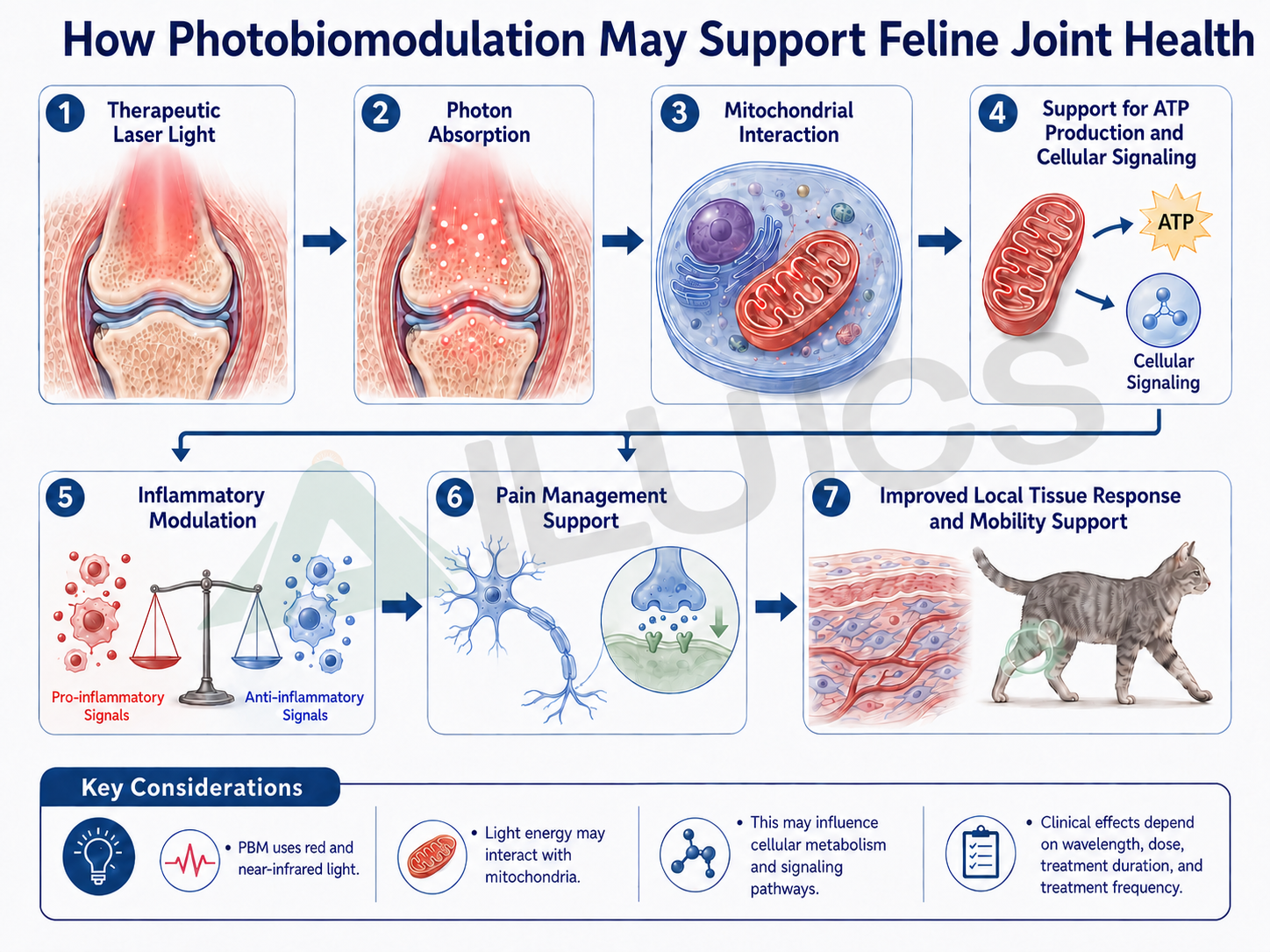
The potential benefits of PBM are related to how light energy interacts with cells. Photons may be absorbed by mitochondrial components, influencing cellular energy production and signaling pathways involved in tissue responses. Clinical reviews suggest that laser therapy may support pain relief and inflammatory modulation in veterinary applications, while also emphasizing that appropriate dosage and treatment protocols remain important.
Current evidence in cats. Direct clinical evidence for photobiomodulation in feline osteoarthritis remains limited. A 2025 review found no feline osteoarthritis-specific PBM studies in its literature search, and much of the available veterinary evidence comes from dogs or other species. Laser therapy should therefore be considered an individualized supportive modality, with outcomes evaluated through veterinary reassessment and owner-observed changes in mobility, activity, and daily behavior.
How Photobiomodulation Works in Feline Joint Support
When therapeutic laser energy reaches targeted tissues, photons may interact with cellular structures, particularly mitochondria.
Mitochondria are responsible for producing ATP, the primary energy source required for normal cellular activity. By influencing mitochondrial activity, PBM may support cellular metabolism and biological responses involved in tissue maintenance.
The potential mechanisms include:
Supporting mitochondrial activity and ATP production
Influencing inflammatory signaling pathways
Supporting local circulation
Modulating pain-related responses
Creating a more favorable environment for tissue recovery
For example, instead of simply stating that “laser reduces pain,” a more accurate explanation is:
Laser therapy may help support pain management by influencing cellular metabolism, improving local tissue responses, and modulating inflammatory pathways associated with discomfort.
However, clinical effects depend on multiple variables, including wavelength, energy density, treatment duration, and frequency. Current veterinary reviews highlight that differences in these parameters contribute to variations in clinical outcomes.
Potential Benefits of Laser Therapy for Cats With Osteoarthritis
The following table summarizes how PBM may support feline osteoarthritis management:
| Potential Effect of Photobiomodulation (PBM) | How It May Support Feline Osteoarthritis Management |
| Inflammatory modulation | Laser energy may influence cellular signaling pathways related to inflammatory responses, helping support a more balanced tissue environment. |
| Pain management | PBM may help regulate pain-related pathways and improve local tissue conditions, allowing cats to move more comfortably. |
| Cellular metabolism support | Light energy may interact with mitochondrial components, supporting ATP production and normal cellular function. |
| Mobility support | Reduced discomfort may encourage cats to participate in normal activities and maintain muscle condition. |
| Rehabilitation support | Laser therapy can be integrated with weight management, controlled activity, environmental adaptation, and other veterinary care strategies. |
Supporting Pain Management and Mobility
Pain is one of the most important factors affecting feline quality of life.
Cats experiencing joint discomfort often do not cry or show obvious signs. Instead, owners may notice:
Less frequent jumping
Reduced play behavior
Changes in sleeping locations
Increased irritability
Difficulty with normal daily activities
Laser therapy may support pain management through several possible mechanisms, including modulation of pain signaling and improvement of local tissue conditions.
When discomfort decreases, cats may become more willing to move. This is important because appropriate movement helps maintain muscle strength and joint function.
The relationship between pain and activity creates an important rehabilitation cycle:
Better comfort → Increased movement → Improved muscle support → Better joint function
This is why pain management is not only about making cats feel better temporarily. It is also about helping them return to normal behaviors.
Why Laser Therapy Is Suitable for Many Senior Cats
Cats have unique characteristics that influence treatment decisions.
Compared with some other approaches, laser therapy offers several practical advantages:
| Feature | Importance for Feline Patients |
| Non-invasive application | Reduces stress associated with treatment |
| No surgical procedure required | Suitable for many senior or sensitive cats |
| Can be combined with other therapies | Supports a multimodal management approach |
| Adjustable treatment parameters | Allows adaptation based on patient condition |
For older cats or patients that may not tolerate invasive procedures, laser therapy may provide an additional supportive option within veterinary rehabilitation.
However, treatment should always be performed by trained professionals using appropriate protocols.
Most cats can undergo laser therapy without sedation. However, patient tolerance may vary, and non-invasive treatment should not be interpreted as completely risk-free or stress-free. Coat characteristics, treatment dose, tissue depth, patient movement, and tissue temperature should be considered. Behavioral signs of discomfort should be monitored throughout and after treatment, and wavelength-appropriate eye protection should be used. For a broader overview, see veterinary laser therapy safety and contraindications.
Clinical Considerations When Applying Veterinary Laser Therapy
The effectiveness of veterinary laser therapy depends on correct application.
Important considerations include:
Wavelength Selection
Different wavelengths interact with tissues differently. Joint conditions may involve deeper structures, including joint capsules, surrounding muscles, and connective tissues.
Therefore, selecting appropriate wavelengths according to treatment goals and tissue characteristics is important.
Dose and Energy Delivery
Therapeutic response depends on:
Power output
Energy density
Treatment area
Higher power does not automatically mean better results. The biological response depends on delivering appropriate energy for the specific clinical situation. Treatment planning should consider power, wavelength, and dose together rather than treating any one specification as a guarantee of outcome.
Treatment Frequency
Treatment schedules should be adjusted according to:
Disease severity
Patient response
Rehabilitation goals
Rather than focusing only on the number of sessions, veterinarians should evaluate functional improvements, including mobility, activity level, and owner observations.
Why Multi-Wavelength Class IV Laser Technology Matters
Multi-wavelength Class IV laser technology provides veterinarians with greater flexibility when developing photobiomodulation protocols. Because tissues absorb and respond to light energy differently, wavelength selection should be considered together with target tissue depth, treatment location, clinical objectives, and patient-specific factors.
A multi-wavelength platform allows veterinarians to consider:
Tissue depth
Treatment location
Clinical objective
Patient condition
TheAILUCS LYRA Veterinary Laser System incorporates five therapeutic wavelengths.
650 nm
810 nm
915 nm
980 nm
1064 nm
This multi-wavelength design allows veterinary professionals to select appropriate wavelengths based on specific clinical applications, treatment goals, and patient needs.
This flexibility supports a more individualized approach to veterinary rehabilitation, where treatment parameters are determined through clinical reasoning rather than applying a standardized protocol for every patient.
The availability of multiple wavelengths does not by itself guarantee better clinical outcomes. The complete treatment protocol, including dose, treatment area, emission mode, patient tolerance, and clinical reassessment, remains important.
Integrating Laser Therapy Into a Complete Feline Osteoarthritis Management Plan
Osteoarthritis management works best when multiple strategies are combined.
A comprehensive plan may include:
Veterinary Diagnosis and Pain Management
Osteoarthritis management should begin with an appropriate veterinary assessment and ongoing evaluation of pain, mobility, and daily function. Veterinarian-prescribed medication and other pain-management strategies may be included when clinically appropriate and should be selected according to the individual cat's health status and treatment response.
Weight Management
Reducing excessive body weight can decrease mechanical stress on affected joints.
Nutrition Support
Appropriate nutritional strategies may provide additional joint support.
Environmental Modification
Simple changes can improve daily comfort:
Lower-access litter boxes
Easier access to food and water
Comfortable resting areas
Ramps or steps
Controlled Activity
Appropriate movement helps maintain muscle strength and mobility.
Veterinary Rehabilitation
Rehabilitation focuses on improving function, not only reducing symptoms.
Within this framework, laser therapy for cats with osteoarthritis can serve as a supportive tool that helps cats participate more comfortably in their overall care and management plan.
Why AILUCS Supports Veterinary Professionals
AILUCS focuses on veterinary rehabilitation and therapeutic equipment solutions, providing veterinary professionals with laser therapy technology designed for clinical applications.
The goal is to support veterinarians in developing structured, measurable rehabilitation programs through appropriate equipment selection, treatment planning, and clinical application.
By combining technology with veterinary expertise, laser therapy can become part of a more comprehensive approach to feline mobility and quality of life management.
Frequently Asked Questions
Can laser therapy cure feline osteoarthritis?
No. Osteoarthritis is a chronic degenerative condition and cannot currently be completely cured.
Laser therapy may support pain management, inflammation regulation, and mobility as part of a comprehensive care plan.
Is laser therapy safe for senior cats?
When appropriate parameters are selected and treatment is performed correctly, laser therapy is generally considered a non-invasive option for many senior cats.
Can laser therapy replace medication?
No. Laser therapy should be considered a complementary approach. Medication decisions should always be made by a veterinarian based on the individual patient.
How often should cats receive laser therapy?
Treatment frequency depends on the cat’s condition, treatment goals, and clinical response. Veterinary professionals should adjust protocols based on patient evaluation.
Conclusion
Feline osteoarthritis is a long-term condition that requires careful management.
Because cats often hide discomfort, recognizing subtle behavioral changes and providing appropriate support are essential.
Laser therapy for cats with osteoarthritis may help support pain management, inflammatory modulation, mobility, and rehabilitation when integrated into a comprehensive veterinary care plan. However, direct clinical evidence in feline osteoarthritis remains limited, and treatment decisions should be guided by veterinary assessment, appropriate parameters, and individual patient response.
The goal is not only to manage joint disease, but also to help cats maintain the activities that make their daily lives meaningful: moving comfortably, interacting with their environment, and enjoying a better quality of life.
References
1. Lefort-Holguin M, Delsart A, Frezier M, et al. Osteoarthritis in cats: what we know, and mostly, what we don't know...yet. J Feline Med Surg. 2025;27(7):1098612X251347999.
2. Barale L, Adami C. Undesired effects of low-level photobiomodulation analgesic therapy in three cats with osteoarthritis. Vet Rec Case Rep. 2025;13:e1034.
3. Taylor SS, Gruen ME, KuKanich K, et al. 2024 ISFM and AAFP consensus guidelines on the long-term use of NSAIDs in cats. J Feline Med Surg. 2024;26(4):1098612X241241951.
4. Lascelles BDX, Henry JB III, Brown J, et al. Cross-sectional study of the prevalence of radiographic degenerative joint disease in domesticated cats. Vet Surg. 2010;39(5):535-544.
5. Bennett D, Zainal Ariffin SMB, Johnston P. Osteoarthritis in the cat: 1. How common is it and how easy to recognise? J Feline Med Surg. 2012;14(1):65-75.
6. Looney AL, Huntingford JL, Blaeser LL, Mann S. A randomized blind placebo-controlled trial investigating the effects of photobiomodulation therapy on canine elbow osteoarthritis. Can Vet J. 2018;59(9):959-966.