
Laser Therapy for Plantar Fasciitis: Evidence, Pain Relief, and Rehabilitation
Plantar fasciitis often causes pain with the first steps in the morning and after prolonged standing or walking. Treatment aims to reduce that pain while restoring the patient’s capacity for everyday activity and exercise.
Laser therapy for plantar fasciitis has been studied as an adjunct to conservative care. Some trials report pain relief, but findings vary with the treatment protocol and comparator. The evidence is stronger for short-term pain reduction with low-level laser therapy than for consistent functional improvement or the superiority of high-intensity treatment.
In practice, laser may help selected patients manage symptoms alongside stretching, strengthening, and adjustments to daily activity. It should support these measures rather than replace them.
Why Plantar Fasciitis Can Be Difficult to Manage
The plantar fascia supports the longitudinal arch and contributes to the foot’s function during weight-bearing. Repeated mechanical stress can contribute to pain around its attachment to the heel.
Although plantar fasciitis remains the familiar clinical term, plantar fasciopathy more accurately describes many persistent cases. Chronic presentations often involve degenerative tissue changes rather than a purely inflammatory process. This distinction matters because reducing inflammation alone does not address every contributor to ongoing heel pain. [1]
Patients often cannot avoid the standing, walking, or exercise that aggravates their symptoms. Pain relief alone may therefore be insufficient unless treatment also addresses daily loading and the patient’s ability to tolerate it.
Recovery should be judged by improvements in walking, standing, and other meaningful activities, as well as changes in pain.
Understanding Plantar Fasciitis and Heel Pain
A typical presentation includes pain beneath the medial heel, especially during the first steps after waking or resting. Symptoms may ease with initial movement and return with continued weight-bearing. Local tenderness near the plantar fascia’s calcaneal attachment is another common finding. [1, 2]
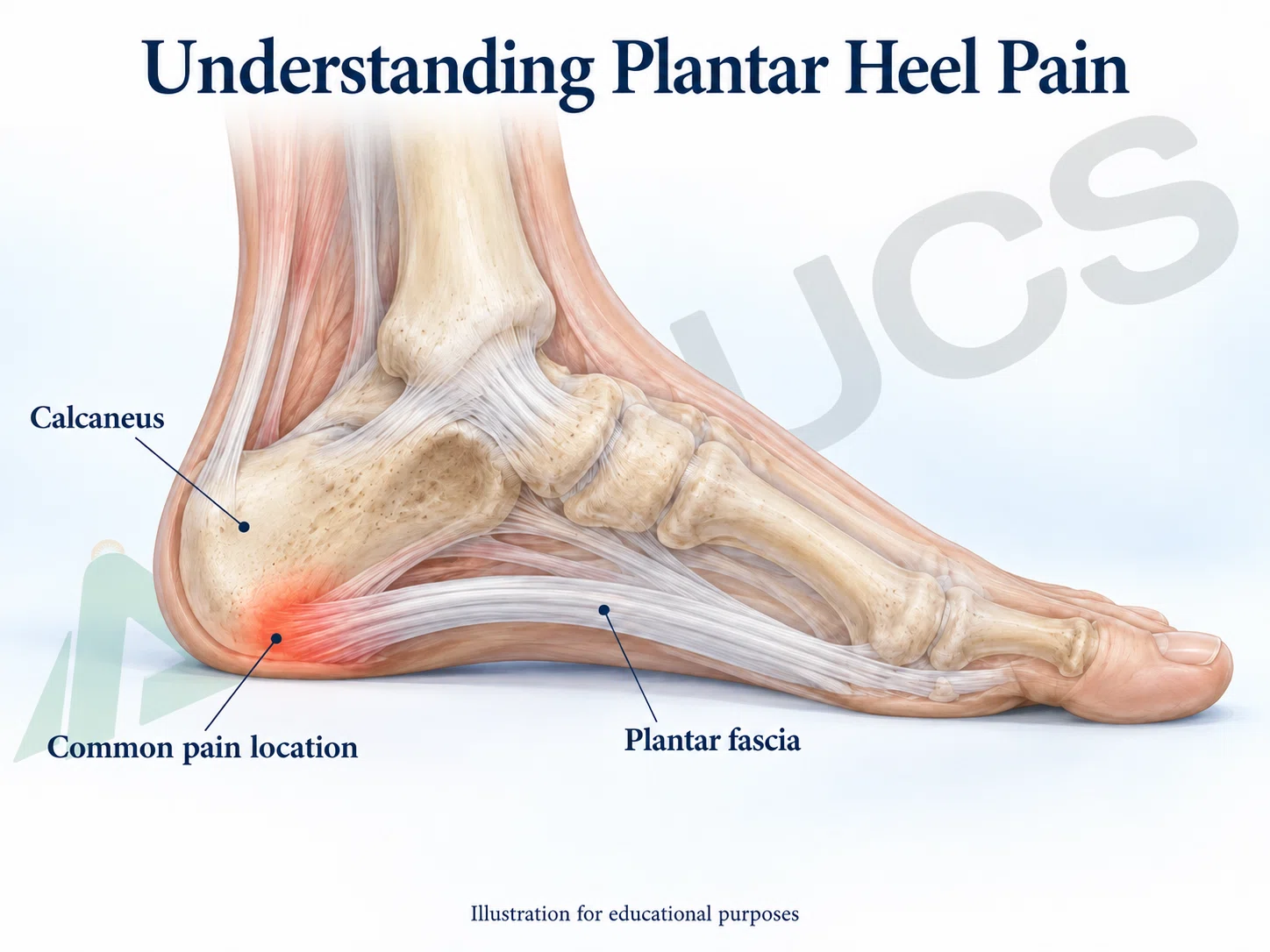
However, plantar heel pain is a symptom, not a diagnosis. Fat-pad disorders, calcaneal stress injury, nerve entrapment, and other conditions can produce overlapping complaints. Clinical assessment should establish whether the symptom pattern is consistent with plantar fasciitis before selecting a treatment modality. Imaging may be appropriate when the presentation is atypical or symptoms persist despite appropriate care. [2, 3]
For rehabilitation planning, useful baseline measures include:
First-step pain and pain during usual activities.
Walking and standing tolerance.
Restrictions in work, exercise, or daily tasks.
A validated measure of foot-related function.
Tracking these measures helps establish whether symptom relief translates into better daily function.
How Laser Therapy May Help
Photobiomodulation, or PBM, involves biological responses to absorbed light. Proposed mechanisms include changes in mitochondrial activity, redox signaling, nitric oxide availability, and other cellular pathways. These responses may influence processes involved in pain modulation and tissue repair. Mechanisms vary with wavelength, dose, tissue characteristics, and the physiological state of the cells being treated. [4, 5]
Experimental research also describes effects on inflammatory signaling. However, a cellular response observed under laboratory conditions does not establish that a particular clinical treatment will restore damaged plantar fascia or produce lasting pain relief. [6]
For plantar fasciitis, clinical trials are needed to determine whether these mechanisms translate into better pain or functional outcomes than an appropriate control.
If treatment reduces pain, prescribed exercise may become easier to tolerate. Clinicians should look for that benefit during follow-up rather than assume it from the proposed biological mechanism.
What Does the Clinical Evidence Say?
LLLT and short-term pain relief
Low-level laser therapy, or LLLT, has been studied in plantar fasciitis for several decades. A 2019 systematic review and meta-analysis reported pain relief that extended to approximately three months after treatment in the included studies. This supports potential short-term benefit, while leaving questions about longer-term outcomes and the most effective protocols. [7]
The 2023 Heel Pain–Plantar Fasciitis clinical practice guideline recommends LLLT as part of a rehabilitation program to reduce pain in the short term. This recommendation is specific to LLLT and does not establish equivalent benefits for every high-power laser system or protocol. [8]
What the 2026 meta-analysis adds
A 2026 systematic review and meta-analysis included 13 trials involving 784 participants. It found a statistically significant improvement in heel tenderness, but no significant pooled advantage for overall pain, function, or plantar fascia thickness. Pain and function results also showed substantial heterogeneity. [9]
The pooled findings argue against presenting laser as a treatment that reliably improves both pain and function across protocols. They do not rule out benefit for particular patients or approaches.
Reviews may reach different conclusions because they include different laser modalities, comparators, and outcome measures. The strongest practical conclusion is that symptom relief is possible, while its magnitude and durability remain uncertain.
What a sham-controlled HILT trial found
A 2026 randomized, double-blind, sham-controlled trial enrolled 34 patients. Both groups completed a stretching program and received nine sessions of active HILT or sham treatment over three weeks. Both improved, but active HILT did not provide a statistically significant additional benefit for pain, foot and ankle function, or plantar fascia thickness. The small sample and immediate post-treatment assessment limit conclusions about other protocols and longer-term outcomes. [10]
Improvement within a treatment group is not the same as evidence of an added laser effect. Stretching, contextual effects, and the course of the condition may also contribute; the between-group comparison helps assess what the laser adds.
HILT vs. LLLT for Plantar Fasciitis
HILT and LLLT differ in their delivery characteristics, but the labels alone do not identify an effective treatment.
| Consideration | LLLT | HILT |
| Delivery | Generally uses lower average power | Uses higher-power delivery; protocols may be continuous or pulsed |
| Dosimetry | Wavelength, exposure, beam area, and application technique matter | The same variables matter, with additional attention to heat accumulation |
| Evidence | Supported by some trials and the 2023 guideline | Findings vary across comparative and sham-controlled trials |
| Clinical interpretation | Benefit depends on the studied protocol | Higher power does not establish superior outcomes |
Direct comparisons have produced conflicting findings. In a 2018 randomized trial involving 70 patients, both groups received stretching exercises and silicone insoles. HILT produced greater improvements than LLLT over three weeks under the protocols tested. [11]
However, a 2020 randomized comparison did not find a statistically significant difference between HILT and LLLT for the reported pain outcomes. [12]
Taken together, these trials do not establish that HILT is consistently superior to LLLT for plantar fasciitis. Their results apply to the protocols tested, not to every device within either category.
Power describes the rate of energy delivery. It does not, by itself, describe exposure across the treatment area or the energy reaching the target tissue. Clinicians therefore need complete treatment parameters rather than a wattage-based comparison.
For a broader comparison of delivery characteristics, dosing, and clinical selection, see our guide to HILT vs. LLLT: differences, dosage, and clinical choice.
Integrating Laser Therapy Into Rehabilitation
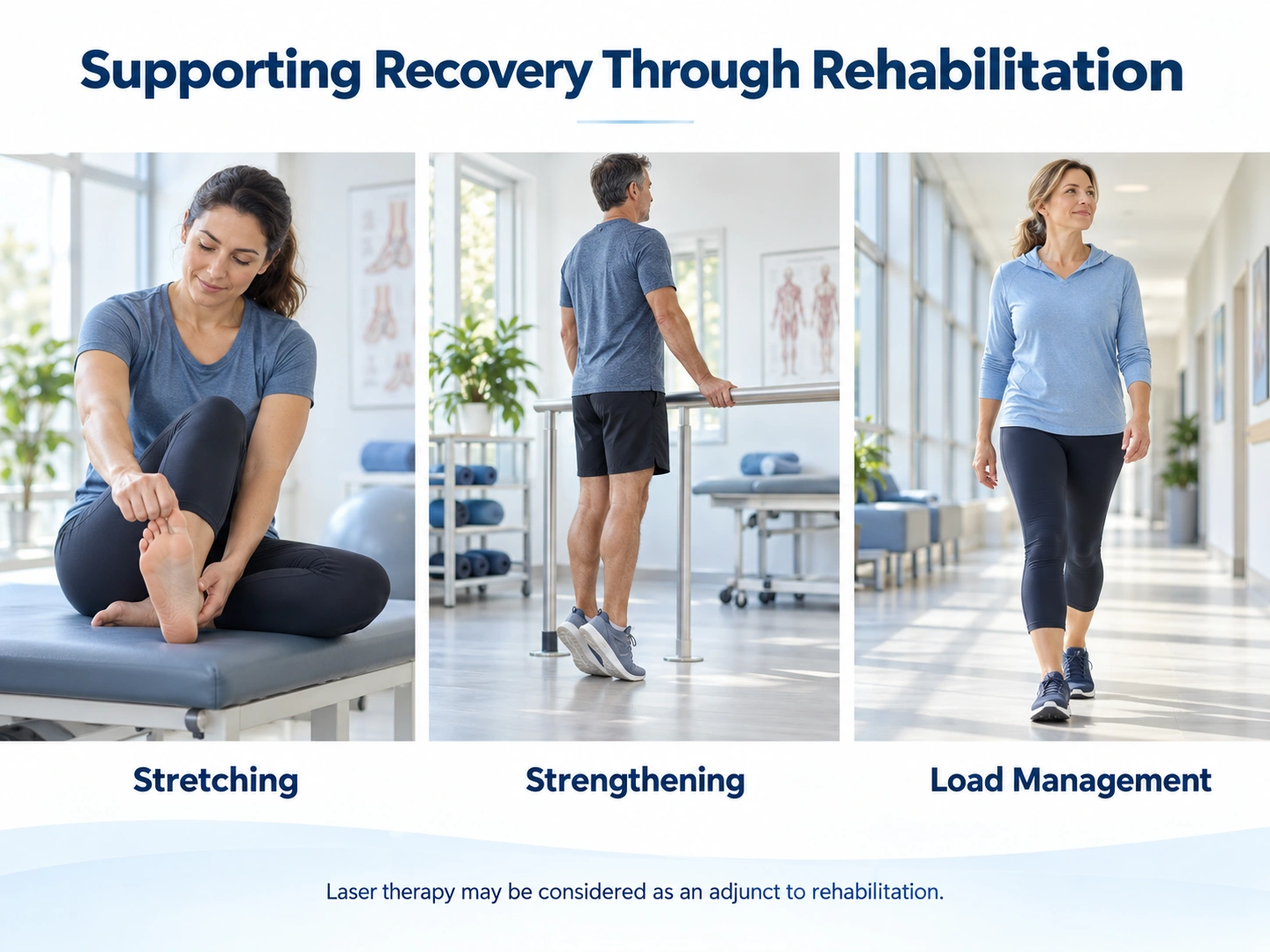
A rehabilitation plan should address the patient’s symptoms, activity demands, and ability to manage loading. A best-practice guide for plantar heel pain identifies plantar fascia stretching, taping, and individualized education as core interventions, including advice about footwear and load management. [13]
Stretching and progressive exercise
Plantar fascia-specific stretching and gastrocnemius–soleus stretching are recommended approaches. The 2023 guideline also supports resistance exercise for the foot and ankle musculature. Exercise selection and progression should reflect the patient’s current tolerance and functional goals. [8]
When laser is used, follow-up should assess whether it helps the patient complete prescribed exercises or manage necessary daily activities more comfortably.
Managing daily demands
Load management requires practical decisions. A patient who stands throughout a shift may need different adjustments from a runner whose symptoms followed a change in training.
The plan should identify aggravating activities and agree on manageable changes. Education should help the patient understand how to adjust activity without treating every episode of discomfort as evidence of new damage. Footwear advice and selected support measures can form part of this discussion. [13]
Adding other measures when appropriate
Taping, orthoses used alongside other treatments, and night splints may be considered according to the presentation. The 2023 guideline recommends a one- to three-month night-splint program for patients who consistently experience first-step morning pain. [8]
Each additional intervention should have a clear purpose. Its value should be reviewed against the patient’s symptoms and functional goals.
Clinical Considerations and Treatment Limitations
Before starting laser therapy, clinicians should define the intended outcome and how it will be assessed. For example, reducing pain during walking is more specific than a general aim to “promote healing.”
Treatment documentation should include wavelength, average power, emission mode, exposure time, total energy, treatment area, and application technique. These details help establish whether a published protocol is relevant to the device and patient being treated.
Laser safety also requires appropriate training, wavelength-matched protective eyewear, and attention to direct or reflected exposure. Patient sensation, skin response, and thermal comfort require assessment, particularly during higher-power treatment. [14]
Pain relief does not demonstrate structural repair or protection against recurrence. Brief follow-up and small study populations also leave uncertainty about sustained recovery.
If progress is limited, reassessment should consider diagnosis, exercise adherence, activity demands, and the overall plan rather than simply increasing laser output.
Where LYRA Fits Into Clinical Practice
For clinics considering laser treatment, device selection also involves practical questions about portability, operation, and appointment workflow. AILUCS’s LYRA podiatry platform offers a touchscreen interface, guided treatment options, and a portable design. These are usability features, rather than evidence of clinical effectiveness. [15]
For clinics comparing equipment, our guide to choosing a medical high-intensity laser machine outlines practical questions about output specifications, dose controls, safety, and workflow.
Clinical use should begin with an assessment and a defined treatment goal, followed by parameter selection, exercise instruction, and review of the patient’s progress. Presets can assist operation but require clinical review for each patient.
Research on other laser systems can inform treatment decisions, but it does not establish LYRA-specific effectiveness.
Clinics can explore the AILUCS LYRA podiatry laser solution and assess the relevant configuration, instructions for use, and locally authorized indications before integrating it into human clinical practice. [15]
Key Takeaway and FAQs
Laser therapy may help selected patients manage plantar fasciitis pain, particularly as a short-term adjunct to rehabilitation. Evidence for functional improvement and the added benefit of HILT remains mixed. Treatment decisions should therefore focus on whether laser supports the patient’s exercise program and recovery of daily function.
Can laser therapy cure plantar fasciitis?
Laser should not be presented as a cure. Some studies report symptom relief, but consistent improvement across pain and functional outcomes has not been established. [9]
Is HILT better than LLLT?
Direct comparisons are mixed. A higher-power device should not be assumed to produce better results. [11, 12]
How many sessions are needed?
There is no universally established course. Studies use different schedules and parameters, so session numbers should not be presented as a guaranteed route to recovery.
Does laser replace rehabilitation exercises?
Exercise remains central to conservative management. Laser should be evaluated as a possible adjunct, with progress judged through symptoms and daily function. [8]
Medical disclaimer: This article provides professional educational information. Diagnosis, treatment selection, exercise progression, and laser parameters should be determined by a qualified healthcare professional.
References
[1] Plantar fasciopathy: A current concepts review (2018). View source
[2] Evaluation and Treatment of Chronic Plantar Fasciitis (2020). View source
[3] Diagnosis and management of plantar fasciitis in primary care (2012). View source
[4] Mechanisms and Mitochondrial Redox Signaling in Photobiomodulation. View source
[5] Photobiomodulation Therapy Mechanisms Beyond Cytochrome c Oxidase. View source
[6] Mechanisms and applications of the anti-inflammatory effects of photobiomodulation (2017). View source
[7] Wang et al. Clinical efficacy of low-level laser therapy in plantar fasciitis: A systematic review and meta-analysis (2019). View source
[8] Koc et al. Heel Pain–Plantar Fasciitis: Revision 2023. View source
[9] Ortiz-Romero et al. Effect of Local Laser Therapy on Plantar Fasciitis: A Meta-Analysis (2026). View source
[10] Jitpimolmard et al. Efficacy of High-Intensity Laser Therapy Combined With Plantar Fascia Stretching Exercises in the Treatment of Plantar Fasciitis: Randomized, Double-Blind, Sham-Controlled Trial (2026). View source
[11] Ordahan et al. The effect of high-intensity versus low-level laser therapy in the management of plantar fasciitis: a randomized clinical trial (2018). View source
[12] Naruseviciute and Kubilius. The effect of high-intensity versus low-level laser therapy in the management of plantar fasciitis: randomized participant blind controlled trial (2020). View source
[13] Morrissey et al. Management of plantar heel pain: a best practice guide informed by a systematic review, expert clinical reasoning and patient values (2021). View source
[14] Occupational Safety and Health Administration. Hospitals: Surgical Suite—Laser Hazards. View source
[15] AILUCS. LYRA Podiatry Laser Solution. View source