
Laser Therapy for Hip Dysplasia in Dogs: Non-Surgical Management
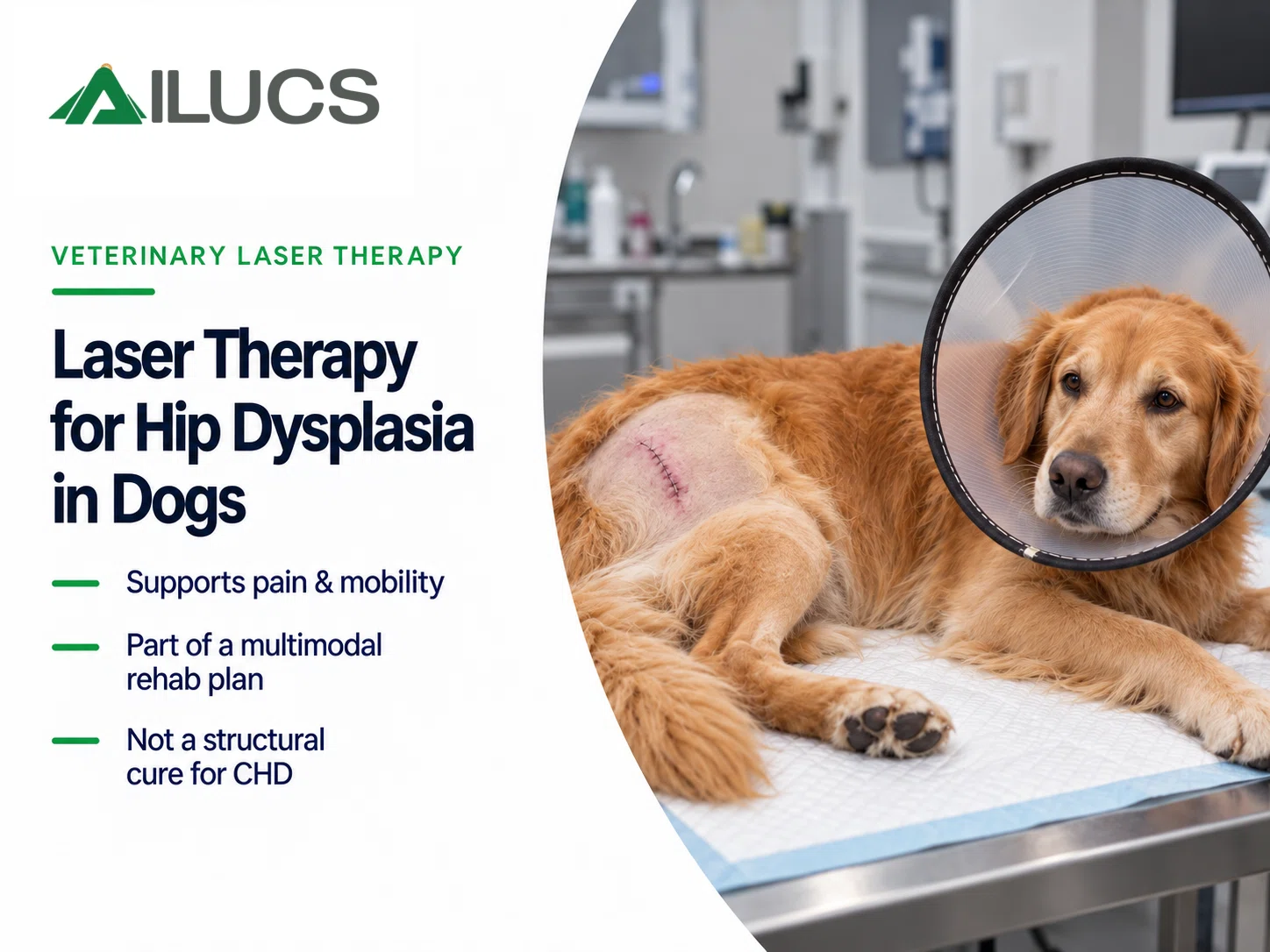
Canine hip dysplasia (CHD) is a developmental orthopedic disorder, not simply another name for arthritis. The disease begins with abnormal laxity and instability of the coxofemoral joint. Over time, repeated subluxation and abnormal loading can contribute to cartilage damage, joint remodeling, pain, reduced range of motion, muscle loss, and secondary osteoarthritis.
That distinction changes how treatment should be discussed. Laser therapy may support pain control, comfort, and rehabilitation in selected dogs, particularly when secondary hip osteoarthritis or periarticular soft-tissue discomfort is present. It does not tighten a lax hip, deepen the acetabulum, or restore normal joint anatomy.
For clinicians and owners, the useful question is therefore not whether laser therapy can “fix” hip dysplasia. The better question is where photobiomodulation (PBM) fits within a complete, non-surgical management pathway—and when conservative care should give way to surgical referral.
1. Start With the Diagnosis, Not the Modality
Dogs with CHD can look very different clinically. Some puppies show pain or a characteristic gait before marked osteoarthritis is visible. Some adult dogs have radiographic hip dysplasia with few obvious signs. Others present later in life, when osteoarthritis, stiffness, loss of muscle mass, and difficulty rising have become the dominant problems.
Radiographs are important, but treatment decisions should not be based on imaging alone. A useful clinical assessment also considers age, joint laxity, pain, gait, muscle mass, body condition, activity requirements, neurologic status, concurrent orthopedic disease, and the owner’s goals.
Differential diagnosis matters as well. Lumbosacral disease, cranial cruciate ligament pathology, patellar disease, iliopsoas injury, neurologic disorders, and other sources of hindlimb pain can mimic or compound hip-related dysfunction. Before adding laser treatment, the clinician should be confident that the hips are a meaningful contributor to the dog’s current limitations.
2. Age Changes the Management Pathway
Age is one of the most important variables in CHD because some joint-preserving procedures are time-sensitive. The American College of Veterinary Surgeons (ACVS) notes that juvenile pubic symphysiodesis is intended for very young puppies, while double or triple pelvic osteotomy is considered for selected immature dogs before substantial arthritic change develops.
For that reason, rehabilitation or laser therapy should never be used to delay orthopedic assessment in a young dog with clinically important hip laxity. A puppy that still qualifies for a joint-preserving procedure is in a different decision window from a skeletally mature dog with established osteoarthritis.
In adult and senior dogs, the emphasis often shifts toward maintaining comfort, preserving muscle, optimizing body condition, sustaining daily mobility, and controlling the consequences of degenerative joint disease. Some dogs remain functional for long periods with conservative care; others ultimately require procedures such as total hip replacement or femoral head and neck ostectomy.
3. Which Dogs Are Reasonable Candidates for Non-Surgical Management?
Non-surgical management may be appropriate for dogs with mild or intermittent signs, mature dogs with acceptable function, patients in which surgery is not currently indicated, and dogs for whom surgery is not feasible because of medical, financial, or practical considerations. It may also serve as a bridge while a patient is being prepared for surgery or while an immature dog is monitored under specialist guidance.
The goal is not to cure the structural abnormality. The goal is to reduce pain, limit unnecessary mechanical stress, preserve useful range of motion and muscle strength, and maintain a sustainable level of activity and quality of life.
Core components of a conservative CHD plan
| Component | Primary objective | Clinical note |
| Weight optimization | Reduce mechanical load | A lean body condition is a cornerstone of long-term management. |
| Veterinary pain management | Control clinically significant pain | Medication choices and monitoring should be individualized by the veterinarian. |
| Controlled exercise | Maintain useful movement | Consistent low-impact activity is generally more useful than cycles of overactivity and rest. |
| Rehabilitation therapy | Preserve strength, motion, balance, and function | Exercise progression should follow the patient’s tolerance and functional goals. |
| Laser therapy / PBM | Adjunctive support for pain and rehabilitation | PBM supports symptoms and function; it does not correct joint laxity. |
| Home modification | Reduce avoidable stress and slipping | Flooring, ramps, rest areas, and activity control can materially affect daily function. |
| Reassessment | Confirm that the plan is working | Treatment should change when objective function does not improve or declines. |
4. Weight Management Is Not Optional
For a dog with unstable or arthritic hips, body condition directly changes the load placed on the joint during standing, rising, walking, stair use, and play. Evidence reviews of non-surgical CHD management identify weight control as one of the best-supported conservative strategies, and AAHA pain-management guidance likewise emphasizes weight optimization as a major component of chronic musculoskeletal care.
This does not mean every dog with CHD must lose weight. It means that body condition should be deliberately assessed and maintained in a lean, appropriate range. For overweight dogs, reducing excess load may produce greater long-term value than simply adding another passive modality to an otherwise unchanged plan.
5. Controlled Activity: Avoid Both Overload and Deconditioning
Pain often creates a self-reinforcing cycle: the dog moves less, muscle mass and neuromuscular control decline, everyday activity becomes harder, and the owner responds by restricting movement even further. At the other extreme, intermittent bursts of high-impact activity can aggravate symptoms in a poorly conditioned dog.
The usual aim is consistent, controlled, low-impact movement. Walking duration and speed can be adjusted to tolerance. Rehabilitation exercises may target gluteal and core strength, controlled sit-to-stand transitions, weight shifting, balance, proprioception, and comfortable hip range of motion. Hydrotherapy can be useful in selected dogs when it is supervised and incorporated into a broader plan.
The correct starting point is determined by current function—not by a fixed exercise template. An older dog with marked atrophy, a young adult with intermittent soreness, and a working dog whose activity has recently declined require different rehabilitation strategies.
6. Where Laser Therapy Fits
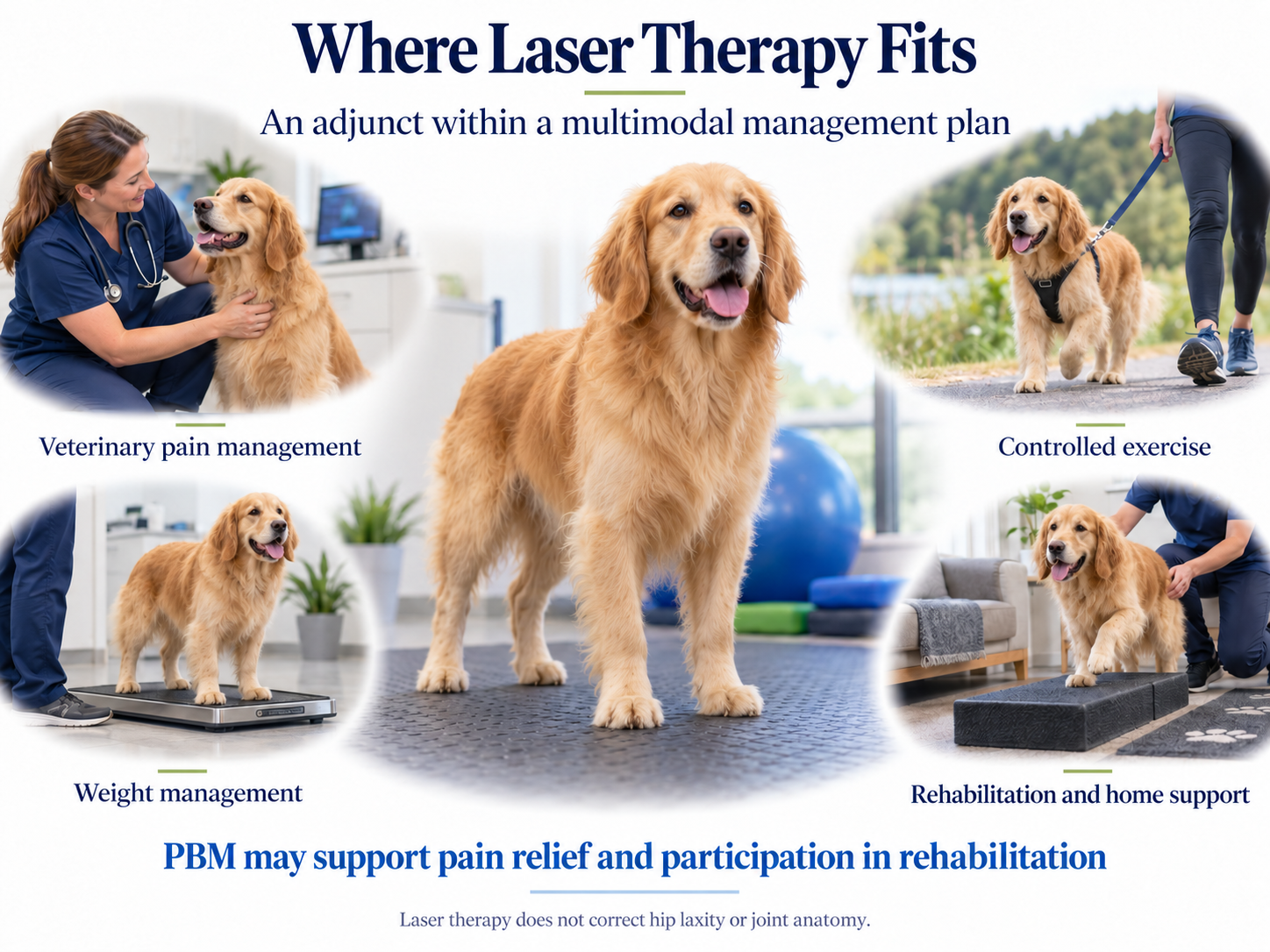
Photobiomodulation is used in veterinary rehabilitation as a noninvasive modality for selected musculoskeletal pain conditions. In CHD, its most defensible role is adjunctive: helping manage painful or inflammatory consequences around the hip so that the dog can move and participate more comfortably in rehabilitation.
This distinction is clinically important. CHD begins with abnormal joint mechanics. PBM does not correct femoral head coverage or eliminate pathologic laxity. Its potential value lies downstream of the structural problem—in the symptomatic and functional consequences that develop around the affected joint.
A practical way to think about PBM is to connect it to a functional goal. For example, if pain is limiting comfortable leash walking, therapeutic exercise, or a controlled strengthening program, reducing that barrier may help the dog engage more effectively in active rehabilitation. If the dog receives repeated laser sessions but continues to lose muscle, becomes less mobile, or cannot perform normal daily activities, the overall management plan needs reassessment.
7. What Does the Evidence Actually Show?
The veterinary PBM literature is encouraging in some musculoskeletal indications, but protocols, devices, treatment schedules, outcome measures, and study quality vary. That makes it inappropriate to present laser therapy as a universally proven solution for canine hip dysplasia.
One study is particularly relevant to dogs with hip disease. In a 2022 randomized, double-blinded controlled trial, 20 dogs with bilateral hip osteoarthritis were evaluated. Forty hip joints were assigned to a control or PBM treatment group. The PBM group received Class IV laser treatment over three weeks, and investigators followed pain, function, gait, stiffness, quality of life, range of motion, and other outcomes for up to 90 days.
The PBM group showed improvements in several pain and function measures at selected follow-up points, and hip range of motion improved from day 15 through day 90. These findings suggest a potential benefit for symptom management, but the small sample and the specific treatment protocol limit how broadly the results can be applied.
The limitation is just as important as the positive result: the trial studied dogs with hip osteoarthritis, not correction of the developmental instability that defines CHD. It therefore supports PBM as a potential adjunct for the painful degenerative consequences of hip disease. It does not demonstrate that laser therapy can reverse hip dysplasia itself.
8. Why This Article Does Not Give a Universal Laser Dose
There is no single evidence-based setting that can be recommended for every dog with CHD. Patient size, coat, pigmentation, tissue thickness, treatment area, severity of secondary osteoarthritis, surrounding muscle involvement, device characteristics, wavelength, average power, total energy, application technique, and treatment frequency can all influence clinical delivery.
Laser parameters should be selected to match the patient, treatment goal, and device. Clinical records should document the settings used and the functional response so that subsequent treatment can be adjusted appropriately.For practical calculations and documentation principles, see our guide to veterinary laser therapy dosage.
Higher power alone does not guarantee a better response, and a protocol published for one laser system should not automatically be copied to a different device or patient. Treatment parameters should be chosen deliberately, documented, and adjusted in response to clinical findings rather than escalated simply because a dog has a chronic diagnosis.Understanding the relationship between power, wavelength, and dose can help clinicians interpret protocols without assuming that higher output means better results.
9. A Practical Non-Surgical CHD Pathway
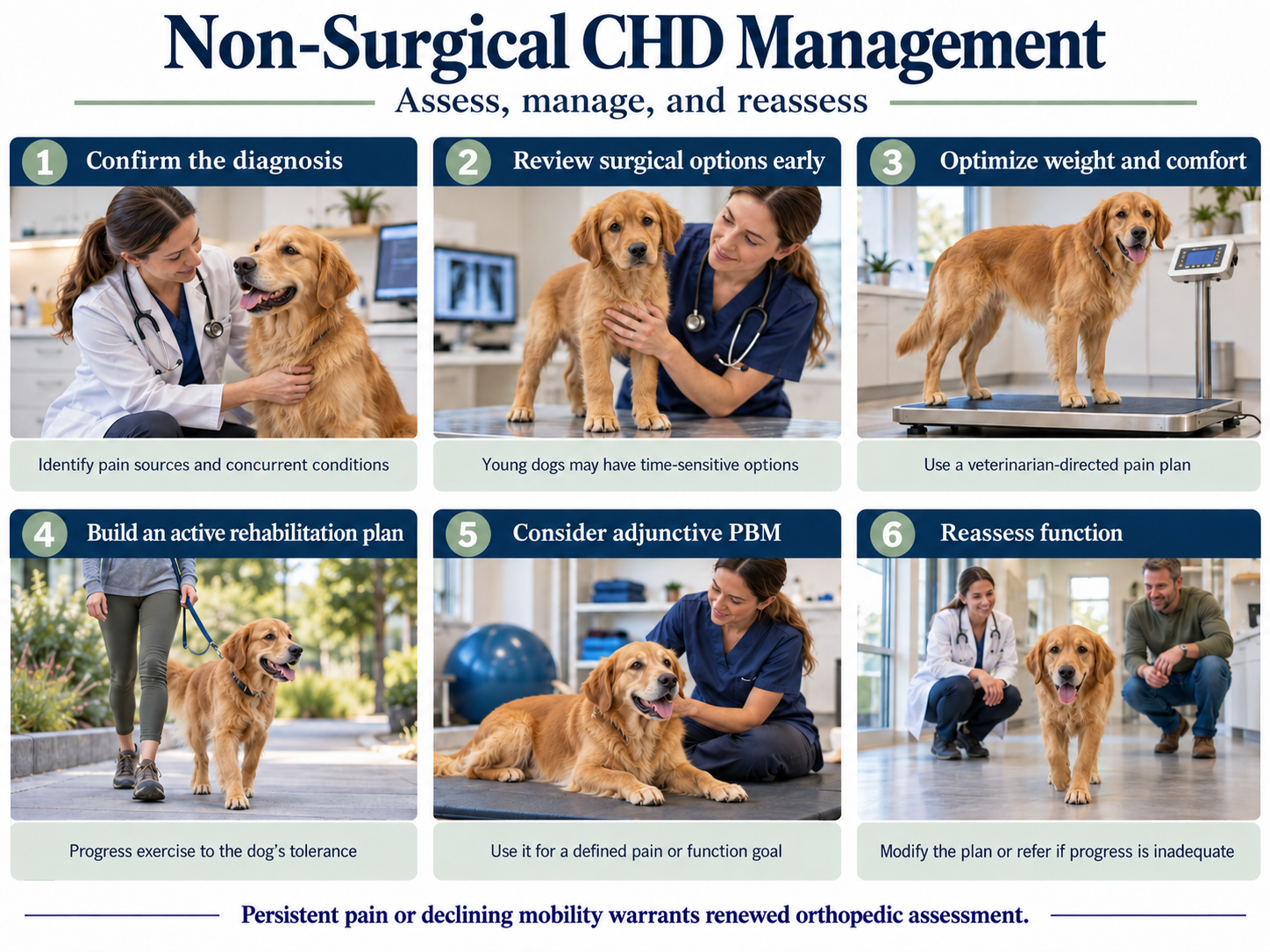
A useful conservative pathway is sequential. Each step should answer a clinical question before another modality is added.
1. Confirm the pain generator. Perform orthopedic examination and appropriate imaging, and identify concurrent conditions that may contribute to hindlimb dysfunction.
2. Check whether age-sensitive surgery is still relevant. In puppies and immature dogs, obtain timely orthopedic input before committing to prolonged conservative treatment.
3. Establish baseline function. Document pain, gait, muscle condition, body condition, range of motion, activity tolerance, and meaningful daily limitations.
4. Correct modifiable load. Address excess body weight, slippery flooring, uncontrolled jumping, and inconsistent high-impact activity.
5. Create a pain-management plan. Use veterinarian-directed pharmacologic and nonpharmacologic options based on the patient’s needs and comorbidities.
6. Begin controlled rehabilitation. Select exercises that match current function and progress gradually as comfort, strength, and control improve.
7. Add PBM when it serves a defined goal. Use laser therapy as an adjunct when pain or periarticular discomfort is limiting function or participation in rehabilitation.
8. Reassess objectively. Continue, modify, taper, or escalate treatment according to functional response rather than session count alone.
9. Escalate when conservative care is failing. Persistent pain, progressive disability, muscle loss, or declining quality of life warrants renewed orthopedic assessment and discussion of surgical options.
10. Measure Function, Not Just Treatment Attendance
A dog can complete a treatment course without achieving a meaningful clinical benefit. Reassessment should focus on what the patient can do and how comfortably they can do it.
Useful measures include willingness to rise, walking duration, gait quality, stair or ramp use, ability to enter a vehicle, frequency of slipping, comfortable hip range of motion, thigh circumference, activity level, sleep and rest behavior, and changes in veterinarian-directed analgesic requirements. Standardized owner questionnaires such as the Canine Brief Pain Inventory, Liverpool Osteoarthritis in Dogs (LOAD), or Canine Orthopedic Index may improve consistency when they are appropriate to the case.
Short videos can also be valuable. Recording the dog performing the same task—such as rising, walking at a controlled pace, turning, or using a step—at comparable intervals may reveal gradual changes that are easy to miss from memory alone.
11. Home Management Is Part of the Treatment
Clinical rehabilitation occupies only a small portion of the dog’s week. The home environment determines how the hips are loaded during the rest of the time.
Secure footing can reduce repeated slipping. Ramps may be preferable to repeated jumping for some dogs. Beds should be easy to enter and rise from. Nail and paw care can affect traction. Exercise should be predictable rather than alternating between long inactivity and intense weekend activity.
These changes are simple, but they can determine whether gains made during rehabilitation are preserved between appointments.
12. When Conservative Management Is No Longer Enough
Non-surgical management should not become an indefinite default when the patient is deteriorating. Reassessment is warranted when pain remains clinically important despite an appropriate multimodal plan, mobility progressively declines, muscle loss continues, daily activities become increasingly difficult, or quality of life is no longer acceptable.
Young dogs deserve particular urgency because some joint-preserving procedures have narrow age and disease-stage windows. In mature dogs with severe function-limiting disease, total hip replacement or other surgical options may provide a more appropriate long-term solution than repeatedly adding conservative modalities.
Laser therapy can still be useful in selected perioperative or rehabilitation settings, but it should not be used to postpone referral when the structural disease has exceeded what conservative care can reasonably manage.
Frequently Asked Questions
Can laser therapy cure hip dysplasia in dogs?
No. Canine hip dysplasia is a structural and biomechanical joint disorder. Laser therapy cannot tighten an unstable hip or recreate normal joint anatomy. Its role is supportive—primarily in managing pain, secondary osteoarthritis, soft-tissue discomfort, and rehabilitation goals.
Can laser therapy replace NSAIDs or other pain medication?
Not automatically. PBM may be incorporated into multimodal pain management, but medication decisions should be made by the treating veterinarian. The objective is appropriate comfort and function with a treatment plan tailored to the individual patient.
How many laser sessions does a dog with hip dysplasia need?
There is no universal course. Frequency depends on clinical severity, chronicity, response, treatment parameters, rehabilitation goals, and other therapies being used. An initial treatment phase should be followed by reassessment rather than assuming indefinite maintenance is necessary.
Is laser therapy appropriate for a puppy with hip dysplasia?
It may be used in selected rehabilitation plans, but it should never replace timely evaluation for age-sensitive surgical options. Puppies and adolescent dogs with pathologic hip laxity should be assessed early so that potential joint-preserving procedures are not missed.
Is exercise safe for dogs with hip dysplasia?
Exercise is usually part of conservative management, but the type, intensity, and progression matter. Controlled low-impact activity and targeted rehabilitation are generally preferable to both prolonged inactivity and uncontrolled high-impact exercise.
Where a Class IV Veterinary Laser Fits in Practice
Class IV veterinary laser systems can make it practical to treat relatively large musculoskeletal regions within a clinical workflow. For CHD patients, however, the device is only one part of the plan. Treatment quality still depends on patient selection, dose planning, application technique, safety, documentation, and integration with active rehabilitation.
For clinics considering a platform such as the AILUCS LYRA veterinary laser, device selection should account for treatment controls, appropriate protocols, safety, and clinician training. The system should be integrated with diagnosis, orthopedic referral when indicated, weight management, therapeutic exercise, and outcome measurement.For a broader purchasing framework, see how to choose a veterinary laser therapy device.
Conclusion
Laser therapy for hip dysplasia in dogs is most useful when it is positioned correctly: not as a structural cure, but as one possible component of a broader non-surgical management strategy.
The strongest conservative plans are built around accurate diagnosis, appropriate body condition, veterinarian-directed pain management, controlled exercise, rehabilitation, practical home modification, and regular reassessment. PBM may help reduce a pain-related barrier to movement and support participation in rehabilitation, particularly when secondary hip osteoarthritis is clinically important.
The key is to keep the treatment goal functional. If the dog is moving more comfortably, maintaining muscle, and performing meaningful daily activities, the plan is serving its purpose. If function continues to decline, the answer is not simply more laser sessions—it is a fresh clinical assessment and, when indicated, renewed consideration of surgical options.
References
American College of Veterinary Surgeons (ACVS). Canine Hip Dysplasia. https://www.acvs.org/small-animal/canine-hip-dysplasia/
Kirkby KA, Lewis DD. Canine hip dysplasia: reviewing the evidence for nonsurgical management. Veterinary Surgery. 2012;41(1):2-9. https://doi.org/10.1111/j.1532-950X.2011.00928.x
Dycus DL, Levine D, Esteve Ratsch B, Marcellin-Little DJ. Physical Rehabilitation for the Management of Canine Hip Dysplasia: 2021 Update. Veterinary Clinics of North America: Small Animal Practice. 2022;52(3):719-747. https://doi.org/10.1016/j.cvsm.2022.01.012
Alves JC, Santos A, Jorge P, Carreira LM. A randomized double-blinded controlled trial on the effects of photobiomodulation therapy in dogs with osteoarthritis. American Journal of Veterinary Research. 2022;83(8):ajvr.22.03.0036. https://doi.org/10.2460/ajvr.22.03.0036
American Animal Hospital Association (AAHA). 2022 AAHA Pain Management Guidelines for Dogs and Cats: Nonpharmacologic Modalities for Pain Management. 2022. https://www.aaha.org/resources/2022-aaha-pain-management-guidelines-for-dogs-and-cats/nonpharmacologic-modalities-for-pain-management/
Medical Disclaimer
This article is intended for veterinary education and general information. Diagnosis, treatment selection, medication use, rehabilitation planning, surgical referral, and laser parameters should be determined by a qualified veterinary professional based on the individual patient.