
How to Choose a Veterinary Laser Therapy Device: A Practical Guide for Clinics
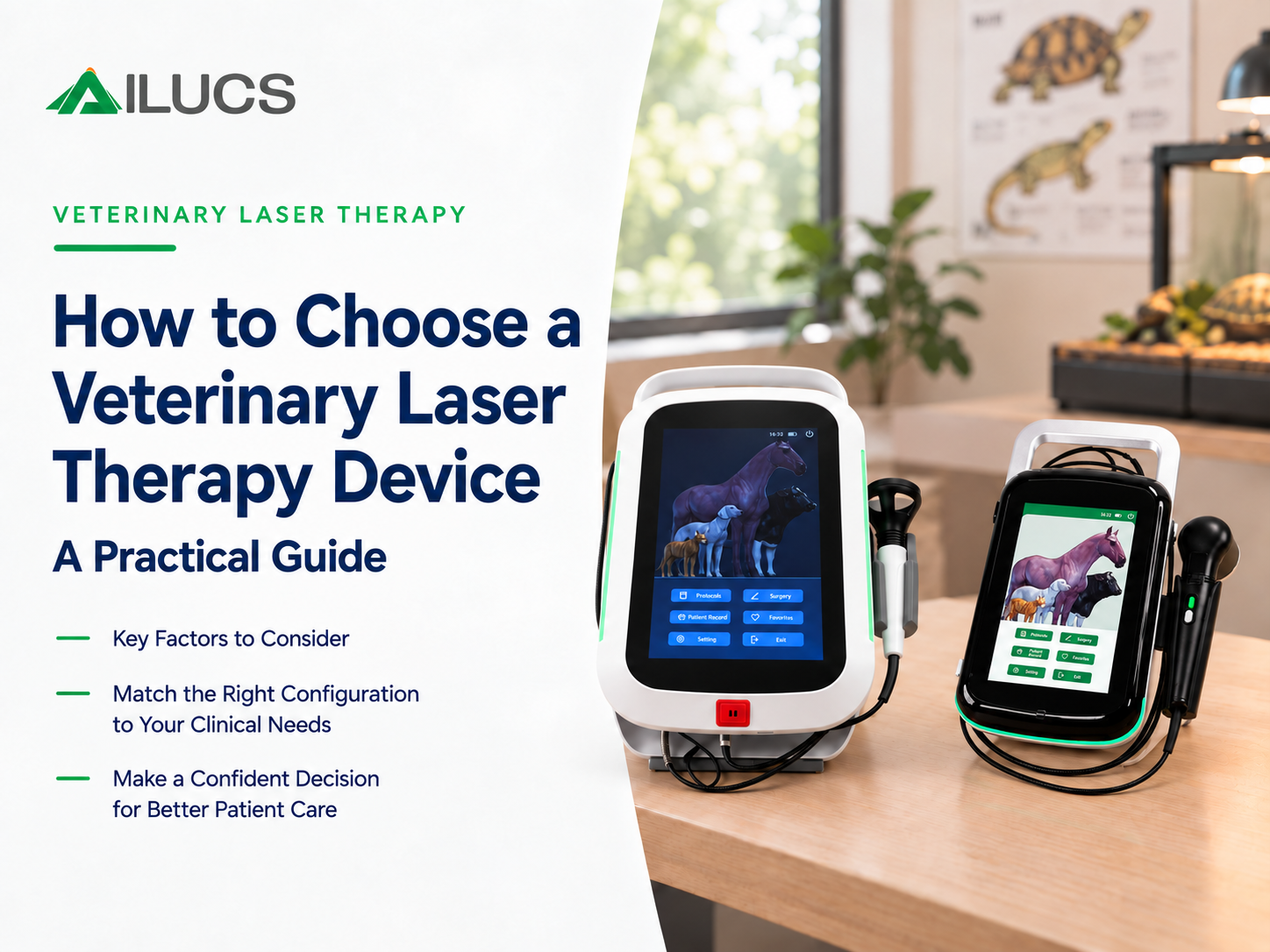
Choosing a veterinary laser therapy device should begin with the way a clinic actually treats patients—not with the highest power rating, the longest wavelength list, or the largest number of presets. The most suitable system is the one that matches the species you see, the tissues and treatment areas you work with, the level of parameter control you need, and the way treatment fits into daily clinical workflow.
A companion-animal rehabilitation clinic may prioritize flexible protocols, easy patient setup, treatment records, and portability between rooms. An equine or mobile practice may place greater emphasis on treatment coverage, energy delivery, battery operation, and practical use outside a fixed treatment room.
This guide focuses on the decisions clinics should make before requesting a quotation or choosing a configuration. It does not assume that one power class, wavelength count, or device format is automatically better for every practice.
Start With the Practice, Not the Specification Sheet
Veterinary laser therapy, also called photobiomodulation (PBM), is used as an adjunctive modality in rehabilitation and in the management of selected cases involving pain, inflammation, wounds, and musculoskeletal tissues. Published veterinary studies cover applications such as osteoarthritis, tendon and ligament injuries, wounds, and postoperative recovery, but the evidence and treatment protocols are not equally established for every indication.
That variability matters when choosing equipment. A clinic does not need every possible feature; it needs enough control, guidance, and treatment flexibility for its actual caseload. The most useful buying process therefore starts with a short clinical profile:
Which species do you treat most often?
Which anatomical areas and tissue types are most common in your caseload?
Will treatment mainly occur in a fixed room, across several rooms, or in mobile and field settings?
How much parameter control do experienced clinicians need, and how much workflow guidance do newer users need?
Which accessories and treatment-head sizes will genuinely be used in routine practice?
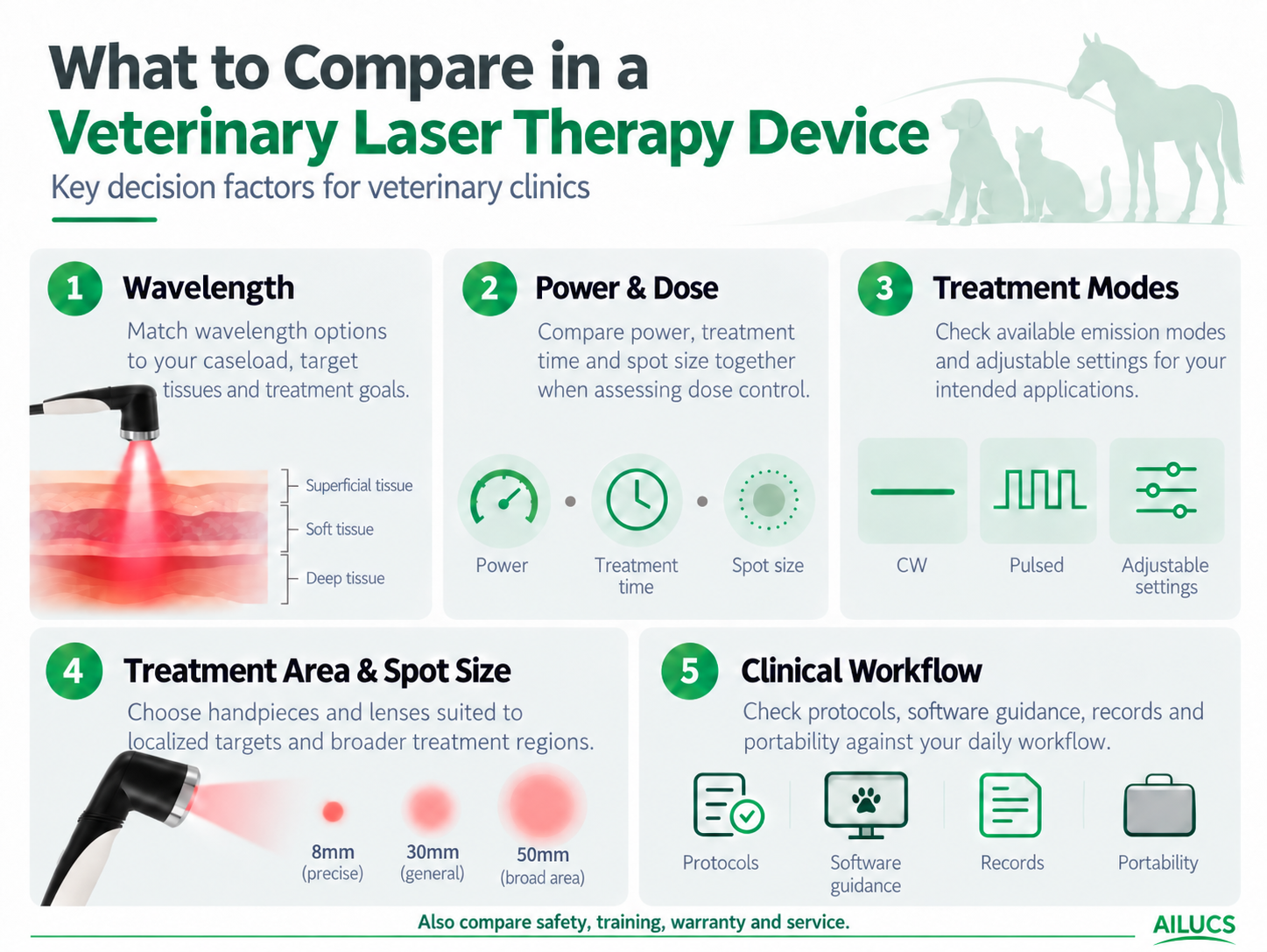
Seven Questions to Ask When Comparing Veterinary Laser Systems
1. Does the Wavelength Configuration Match Your Caseload?
Wavelength is an important specification, but it should be interpreted in the context of the cases a clinic treats. Red and near-infrared wavelengths are commonly used in PBM, and different wavelength combinations may be selected to support different treatment goals and tissue targets.
A multi-wavelength system can provide useful flexibility when a clinic treats different species, anatomical regions, and tissue depths. However, more wavelengths do not automatically make a system clinically superior. The practical question is whether the configuration adds value for the clinic's real case mix.
For a deeper technical discussion, see: How to Choose the Right Wavelength for Veterinary Laser Therapy
2. Can the System Deliver and Control Energy Appropriately?
Maximum output power matters, but it should never be compared in isolation. The energy delivered during treatment depends on the relationship between power, treatment time, spot size, wavelength, emission mode, treatment area, and the selected dose.
Higher available power can be useful when a clinician needs to deliver energy efficiently over a larger treatment area, but the ability to control that energy is just as important. When comparing devices, look for clinically usable power ranges, adjustable treatment time, appropriate spot sizes, clear dose control, and consistent parameter display.
Related reading: Power, Wavelength, and Dose in Class IV Veterinary Laser Therapy and Veterinary Laser Therapy Dosage: Power, Time & Area
3. Is There Enough Parameter Control Without Making Routine Use Unnecessarily Complex?
Veterinary laser systems may offer continuous wave, pulsed, or other emission options depending on the device. The objective is not to collect as many modes as possible, but to give clinicians enough control to adapt treatment to the target tissue, treatment area, and individual patient.
A good interface should make it easy to confirm the active wavelength configuration, power, treatment time, mode, and other relevant settings before treatment begins. For routine workflows, clarity and repeatability are often more useful than a large number of settings that are rarely used.
4. Does the Software Support Clinical Workflow?
Software design can be as important as hardware in daily practice. Built-in protocols, anatomical guidance, species selection, and saved treatment settings may help organize workflow—especially in clinics introducing laser therapy or treating a broad range of species.
Useful workflow functions may include:
Species and anatomical-area selection
Protocol guidance with editable parameters
Favorite or frequently used settings
Patient records and treatment history
Clear treatment-area or anatomical visualization
These tools should support clinical judgment rather than replace it. Published veterinary protocols vary considerably, so treatment still needs to be adjusted to the patient, indication, tissue, and clinical context.
5. Do the Handpieces and Treatment Heads Match the Areas You Actually Treat?
Accessory lists can look impressive on a specification sheet, but clinics should focus on the heads and handpieces they will genuinely use. Smaller treatment lenses can be practical for localized areas, while larger treatment heads can improve coverage of broader muscle groups and other large treatment regions.
Compare:
Small-area and large-area treatment options
Interchangeable treatment heads
Ergonomics during repeated sessions
Cable handling and setup
pecialized accessories only where they match a real clinical need
6. Does the Device Fit the Clinic's Mobility Requirements?
Portability means different things in different veterinary settings. A fixed small-animal hospital may only need to move a device between rehabilitation, consultation, and treatment rooms. An equine practitioner, mobile veterinarian, or multi-site team may need battery operation, fast setup, and practical transport between clinics, stables, and field locations.
Before comparing weight alone, ask:
Can the system operate on battery when needed?
How is it carried or transported?
How quickly can it be set up in another room or field environment?
Are the screen, handpiece, and accessories practical to use while moving between patients?
Does the system remain stable and easy to position during treatment?
7. Are Safety, Training, Service, and Support Part of the Purchase?
A veterinary laser is a clinical device, and purchasing decisions should include operator training and safety support—not only the specification sheet. Incorrect settings or excessive exposure can create a risk of thermal tissue injury, while direct or reflected laser exposure can seriously injure the eyes.
Ask whether the manufacturer or distributor provides:
Clear operating instructions
Laser safety guidance and appropriate protective equipment
Initial operator training
Technical and application support
Maintenance and service information
A clear process for warranty and after-sales support
Match the System to the Practice Profile
Once the clinic has defined its caseload and workflow, model selection becomes much easier. Within the AILUCS range, LYRA is positioned for companion-animal and general veterinary workflows, while REX is designed around equine and large-animal use.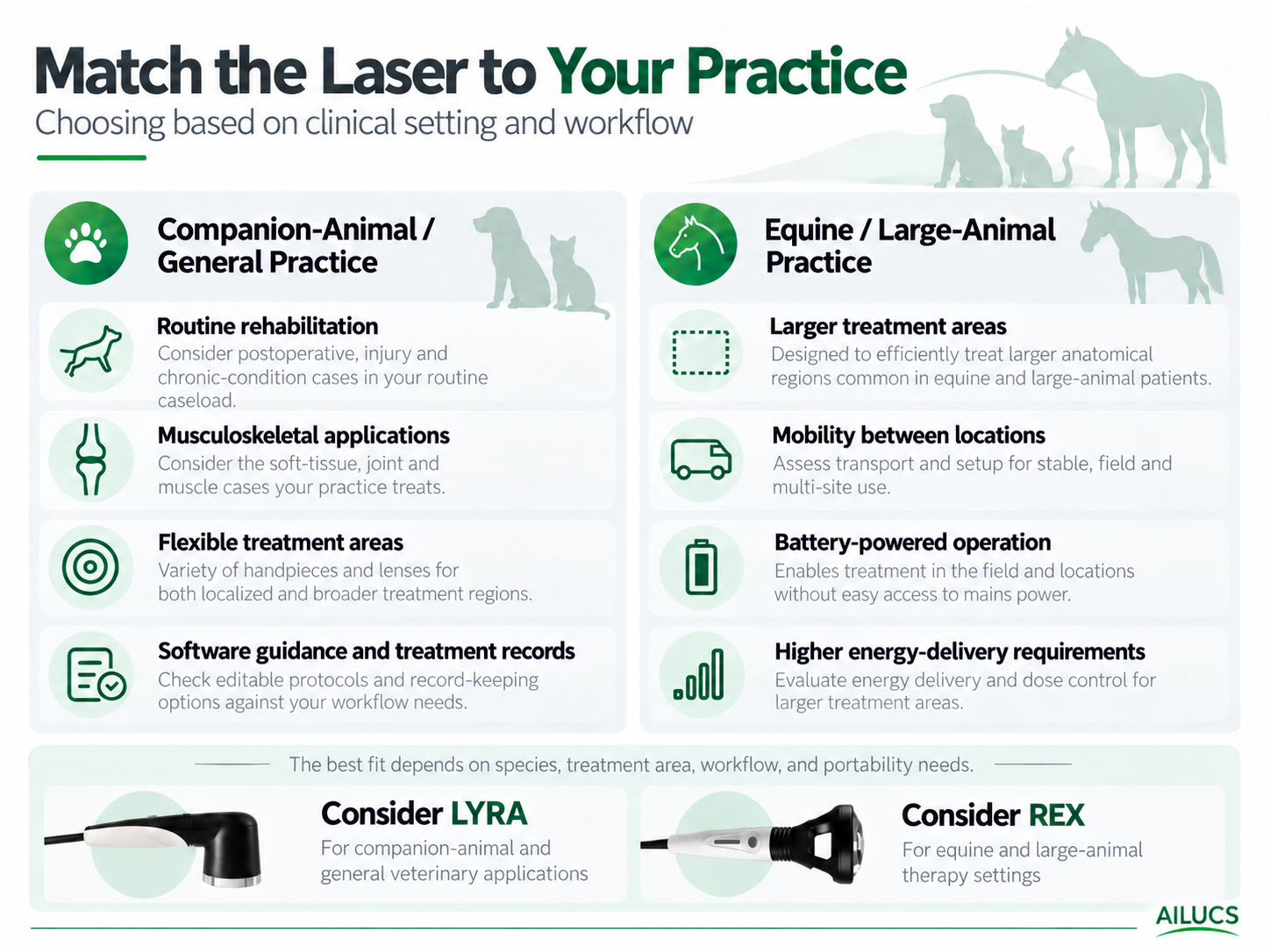
LYRA 3, LYRA 4, and LYRA 5
The LYRA series is available in three wavelength configurations. The choice should be based on the clinical applications the practice expects to perform, not simply on choosing the model with the greatest number of wavelengths.
LYRA 3 – 650/810/980 nm: A three-wavelength configuration for clinics that want a focused setup for routine companion-animal therapy and rehabilitation workflows.
LYRA 4 – 650/810/915/1064 nm: A four-wavelength configuration that broadens wavelength coverage for practices working frequently with musculoskeletal areas such as muscles, joints, tendons, and ligaments.
LYRA 5 – 650/810/915/980/1064 nm: The broadest wavelength configuration in the LYRA series for practices seeking greater flexibility across a wider range of veterinary applications.
REX for Equine and Large-Animal Workflows
REX is designed around equine and large-animal practice, where larger treatment areas, mobility, battery operation, and use outside a fixed treatment room may carry more weight in the purchasing decision. It combines five wavelengths—650, 810, 915, 980, and 1064 nm—with high-power output, 3D treatment guidance, battery operation, and a portable format.
For clinics that primarily treat horses or other large animals, the key question is not whether REX has more features, but whether its treatment coverage, mobility, and workflow design better match the way care is delivered.
Quick Practice-to-Configuration Comparison
| Practice profile | Configuration to compare | Why it may fit |
| Routine companion-animal therapy and rehabilitation | LYRA 3 | Focused three-wavelength configuration for routine veterinary therapy workflows |
| Broader companion-animal rehabilitation and musculoskeletal caseload |
LYRA 4 | Broader wavelength coverage for clinics frequently working with musculoskeletal areas |
| Broader companion-animal rehabilitation and musculoskeletal caseload | LYRA 5 | Five-wavelength configuration across a wider range of applications |
| Equine and large-animal practice | REX | Larger treatment areas, battery operation, mobility, and higher-power delivery |
Class III vs. Class IV: Keep the Decision Practical
Power class is one factor in device selection, but it should not be the only factor. Class IV systems generally offer substantially higher available output than lower-power therapeutic laser systems, which can provide greater flexibility when energy needs to be delivered efficiently across larger treatment areas.
However, biological response depends on the treatment parameters used. When comparing devices across power classes, evaluate wavelength configuration, dose control, treatment time, treatment area, emission modes, safety requirements, operator training, and intended clinical applications together.
For a dedicated comparison, see: Class 3B vs Veterinary Class IV Lasers: A Scientific Guide to Veterinary Laser Therapy Selection
Before Requesting a Quotation: Eight Questions to Ask
Which species and treatment areas will make up most of our laser caseload?
Which wavelength configuration is relevant to those cases?
What power range and energy-control options are available in normal clinical use?
Which treatment heads and accessories are included, and which are optional?
Can protocols be edited and saved for repeated clinical workflows?
Does the system support patient records or treatment history if our clinic needs them?
Will the device operate practically in every location where we plan to use it?
What training, warranty, technical support, and service are included in the quotation?
If a supplier cannot answer these questions clearly, a lower price or longer feature list may not translate into a better long-term fit for the clinic.
Frequently Asked Questions
What should I look for first when choosing a veterinary laser?
Start with the clinic's case mix and workflow. Identify the species treated most often, common treatment areas, the need for portability, the level of parameter control required, and the type of clinical guidance the team will actually use.
Is a higher-power veterinary laser always better?
No. Higher available power can increase flexibility and may be useful for larger treatment areas, but appropriate treatment also depends on wavelength, dose, time, spot size, target tissue, and application technique.
How many wavelengths should a veterinary laser have?
There is no universal number. The useful configuration is the one that matches the clinic's intended applications. More wavelengths can increase flexibility, but only if that flexibility corresponds to a real clinical need.
Which LYRA model should a clinic compare?
LYRA 3 is a focused three-wavelength configuration for routine companion-animal workflows. LYRA 4 broadens wavelength coverage for practices frequently working with musculoskeletal areas. LYRA 5 provides the widest wavelength combination in the LYRA series for clinics seeking greater flexibility.
When should a clinic consider REX instead of LYRA?
REX is designed around equine and large-animal workflows, particularly when larger treatment areas, battery operation, mobility, and use in clinics, stables, or field environments are important.
Conclusion: Choose the Veterinary Laser Around the Practice
A good veterinary laser purchasing decision begins with the animals, treatment areas, clinical workflow, and level of control the practice actually needs. Wavelength count, maximum power, software functions, and accessory lists are useful only when they support those requirements.
For companion-animal and general veterinary practices, the LYRA series offers three wavelength configurations for different workflow needs. For equine and large-animal practices, REX is configured around larger treatment areas, battery-powered mobility, and field-oriented use.
The objective is not to choose the most powerful or most feature-rich system. It is to choose a veterinary laser therapy device that can be used safely, consistently, and practically within the clinic's real treatment environment.
Selected Scientific References
1. Hochman L. Photobiomodulation Therapy in Veterinary Medicine: A Review. Topics in Companion Animal Medicine. 2018.
2. Bunch J. Photobiomodulation (Therapeutic Lasers): An Update and Review of Current Literature. Veterinary Clinics of North America: Small Animal Practice. 2023.
3. Millis DL, Bergh A. A Systematic Literature Review of Complementary and Alternative Veterinary Medicine: Laser Therapy. Animals. 2023.