
Power, Wavelength, and Dose in Class IV Veterinary Laser Therapy
Introduction
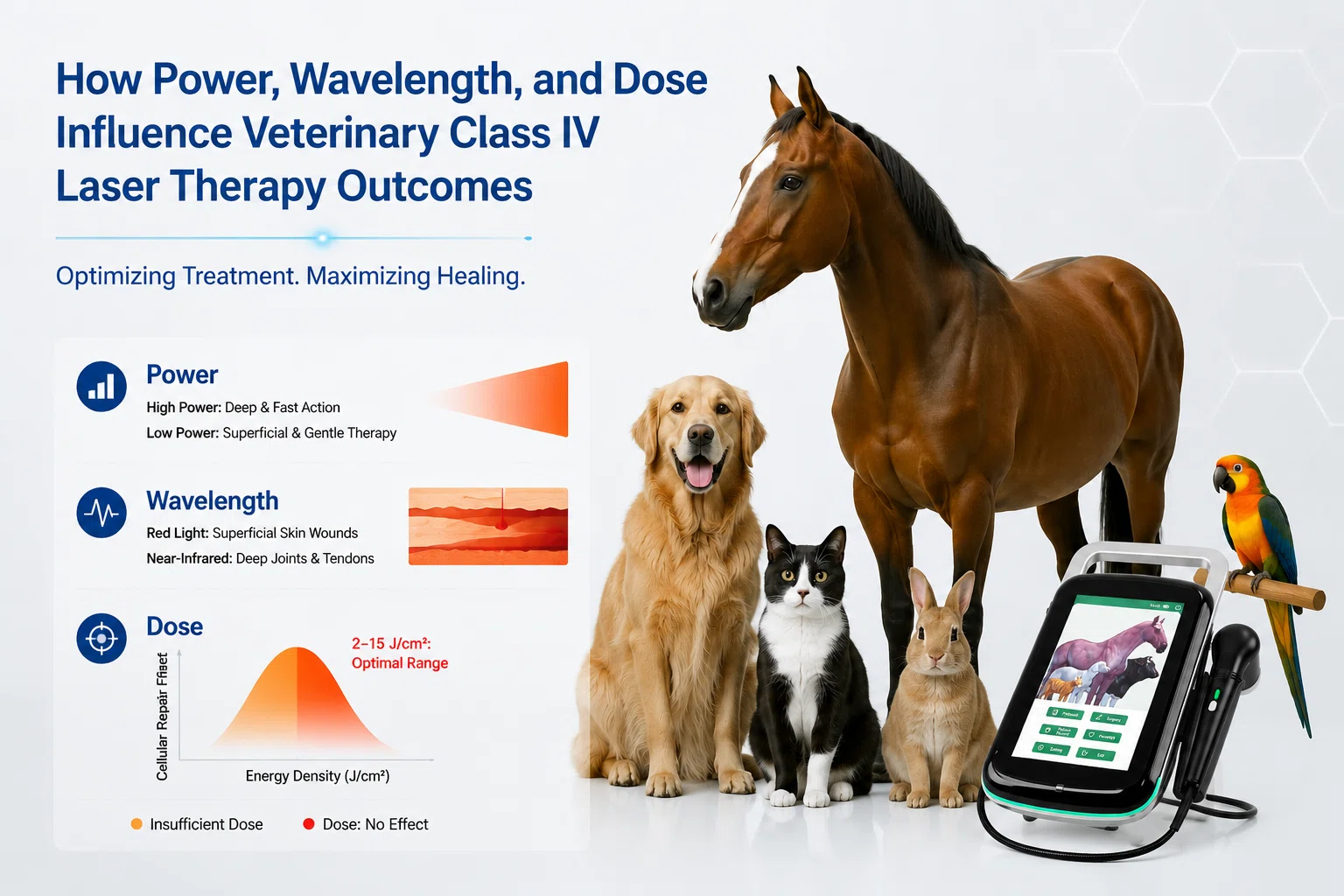
When using a Class IV therapeutic laser in veterinary medicine, three variables are central to treatment planning: power, wavelength, and dose. Understanding how these variables interact is fundamental to veterinary laser therapy because they influence how laser energy is delivered, distributed, and interpreted during treatment.
Power describes how quickly energy is delivered. Wavelength describes the characteristics of the emitted light and how it interacts with tissue. Dose describes how much energy is delivered over a defined treatment area.
These variables are connected. The same dose can be delivered using different combinations of power and treatment time, while wavelength, tissue characteristics, and application technique can influence how much of the emitted light reaches the intended tissue.
There is therefore no single laser setting that applies to every veterinary patient or condition. A systematic review of veterinary laser therapy found substantial variation in wavelength, laser class, dose, treatment frequency, and treatment duration across published studies, with no consensus on an optimal treatment protocol.
Understanding these relationships is more useful than evaluating any single laser specification in isolation.
How Power, Wavelength, and Dose Work Together
Each parameter answers a different question:
| Variable | What it describes | Why it matters |
| Power (W) | Rate of energy delivery | Influences treatment time and irradiance |
| Wavelength (nm) | Physical characteristic of the emitted light | Influences absorption, scattering, and tissue transmission |
| Dose (J/cm²) | Energy delivered per unit area | Describes energy applied to the treatment area |
The basic relationship is:
Energy (J) = Power (W) × Time (s)
Dose can then be calculated as:
Dose (J/cm²) = Energy (J) ÷ Treatment Area (cm²)
For a fixed amount of energy, changing power changes the delivery time.
This mathematical equivalence does not mean the tissue experiences identical treatment conditions.
This distinction matters because treatment is not determined by total energy alone. Irradiance, treatment area, wavelength, application technique, tissue characteristics, and patient tolerance can all influence how the delivered energy interacts with tissue.
Power and Energy Delivery in Veterinary Laser Therapy
Laser Power, measured in watts, describes the rate at which laser energy is delivered.
A higher setting can deliver a defined amount of energy in less time, which can be useful when treating larger areas or when a defined amount of energy needs to be delivered within a practical treatment period.
However, higher power does not automatically mean better treatment. Increasing power also changes irradiance and may increase local heating depending on the treatment area and application technique.
Power affects irradiance according to the relationship:
Irradiance (W/cm²) = Power (W) ÷ Treatment Area (cm²)
For the same output power, changing the treatment area changes the irradiance. Concentrating energy over a smaller area produces a different energy distribution from applying the same power over a larger area.
Treatment time is also directly related to power. If the desired energy remains constant, increasing power decreases the time required, while decreasing power increases treatment time. For a separate discussion of session duration and treatment-course expectations, see How Long Does Veterinary Laser Therapy Take?
For this reason, maximum output should be viewed as one technical characteristic rather than as a direct measure of clinical effectiveness.
Wavelength and Tissue Interaction
Laser Wavelength, measured in nanometers, influences how light interacts with biological tissue.
Absorption and scattering vary with wavelength and tissue composition. Chromophores such as water, hemoglobin, and melanin can affect how light is absorbed and transmitted.
In veterinary laser therapy, wavelength selection is therefore related to the treatment target rather than simply to a numerical concept of penetration depth.
For example:
Visible red wavelengths may be considered for more superficial tissue applications.
Near-infrared wavelengths are commonly considered when deeper soft-tissue structures are involved.
1064 nm may be considered when deeper anatomical structures or larger treatment areas are being evaluated.
Wavelength should not be treated as a simple depth chart. Power, tissue composition, pigmentation, treatment technique, and contact or non-contact application can also affect energy transmission.
For a more detailed discussion, see Why Wavelength Is Critical in Veterinary Laser Therapy.
Wavelength and Patient Factors
The amount of light reaching tissue can vary between patients.
A study involving 47 dogs found that laser power, wavelength, coat color, and shaving affected photon transmission under the study conditions.
This provides a practical reason to consider patient and treatment-site characteristics rather than assuming that the output of the device represents the amount of energy reaching the target tissue.
Laser Dose and Energy Density
In clinical discussions, laser dose is often reported as energy delivered per unit treatment area, commonly in J/cm². It should be interpreted together with power, time, area, wavelength, irradiance, and application technique.
The basic relationship is:
Dose (J/cm²) = Energy (J) ÷ Treatment Area (cm²)
Because energy equals power multiplied by time, changing power, time, or treatment area can change the calculated surface exposure.
For worked calculations, including the distinction between laser spot area and the larger treatment field, see Veterinary Laser Therapy Dosage: Power, Time & Area.
Interpreting Dose in Veterinary Laser Therapy
There is no single dose that can be considered universally optimal for veterinary laser therapy.
Published studies use different parameters according to the condition, anatomical site, wavelength, device, treatment area, and treatment schedule. The available veterinary literature therefore provides study-specific reference points rather than one universal dose.
This is consistent with broader Photobiomodulation literature, which also reports substantial variation in wavelength, fluence, power, irradiance, pulse mode, and treatment duration.
Veterinary Evidence on Treatment Parameters
Clinical studies illustrate why power, wavelength, and dose should be evaluated together.
Canine Elbow Osteoarthritis
A randomized, blinded, placebo-controlled study evaluated Laser Therapy in 20 dogs with naturally occurring elbow osteoarthritis.
The treatment group received 10–20 J/cm² per elbow over six weeks. The study reported improvements in lameness and pain-related outcomes, together with reduced NSAID requirements compared with the sham-treatment group.
These parameters represent the treatment conditions used in that controlled study and should not be considered a universal protocol.
Laser Transmission in Dogs
Another study evaluated how power, wavelength, coat characteristics, and shaving affected photon transmission in 47 dogs.
The findings demonstrate that the amount of light reaching tissue can be influenced by factors beyond nominal device output.
This is particularly relevant when treatment is performed through a hair coat or over highly pigmented tissue.
What Does the Broader Veterinary Literature Show?
A systematic review of 45 veterinary laser therapy studies found substantial variation in wavelength, laser class, dose, treatment frequency, duration, and clinical indication.
The review reported conflicting study results and limited evidence quality in several areas.
This variation makes direct comparison between protocols difficult and supports interpreting treatment parameters within the context of the specific study, device, condition, and treatment target.
Applying Laser Parameters in Clinical Practice
A practical treatment-planning process can begin with the clinical target rather than with the maximum output of the device.
1. Identify the Treatment Target
First identify the tissue or anatomical region being treated.
A superficial skin lesion, muscle injury, joint, tendon, or deeper anatomical structure may require different considerations.
2. Consider Wavelength
Select the wavelength or wavelength combination according to tissue characteristics and the clinical objective.
The goal is not simply to select the wavelength with the greatest nominal penetration, but to consider how the emitted light interacts with the treatment site.
3. Define the Treatment Area
Define the treatment area before interpreting the dose, because the same total energy produces different J/cm² values across different treatment areas.
4. Consider Power and Treatment Time Together
Once the intended energy and treatment area have been established, power and time can be considered together.
Power determines the rate of energy delivery, while treatment time determines how long that energy is applied.
5. Reassess the Patient
Treatment should remain responsive to the patient's condition and clinical response.
Patient tolerance, tissue sensitivity, anatomical location, coat characteristics, and changes in the clinical condition may influence how treatment is applied.
Higher Power and Treatment Control
High-power systems can deliver a defined amount of energy more quickly, which may be useful when treating larger areas.
Class IV systems are one example of high-power systems used in veterinary practice. However, the clinical value of a high-power system depends on how precisely the delivered energy can be controlled in relation to the treatment target, treatment area, and application technique.
Maximum power is therefore a technical capability rather than a treatment objective.
FAQ
Is Higher Power Always More Effective?
No.
Higher power can deliver a defined amount of energy more quickly, but increasing power also changes irradiance and may increase local heating. Clinical effects therefore depend on how the energy is delivered, not simply on the maximum power output.
Does a Higher Dose Always Produce Better Results?
No.
Current veterinary evidence does not establish one universally optimal dose. Different studies use different treatment parameters, and their results cannot always be directly compared.
Can the Same Dose Be Delivered with Different Power Settings?
Yes.
Because energy equals power multiplied by time, the same total energy can be delivered using different combinations of power and treatment duration.
However, identical total energy does not necessarily mean identical treatment conditions because irradiance and application technique may differ.
Why Are Multiple Wavelengths Used in Veterinary Laser Systems?
Different wavelengths interact with biological tissues differently.
A multi-wavelength system can provide more options when considering different treatment targets, tissue characteristics, and clinical objectives. For a broader discussion of this approach, see Multi-Wavelength Laser Therapy in Veterinary Rehabilitation.
Should Published Laser Parameters Be Copied Directly Into Clinical Practice?
No.
Published parameters provide useful reference points, but they were developed under specific study conditions. Patient characteristics, treatment area, equipment, application technique, and clinical objectives may differ.
Which Laser Parameters Are Most Important to Understand?
Power, wavelength, dose, irradiance, treatment area, treatment time, and emission mode are all relevant.
The key is to understand how these variables interact rather than evaluating any single specification in isolation.
Conclusion
In Class IV veterinary laser therapy, power, wavelength, and dose describe different parts of the same energy-delivery process.
Power determines the rate of energy delivery. Wavelength influences how the emitted light interacts with tissue. Dose describes the energy delivered over a defined area.
None of these variables should be interpreted alone.
Current veterinary research shows considerable variation in treatment parameters, so clinical protocols should be interpreted in relation to the treatment target, treatment area, device, application technique, and patient rather than reduced to a single universal setting.
Understanding these relationships provides a stronger scientific basis for evaluating laser parameters and planning veterinary photobiomodulation treatment.
AILUCS Veterinary Laser Systems
AILUCS develops Class IV veterinary laser platforms for professional clinical workflows. Explore the LYRA Veterinary Laser to see how multi-wavelength options, adjustable treatment parameters, and guided workflows are integrated into a portable veterinary laser platform.
References
1. Millis DL, Bergh A. A Systematic Literature Review of Complementary and Alternative Veterinary Medicine: Laser Therapy. Animals. 2023;13(4):667.
2. Hochman-Elam LN, Heidel RE, Shmalberg JW. Effects of laser power, wavelength, coat length, and coat color on tissue penetration using photobiomodulation in healthy dogs. Canadian Journal of Veterinary Research. 2020;84(2):131–137.
3. Looney AL, Huntingford JL, Blaeser LL, Mann S. A randomized blind placebo-controlled trial investigating the effects of photobiomodulation therapy (PBMT) on canine elbow osteoarthritis. Canadian Veterinary Journal. 2018;59(9):959–966.
4. Zein R, Selting W, Hamblin MR. Review of light parameters and photobiomodulation efficacy: dive into complexity. Journal of Biomedical Optics. 2018;23(12):1–17.
5. Hadis MA, Zainal SA, Holder MJ, Carroll JD, Cooper PR, Milward MR, Palin WM. The dark art of light measurement: accurate radiometry for low-level light therapy. Lasers in Medical Science. 2016;31(4):789–809. DOI: 10.1007/s10103-016-1914-y.