
Photobiomodulation in Veterinary Medicine: How Laser Therapy Works
Introduction
Photobiomodulation (PBM) describes the biological effects produced when cells and tissues interact with specific wavelengths of non-ionizing light. In veterinary medicine, PBM is commonly delivered through therapeutic laser systems and is increasingly used as part of rehabilitation, pain management, wound care, and postoperative recovery.
The basic idea may sound simple: light reaches tissue and influences cellular activity. However, the biological response is more complex than the frequently repeated explanation that “laser light increases ATP.”
A more useful framework is:
Light
↓
Photon absorption
↓
Cellular signaling
↓
Biological response
↓
Tissue response
Each step is influenced by treatment parameters and by the biological condition of the target tissue.
This means veterinary laser therapy cannot be understood through wavelength, power, or energy alone. Wavelength, irradiance, dose, exposure time, treatment area, emission mode, tissue characteristics, and patient condition all contribute to the final biological response.
Understanding these principles helps veterinary professionals evaluate treatment protocols more critically and use photobiomodulation as a biological intervention rather than simply as a device-based procedure.
What Is Photobiomodulation in Veterinary Medicine?
Photobiomodulation is the use of non-ionizing light to influence biological processes in cells and tissues.
The term is broader than the older expression low-level laser therapy (LLLT) because PBM can be produced by both laser and non-laser light sources.
In veterinary practice, therapeutic lasers provide a controlled way to deliver selected wavelengths and optical energy to a defined treatment area.
When light reaches biological tissue, several things happen.
Some photons are reflected from the surface. Others are scattered within the tissue, while a proportion is absorbed by molecules capable of interacting with light. These light-sensitive molecules are commonly referred to as chromophores.
Photon absorption may initiate changes involving:
Mitochondrial activity
Cellular energy metabolism
Redox signaling
Nitric oxide-related pathways
Inflammatory signaling
Cell migration and proliferation
Protein expression
Tissue remodeling
These processes are interconnected rather than independent.
PBM therefore describes a biological response to light—not simply the delivery of laser energy.
How Does Photobiomodulation Work?
PBM begins with the interaction between light and biological tissue.
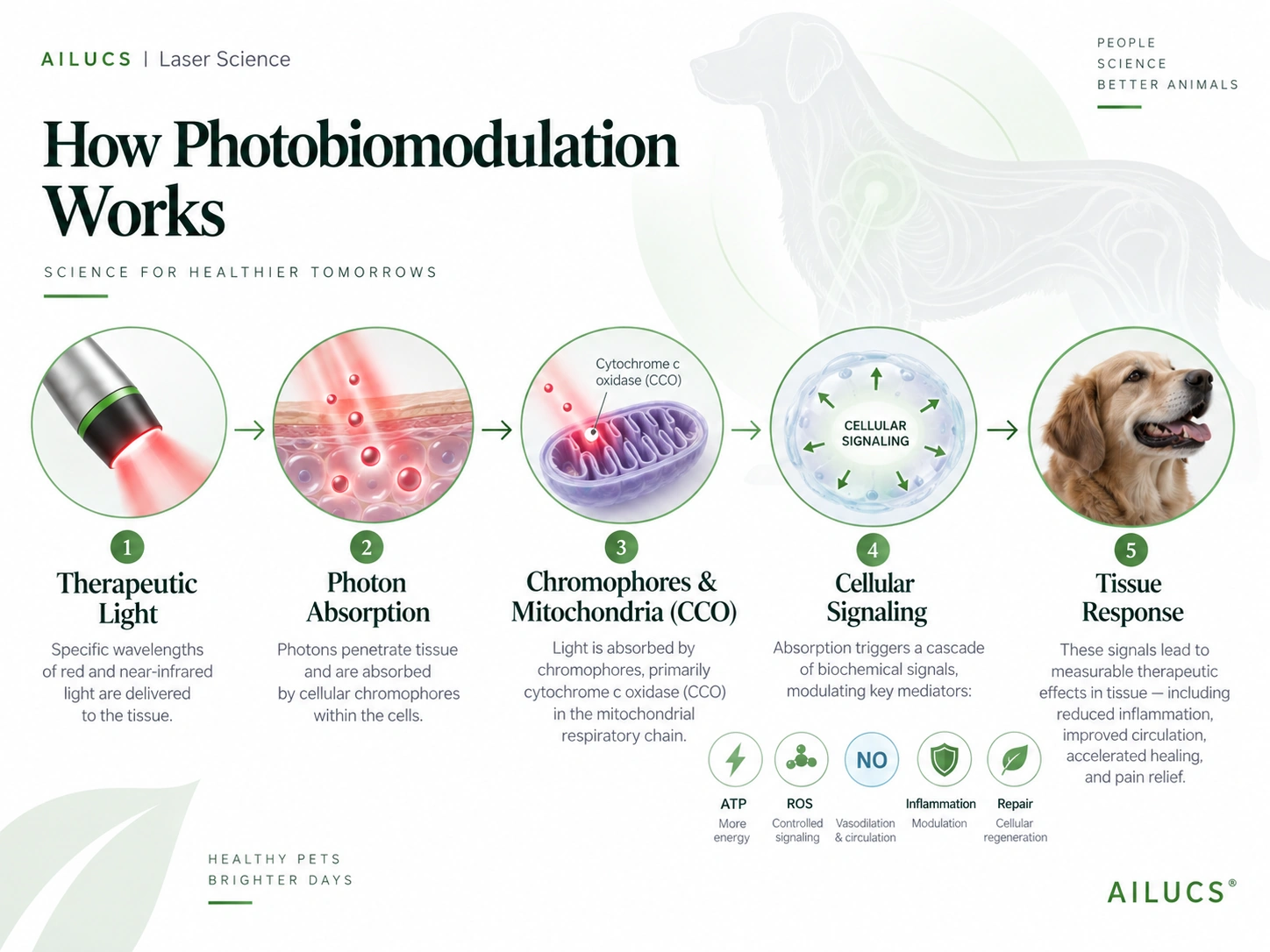
A simplified sequence is:
Therapeutic light
↓
Photon absorption
↓
Molecular and mitochondrial signaling
↓
Changes in cellular activity
↓
Potential tissue-level response
One of the most extensively studied areas involves mitochondrial activity, particularly pathways associated with cytochrome c oxidase (CCO).
CCO is part of the mitochondrial electron transport chain and has long been investigated as a potential photoreceptor for red and near-infrared light.
Research has proposed that light interaction with mitochondrial components may influence electron transport, mitochondrial membrane potential, cellular respiration, and downstream signaling.
However, PBM should not be reduced to one molecule or one biochemical pathway.
Other proposed mechanisms include light-sensitive ion channels, calcium signaling, reactive oxygen species, nitric oxide pathways, and changes in transcription factors.
The exact contribution of each mechanism may depend on wavelength, cell type, tissue condition, and treatment parameters.
What Role Do Mitochondria and ATP Play?
Mitochondria are responsible for much of the energy metabolism that supports cellular function.
One of the best-known hypotheses in PBM research is that photon absorption may influence mitochondrial activity and consequently affect the production or availability of adenosine triphosphate (ATP).
ATP supports many cellular processes, including:
Protein synthesis
Membrane transport
Cellular maintenance
Cell migration
Tissue remodeling
This provides one biological explanation for why photobiomodulation has been investigated in tissue recovery and rehabilitation.
But ATP is only part of the picture.
The often-used explanation “Laser → mitochondria → more ATP → faster healing” is too simplistic.
Changes in cellular metabolism can trigger secondary signaling events involving redox balance, nitric oxide, calcium signaling, gene expression, inflammatory pathways, and other cellular responses.
PBM is therefore better understood as a network of biological signaling processes rather than a simple energy boost.
Why Are ROS and Nitric Oxide Important?
Reactive Oxygen Species Signaling
Reactive oxygen species (ROS) are often associated with oxidative damage, but at controlled levels they also function as normal signaling molecules.
Transient changes in ROS may participate in cellular adaptation and regulation.
PBM research suggests that light exposure can influence redox signaling, which may subsequently affect transcription factors and processes related to cellular survival, migration, proliferation, and inflammatory regulation.
This does not mean that laser therapy simply “removes oxidative stress.” The response depends on the existing biological state of the cell and the amount of light delivered.
Nitric Oxide-Related Signaling
Nitric oxide (NO) participates in vascular regulation and numerous cellular signaling pathways.
Several PBM mechanisms involving nitric oxide have been proposed, including interactions between NO and mitochondrial components.
Changes in nitric oxide signaling may contribute to local vascular and cellular responses following light exposure.
However, it is more accurate to describe NO as one part of a broader signaling network rather than claim that PBM produces a single predictable vascular effect in every patient.
How May PBM Influence Inflammation and Tissue Repair?
Inflammation is an essential part of normal healing.
After tissue injury, inflammatory signaling helps coordinate immune activity, remove damaged material, and initiate repair. However, excessive or prolonged inflammation may contribute to pain, swelling, and delayed recovery.
PBM has been investigated for its ability to modulate inflammatory signaling.
Possible mechanisms include changes involving:
Pro-inflammatory and anti-inflammatory signaling
Oxidative stress
Cellular metabolism
Vascular responses
Cell migration
Protein expression
The important word is modulation.
Laser therapy should not be described as simply “turning inflammation off.” Suppressing all inflammatory activity would not necessarily be desirable because inflammation is part of normal tissue repair.
PBM has also been studied in relation to fibroblast activity, epithelial responses, collagen-related processes, cell migration, and tissue remodeling.
These biological findings help explain why laser therapy is being investigated in wound management and postoperative rehabilitation, but they should not be interpreted as proof that every wound or surgical patient will respond in the same way.
Clinical outcomes remain dependent on the patient, condition, treatment protocol, and quality of the available evidence.
Why Wavelength Matters in Veterinary Laser Therapy
Wavelength influences how light interacts with biological tissue.
Different wavelengths have different absorption and scattering characteristics. As a result, photons of different wavelengths may be distributed differently within tissue.
Red and near-infrared wavelengths are commonly used in photobiomodulation because they can interact with relevant biological chromophores while providing useful tissue penetration characteristics.
However, wavelength alone does not determine treatment depth or clinical outcome.
Light propagation is also influenced by:
Skin and coat characteristics
Melanin
Hemoglobin
Water content
Tissue composition
Treatment technique
Beam characteristics
It is therefore misleading to state that a specific wavelength automatically reaches a particular anatomical structure or guarantees a specific biological effect.
A more accurate relationship is:
Wavelength + Dose + Irradiance + Exposure Time + Treatment Area + Tissue Characteristics
All of these variables must be considered together.
Why Power Alone Does Not Define Laser Dose
Laser power is often used as a headline specification, particularly with Class IV veterinary laser systems.
But maximum wattage does not tell clinicians how much energy a tissue actually receives.
Power describes the rate at which energy is delivered.
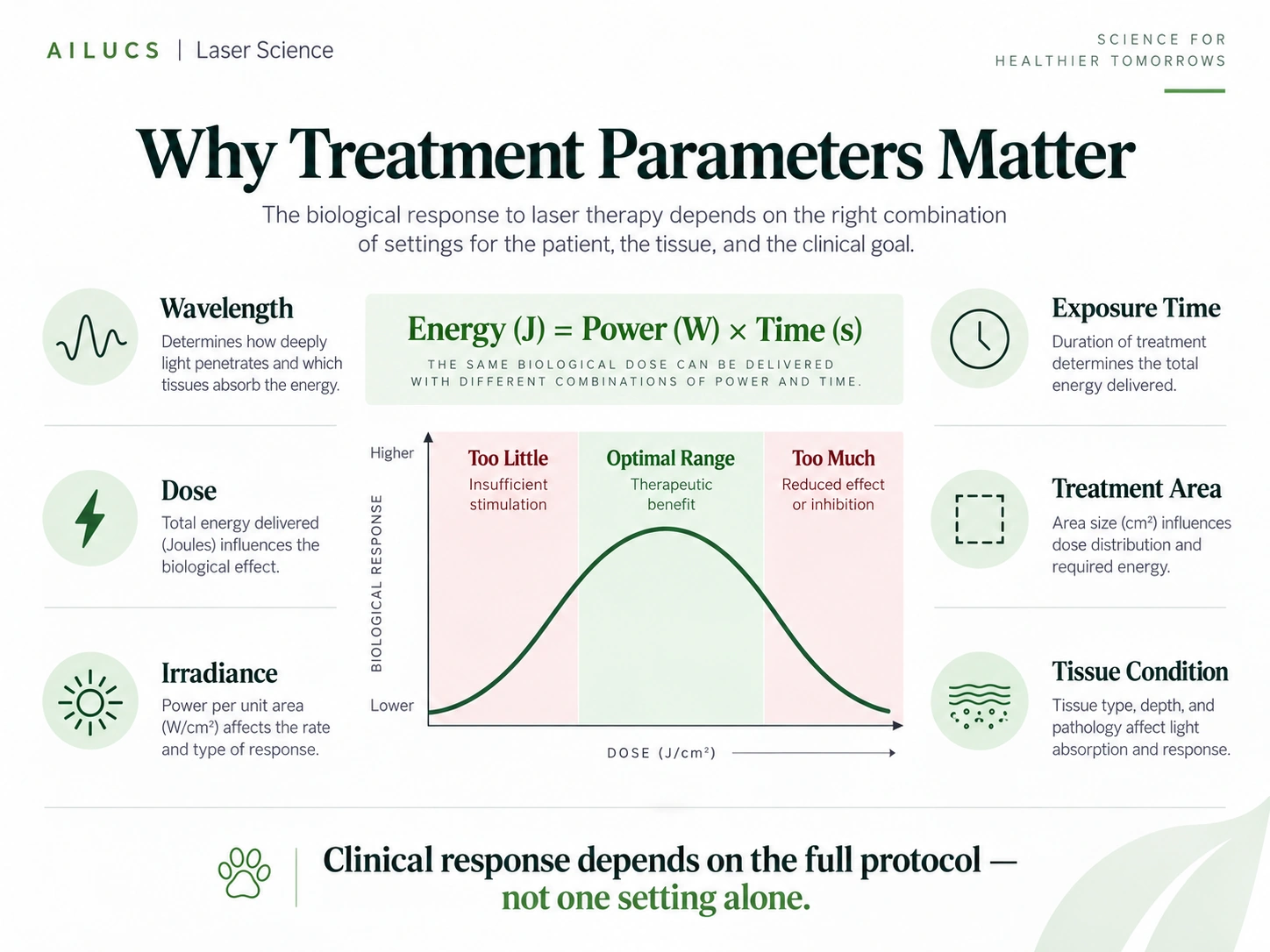
Energy (J) = Power (W) × Time (s)
For example, increasing treatment time while maintaining the same power increases the total energy delivered.
When treatment area is considered, clinicians may also evaluate radiant exposure, often expressed in J/cm².
Irradiance describes optical power distributed over an illuminated area and is commonly expressed in W/cm².
Two treatments using the same total energy may therefore produce different biological exposures if the spot size, treatment area, irradiance, movement technique, or exposure time differs.
This is why comparing veterinary laser systems only by maximum power can be misleading.
Power is important—but it is only one part of the treatment protocol.
Our guide to veterinary laser therapy dosage explains how power, treatment time and area relate to delivered energy.
What Is the Biphasic Dose Response?
One of the most important concepts in photobiomodulation is the biphasic dose response.
In simplified terms:
Insufficient exposure → limited response
Appropriate exposure → greater biological response
Excessive exposure → response may plateau or decrease
This challenges the assumption that more energy or higher power always produces a better biological effect.
The response can be affected by:
Wavelength
Irradiance
Fluence
Exposure time
Spot size
Total energy
Pulse characteristics
Treatment frequency
Tissue condition
For veterinary professionals, the practical lesson is straightforward:
More laser energy is not automatically better laser therapy.
The objective is to deliver an appropriate optical stimulus for the intended tissue and clinical goal.
Does Tissue Condition Affect the PBM Response?
Yes.
PBM is applied to living biological tissue, and the condition of that tissue influences how it responds.
Healthy tissue, acutely injured tissue, chronically inflamed tissue, postoperative tissue, and recovering tissue should not necessarily be expected to respond identically to the same laser exposure.
Relevant factors can include:
Tissue type
Tissue depth
Stage of healing
Degree of inflammation
Blood supply
Tissue optical properties
Treatment area
Patient size
Clinical objective
Species, coat characteristics, body size, anatomy, and individual patient variation can add another layer of complexity in veterinary medicine.
This helps explain why a treatment protocol used successfully in one patient should not automatically be transferred unchanged to another patient or condition.
Why Is There No Single “Best” Veterinary Laser Protocol?
Veterinary laser studies use widely varying protocols.
Research may differ in:
Wavelength
Output power
Irradiance
Energy density
Treatment duration
Treatment frequency
Treatment area
Continuous or pulsed emission
Application technique
A systematic review of veterinary laser therapy found substantial variation in treatment parameters and limitations in the available evidence.
For this reason, there is currently no universal setting that can be considered optimal for every animal, tissue, or clinical condition.
Veterinary professionals should evaluate the complete treatment protocol rather than focusing on one specification.
A practical sequence is:
1. Wavelength — Which wavelength or wavelength combination is appropriate for the intended tissue?
2. Dose — How much optical energy is intended to be delivered?
3. Irradiance — How concentrated is the optical power over the treatment area?
4. Treatment Time — How long will the selected exposure be delivered?
5. Treatment Area — Is treatment applied to a defined point, a larger field, or using a scanning technique?
6. Emission Mode — Is the energy delivered continuously or intermittently?
7. Patient Response — How does the individual patient tolerate and respond to treatment?
This final consideration is essential because laser parameters ultimately interact with biological tissue—not an abstract mathematical model.
Veterinary Applications: From Biological Mechanism to Clinical Use
Understanding PBM mechanisms helps explain why veterinary laser therapy has been investigated across several areas of clinical practice.
Musculoskeletal Rehabilitation
PBM is commonly studied and used as an adjunct in rehabilitation programs involving muscles, joints, tendons, and other soft tissues.
Potential biological targets include inflammatory signaling, local cellular metabolism, vascular signaling, and tissue remodeling.
Osteoarthritis and Pain Management
Laser therapy has also been investigated as part of multimodal management for animals with musculoskeletal discomfort and osteoarthritis.
Clinical outcomes may vary depending on the protocol, condition severity, outcome measure, and patient population.
PBM should therefore be viewed as one possible component of an overall treatment plan rather than a replacement for diagnosis or other indicated therapies.
Postoperative Rehabilitation
Following surgery, veterinary rehabilitation may focus on pain management, mobility, tissue recovery, and gradual return to function.
PBM may be incorporated into postoperative rehabilitation when appropriate, but treatment parameters and timing should reflect the surgical procedure, tissue condition, and individual patient.
Wound Management
Photobiomodulation has been investigated in relation to processes involved in wound repair, including cellular migration, fibroblast activity, inflammatory regulation, and tissue remodeling.
However, laser therapy does not replace essential wound management such as cleaning, infection control, surgical care, or other appropriate veterinary treatment.
Muscle, Tendon, and Ligament Recovery
Muscle recovery and connective tissue repair are additional areas of PBM research.
Because these tissues differ in depth, structure, vascular supply, and healing characteristics, the same protocol should not automatically be applied across all rehabilitation cases.
How Does PBM Relate to Multi-Wavelength Laser Therapy?
Multi-wavelength laser systems allow clinicians to work with more than one wavelength within the same platform.
Because wavelength influences photon absorption, scattering, and tissue distribution, different wavelengths may provide different optical characteristics.
A multi-wavelength system can therefore increase treatment flexibility when working with different anatomical targets and clinical objectives.
More wavelengths do not automatically mean better clinical outcomes.
The potential advantage is flexibility—not a guarantee of superior treatment.
Clinical decisions should still be based on the complete protocol, the target tissue, the individual patient, and the available evidence.
What Does the Current Evidence Tell Us?
The biological plausibility of photobiomodulation is supported by extensive laboratory and mechanistic research.
Research has investigated pathways involving:
Mitochondrial activity
Cytochrome c oxidase
ATP metabolism
Reactive oxygen species
Nitric oxide
Calcium signaling
Inflammatory regulation
Cellular proliferation and migration
However, biological plausibility and clinical effectiveness are not the same thing.
Veterinary clinical studies remain heterogeneous.
Different studies may use different devices, wavelengths, doses, treatment schedules, patient populations, application techniques, and outcome measures.
Therefore, evidence supporting one PBM protocol should not automatically be generalized to another.
A useful distinction for veterinary professionals is:
Biological mechanism explains how an intervention might work.
Clinical evidence determines whether a particular protocol produces meaningful outcomes in a particular patient population.
Both should be considered when interpreting veterinary laser therapy research.
Frequently Asked Questions
What is photobiomodulation?
Photobiomodulation is the use of non-ionizing light to influence biological processes in cells and tissues.
Is photobiomodulation the same as veterinary laser therapy?
Not exactly. PBM describes the biological process. Therapeutic laser systems are one technology used to deliver light capable of producing photobiomodulatory effects.
What is the main mechanism of PBM?
There is no single confirmed mechanism that explains every PBM response. Mitochondrial pathways, including mechanisms involving cytochrome c oxidase, are among the most extensively studied, while ROS, nitric oxide, calcium signaling, and other pathways may also contribute.
Does PBM only work by increasing ATP?
No. Changes in ATP metabolism represent only one proposed component. Redox signaling, nitric oxide pathways, inflammatory regulation, ion-channel activity, gene expression, and other cellular responses may also be involved.
Is higher laser power always better?
No. Power is only one treatment parameter. Wavelength, irradiance, treatment time, dose, area, application technique, and tissue condition must also be considered.
Does more energy produce a stronger biological response?
Not necessarily. PBM can demonstrate a biphasic dose response, meaning that increasing exposure beyond an appropriate range does not necessarily produce a greater response.
Is there one ideal PBM dose for all veterinary patients?
No. There is currently no universal dose applicable to every species, tissue, condition, and clinical objective.
Are multi-wavelength veterinary lasers automatically more effective?
No. Multiple wavelengths can provide greater treatment flexibility, but the number of wavelengths alone does not establish clinical superiority.
Conclusion
Photobiomodulation provides a scientific framework for understanding how therapeutic light may influence biological tissue in veterinary medicine.
Its biological effects cannot be reduced to a single pathway such as ATP production. Instead, PBM involves interactions between photons and tissue chromophores followed by mitochondrial, redox, nitric oxide, inflammatory, and other cellular signaling responses.
For veterinary laser therapy, the most important practical principle is that the complete treatment protocol matters.
Wavelength, power, dose, irradiance, exposure time, treatment area, emission mode, tissue characteristics, and patient condition should be considered together.
Understanding these relationships can help veterinary professionals interpret laser specifications, evaluate published research, and make more informed treatment decisions while avoiding the assumption that higher power, greater energy, or more wavelengths automatically produce better clinical results.
As research continues, better standardized reporting and veterinary-specific clinical studies will be essential for defining more consistent treatment protocols across species and conditions.
References
1. Zein R, Selting W, Hamblin MR. Review of light parameters and photobiomodulation efficacy: dive into complexity. Journal of Biomedical Optics. 2018;23(12):120901.
2. Hamblin MR. Mechanisms and Mitochondrial Redox Signaling in Photobiomodulation. Photochemistry and Photobiology. 2018;94(2):199–212.
3. de Freitas LF, Hamblin MR. Proposed Mechanisms of Photobiomodulation or Low-Level Light Therapy. IEEE Journal of Selected Topics in Quantum Electronics. 2016;22(3):7000417.
4. Hamblin MR. Mechanisms and applications of the anti-inflammatory effects of photobiomodulation. AIMS Biophysics. 2017;4(3):337–361.
5. Millis DL, Bergh A. A Systematic Literature Review of Complementary and Alternative Veterinary Medicine: Laser Therapy. Animals. 2023;13(4):667.