
Veterinary Laser Therapy vs. Acupuncture: Which Is Better for Pets?
Introduction
As complementary and rehabilitative therapies become increasingly integrated into veterinary medicine, pet owners are often faced with an important question: Should I choose laser therapy or acupuncture for my pet?
Both therapies are widely used to support pain management, improve mobility, and enhance recovery in dogs, cats, and horses. While they are sometimes viewed as competing options, they are based on different therapeutic principles and often serve different clinical purposes.
Neither therapy is universally better. Laser therapy is generally selected to support localized tissue recovery and musculoskeletal rehabilitation, while acupuncture may be considered as an adjunct for pain modulation and selected neurological or neuromuscular cases. In selected cases, both may be included in the same multimodal plan when they address different clinical goals.
Common Conditions Treated
Both therapies are used across a broad range of veterinary conditions, although their strengths differ depending on the underlying pathology.
Veterinary laser therapy is commonly incorporated into treatment plans for:
· Osteoarthritis
· Soft tissue injuries
· Tendon and ligament disorders
· Postoperative rehabilitation
· Wound healing
· Muscle strain
· Chronic inflammatory conditions
Veterinary acupuncture may be considered for:
· Selected neurological rehabilitation cases, including intervertebral disc disease (IVDD)
· Chronic or neuropathic pain management
· Postoperative pain support
· Muscle tension and neuromuscular dysfunction
· Patients who may benefit from an individualized multimodal rehabilitation plan
The strength of evidence varies by condition. Acupuncture should therefore be selected following an individual veterinary assessment rather than presented as a standard treatment for every neurological, gastrointestinal, urinary, or stress-related disorder.
Why Veterinary Laser Therapy?
Therapeutic laser treatment uses photobiomodulation (PBM), in which applied light may influence mitochondrial activity and cellular signaling associated with inflammation, circulation, and tissue repair. The biological response depends on factors such as laser wavelength and treatment dose, tissue characteristics, and the condition being treated.
When applied using appropriate treatment parameters, laser therapy may help:
· Reduce inflammation
· Relieve musculoskeletal pain
· Improve local circulation
· Accelerate tissue healing
· Promote collagen synthesis
· Support postoperative recovery
Because laser therapy is non-invasive and generally well tolerated, it is commonly used in rehabilitation programs for orthopedic surgery, sports injuries, and chronic degenerative joint disease.
How Veterinary Acupuncture Works
Veterinary acupuncture involves inserting fine, sterile needles into selected anatomical points to stimulate sensory nerves and physiological responses.
Proposed mechanisms include:
· Stimulation of peripheral sensory nerves
· Modulation of spinal and central pain pathways
· Release of endogenous pain-modulating substances
· Changes in muscle tension
· Neuromuscular regulation
Unlike laser therapy, which delivers light energy to a defined treatment area, acupuncture primarily aims to influence sensory, neurological, and neuromuscular responses. Its effectiveness can vary according to the condition, technique, practitioner, and individual patient.
Acupuncture should be considered an adjunctive therapy and should not replace appropriate diagnosis, medication, surgery, or structured rehabilitation when these treatments are clinically indicated.
Treatment Comparison
Although both therapies aim to improve patient comfort and function, their clinical applications are not identical.
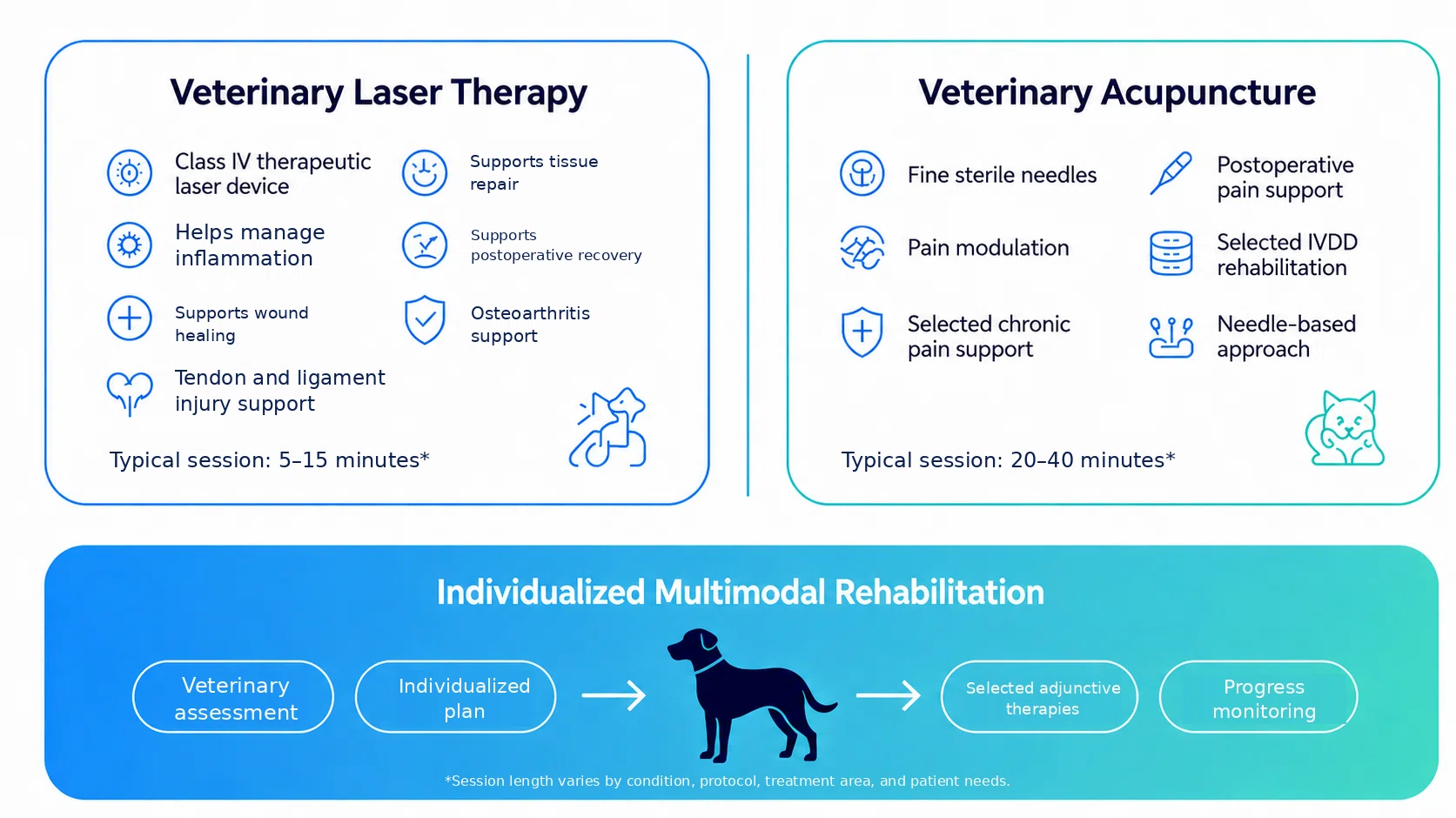
| Clinical Factor | Laser Therapy | Acupuncture |
| Primary Action | Tissue repair and inflammation control | Sensory nerve stimulation and pain modulation |
| Common Applications | Soft tissue injuries, postoperative recovery, osteoarthriti | Selected chronic or neuropathic pain, postoperative pain support, and selected IVDD rehabilitation |
| Patient Experience | Non-invasive, no needles | Fine sterile needle insertion; patient tolerance varies |
| Treatment Time | Usually 5–15 minutes | Typically 20–40 minutes |
| Common Role | Rehabilitation and wound healing | Adjunctive pain modulation and selected neurological rehabilitation |
Selection should always be based on an individual veterinary assessment rather than assuming one therapy is superior in all situations.
Clinical Evidence
Clinical evidence supports the use of both laser therapy and acupuncture for selected veterinary indications, although the strength and consistency of evidence vary by condition.
Controlled studies of photobiomodulation have reported reduced pain and improved function in some dogs with osteoarthritis. However, outcomes depend on treatment parameters, diagnosis, and patient selection.
Evidence for veterinary acupuncture remains more limited and mixed. Clinical guidelines describe acupuncture as a possible adjunct for postoperative pain and selected neurological rehabilitation cases, including IVDD. However, evidence does not support presenting acupuncture as consistently effective for every chronic pain, gastrointestinal, urinary, or stress-related condition.
Current evidence does not establish either therapy as universally superior. Both should be selected on a case-by-case basis and incorporated into a broader veterinary treatment plan when appropriate.
Can Laser Therapy and Acupuncture Be Combined?
Yes. Laser therapy and acupuncture may be included in the same multimodal rehabilitation plan when they address different clinical goals.
A veterinarian may recommend combining both therapies for patients with:
· Chronic pain with both localized tissue inflammation and neuropathic features
· Selected intervertebral disc disease rehabilitation cases
· Postoperative rehabilitation involving different tissue-healing and pain-management goals
· Senior pets with multiple rehabilitation needs
· Long-term multimodal pain-management programs
Laser therapy may be used to support local tissue healing, inflammation management, and musculoskeletal recovery, while acupuncture may be considered for pain modulation and selected neurological or neuromuscular rehabilitation needs.
However, combining the two therapies does not automatically produce better results than using one therapy alone. The decision should be based on diagnosis, treatment response, patient tolerance, and veterinary assessment.
FAQs
Which treatment is better for arthritis?
Laser therapy has controlled clinical evidence supporting its use in selected dogs with osteoarthritis. Acupuncture may also be considered as an adjunctive option, although veterinary evidence for osteoarthritis is mixed. Neither therapy should replace established arthritis management measures such as weight management, appropriate medication, controlled exercise, and veterinary monitoring.
Can laser therapy and acupuncture be performed on the same day?
In selected cases, both therapies may be performed during the same rehabilitation visit. The decision and treatment sequence should be determined by the veterinarian based on the diagnosis, patient tolerance, and overall treatment plan.
Which therapy is better for IVDD?
Acupuncture has been reported as a possible adjunct in rehabilitation plans for selected dogs with IVDD. Laser therapy may also be incorporated to support pain management and recovery of affected tissues. Neither therapy replaces neurological assessment, diagnostic imaging, surgery when indicated, or a structured rehabilitation program.
Is laser therapy less stressful than acupuncture?
Many pets tolerate laser therapy well because it is non-invasive. Acupuncture requires needle insertion, which some animals may find less comfortable, although many adapt well when treatment is performed by trained veterinary professionals. Patient temperament and handling needs should guide selection.
How do veterinarians decide which therapy to use?
Treatment selection is based on diagnosis, tissue involved, disease stage, patient temperament, medical history, and rehabilitation objectives rather than a one-size-fits-all approach.
Conclusion
Veterinary laser therapy and acupuncture should not be viewed as universally competing treatments. They are different tools that may be used individually or together within modern veterinary rehabilitation.
Laser therapy primarily supports local tissue repair, inflammation management, and musculoskeletal recovery, whereas acupuncture may be considered for pain modulation and selected neurological or neuromuscular rehabilitation needs. Selecting the most appropriate therapy depends on the patient's diagnosis, treatment goals, tolerance, and response. Combining both approaches may be appropriate in selected cases, but is not automatically superior to using one modality alone.
Working with a veterinarian trained in rehabilitation medicine can help ensure that treatment decisions are evidence-informed, individualized, and aligned with the pet's long-term recovery goals.
AILUCS Veterinary Laser Systems
AILUCS develops Class IV veterinary laser systems for companion animal and equine applications. Designed to support precise energy delivery and flexible treatment planning, these systems can be integrated into veterinarian-directed rehabilitation programs for pain management, postoperative recovery, and soft tissue healing.
To learn more about incorporating veterinary laser therapy into a multimodal rehabilitation workflow, contact AILUCS.
References
1. American Animal Hospital Association (AAHA). Pain Management Guidelines for Dogs and Cats. Clinical reference for multimodal pain management and individualized treatment planning.
2. PubMed-indexed studies on photobiomodulation therapy in canine osteoarthritis and veterinary rehabilitation. Evidence has reported improvements in pain management and functional outcomes in selected patients.
3. PubMed-indexed veterinary acupuncture literature regarding adjunctive use in selected pain and neurological rehabilitation cases.
4. World Association for Laser Therapy (WALT). Evidence-based guidance on photobiomodulation therapy principles and clinical application.