When Acupuncture Meets Laser: A Pain-Free Treatment Option for Cats
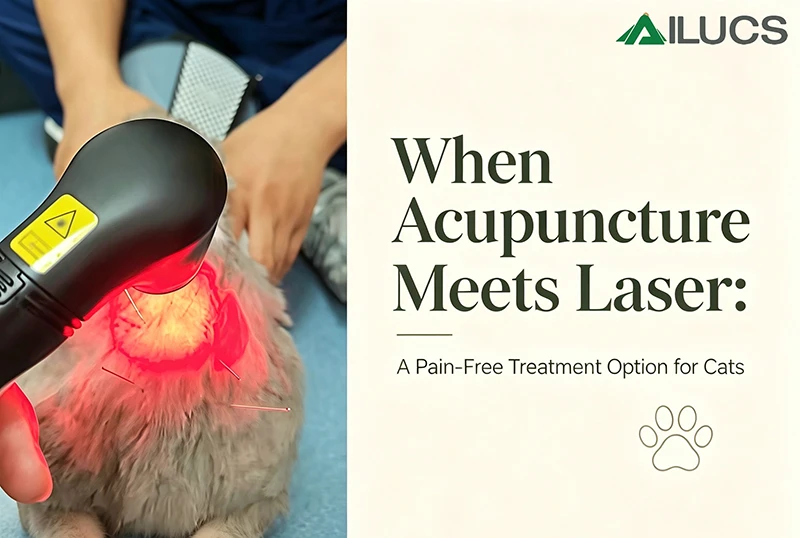
In recent years, Traditional Chinese Veterinary Medicine (TCVM) has gained rapid attention in the field of pet rehabilitation. Many owners of cats and dogs suffering from spinal disorders, hind limb paralysis, or mobility issues choose acupuncture and laser therapy as supportive treatment options. At the same time, many pet parents may still wonder: Is acupuncture for cats really effective? Does laser therapy work? Today, AILUCS Laser invites you to learn more about these two popular therapies.
A Healing Method Passed Down for Thousands of Years
TCVM acupuncture has a history of thousands of years and can be traced back to ancient China’s treatment practices for livestock diseases. After long-term development, acupuncture has become an important therapeutic method within the TCVM system.
According to TCVM theory, disease is related to imbalances in the flow of "Qi" and blood within the body. Meridians on the body surface are considered pathways through which "Qi" and blood circulate, while acupoints are key locations used to regulate bodily functions. By stimulating specific acupoints with needles, acupuncture may help unblock meridians, balance "Qi" and blood, and promote the body’s natural healing ability, thereby assisting in the management of pain, paralysis, and chronic conditions.
Non-Invasive and Efficient Laser Therapy
Laser therapy is a modern technology that has emerged in recent decades. It uses specific wavelengths of light to penetrate tissues and, under non-thermal or mild thermal conditions, stimulates biological responses at the cellular level, promoting the body’s natural repair processes.
Acupoints in Cats and Dogs Differ from Humans, but Follow Recognizable Patterns
The distribution of acupoints in cats and dogs is not exactly the same as in humans, so the human acupuncture system cannot simply be copied. Current standards mainly apply to equine animals, and there is still no fully unified standard for dogs and cats. However, after years of clinical practice, the veterinary field has developed a relatively mature consensus for practical application.
For example, in cats, points such as Zanzhu, Taiyang, and Chengqi are commonly used to help relieve eye discomfort. For dogs with hind limb weakness, paralysis, or mobility disorders, points such as Baihui, Hou San Li, and Yanglingquan are often selected for treatment.
Although acupuncture has strong supportive therapeutic value, it is not suitable for every case. Some cats are naturally sensitive or timid and may become stressed during treatment, so careful evaluation by a professional veterinarian is necessary. In cases of acute trauma or severe infection, conventional Western veterinary treatment should be prioritized.
However, acupuncture is widely used for the following conditions:
Joint Conditions: joint pain, arthritis, reduced mobility, or stiffness in senior pets
Spinal Conditions: disc problems, hind limb weakness, mild paralysis, difficulty walking
Post-Surgical Recovery: post-operative rehabilitation, supportive nerve recovery
Chronic Conditions: chronic kidney disease, digestive discomfort, stress management
Pain Management: chronic pain, lethargy, reduced activity
Laser Therapy: A Needle-Free Acupuncture Alternative
Laser therapy is not a replacement for acupuncture, but an extension of traditional treatment methods. It uses focused light to mimic the precise stimulation of acupuncture needles, while its gentle warming effect resembles the therapeutic warming action of moxibustion. For this reason, it is often called “needle-free acupuncture.”
In clinical practice, laser therapy is often precisely applied to specific acupoints (such as Shenshu and Zusanli) and combined with electroacupuncture to enhance neurological regulation. This creates a dual-modality treatment approach of “acupuncture + laser therapy,” providing pets with a more comfortable and efficient rehabilitation experience.
Many laser therapy devices on the market now include dedicated acupuncture settings, such as the LYRA Laser Therapy System.
Powerful Combination: The Synergistic Effect of Acupuncture and Laser Therapy
Traditional Chinese veterinary acupuncture and laser therapy represent the fusion of ancient wisdom and modern technology. Acupuncture focuses on whole-body balance, pattern-based diagnosis, and long-term regulation, while laser therapy excels in precise targeting and rapid response. Today, more and more pet rehabilitation centers are adopting an integrated treatment approach, combining both methods to provide more comprehensive recovery solutions for pets.
At present, some professional institutions have gradually established standardized protocols such as: assessment and diagnosis → acupuncture treatment → laser therapy enhancement, addressing both overall recovery and localized healing.
Why Does “Acupuncture + Laser Therapy” Work Better?
In clinical practice, combining these two methods often creates a 1 + 1 > 2 synergistic effect.
Laser Therapy as a “Warm-Up” for Acupuncture
Applying laser therapy to painful or tense areas before acupuncture can help relax muscles, relieve localized discomfort, and make pets more receptive to needle treatment, while improving overall comfort.
Laser Therapy Enhances Acupuncture Results
After acupuncture, laser treatment can be applied to the same acupoints or surrounding areas to provide continued stimulation, helping prolong therapeutic effects and improve rehabilitation outcomes.
Comprehensive, Multi-Level Support
Acupuncture is especially effective for whole-body regulation, neurological recovery, and deeper functional issues. Laser therapy performs particularly well in localized anti-inflammatory treatment, pain relief, and superficial tissue repair. Together, they provide a more complete treatment approach—from systemic balance to local healing, and from meridian theory to cellular response.
Choosing a Treatment Provider Carefully
Seek a Professional Veterinary Team
Animal acupuncture and laser therapy are professional medical procedures and should only be performed by licensed veterinarians with proper training and qualifications. Accurate diagnosis, appropriate acupoint selection, and correct treatment settings are essential for successful outcomes.
Value Treatment Planning
These therapies usually require a structured treatment course. Acute conditions may improve after several sessions, while chronic problems often need longer-term management, such as 1–2 sessions per week for 4–6 weeks, followed by a maintenance phase depending on recovery progress.
Keep Safety and Progress Records
Before treatment, provide the veterinarian with your pet’s complete medical history. During treatment, it is helpful to record changes in your pet’s mood, activity level, gait, and pain signs, as these are important indicators for evaluating progress.
Conclusion
The combination of traditional acupuncture and modern veterinary laser therapy represents a new direction in Traditional Chinese Veterinary Medicine. Together, they offer pets gentler and more diverse rehabilitation options, helping reduce reliance on medication, stimulate the body’s natural healing ability, and allow our furry companions to enjoy a healthier, higher-quality life with little or no pain.