
High-Power Laser Therapy: Enhancing Post-Surgical Healing in Animals
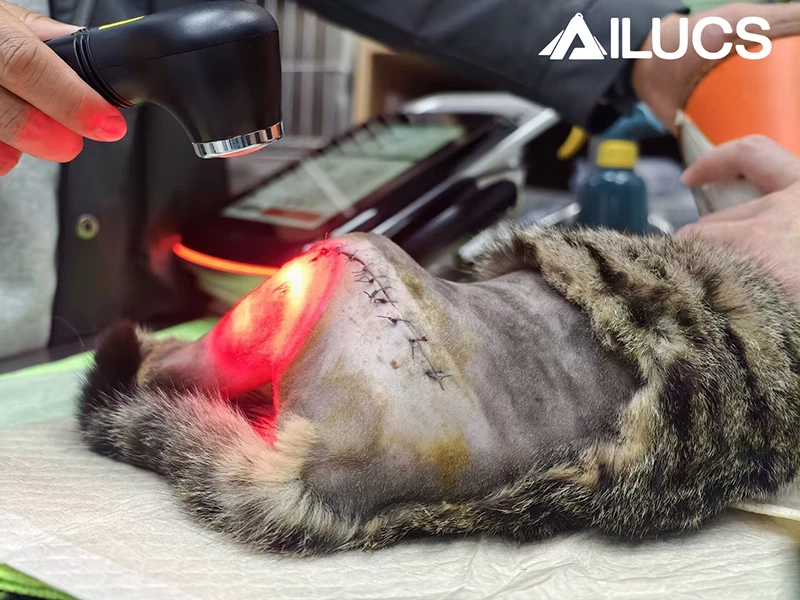
How High-Power Laser Therapy Accelerates Recovery
Post-surgical wound healing complications in animals occur in approximately 18%–22% of cases, particularly in complex procedures such as orthopedic and abdominal surgeries. Factors such as deep tissue trauma, poor local blood circulation, and licking behavior can significantly delay healing and increase the risk of infection.
High-power laser therapy (Class IV Laser Therapy) has emerged as a safe, non-invasive solution for improving post-operative recovery. Through the mechanism of photobiomodulation, specific wavelengths of laser light penetrate tissue and stimulate cellular activity, promoting faster and more efficient healing.
How Laser Therapy Supports Wound Healing
Laser therapy works by delivering light energy into tissues, where it is absorbed by cellular components such as mitochondria. This process:
Enhances ATP production and cellular metabolism
Promotes angiogenesis (new blood vessel formation)
Improves local blood circulation
Reduces inflammation, swelling, and exudation
The non-contact treatment approach also minimizes stress in animals, making it especially suitable for post-surgical patients that are weak or less cooperative.
Clinical observations show that laser therapy can:
Significantly accelerate wound healing time
Reduce scar formation
Lower the risk of post-surgical infection
Indications for Laser Therapy in Veterinary Wound Healing
1. Superficial Incisions
Superficial wounds affect the epidermis and parts of the dermis, including structures such as hair follicles and glands.
Laser therapy helps:
Stimulate epithelial cell proliferation
Promote collagen synthesis
This can lead to faster healing and improved cosmetic outcomes compared to conventional care.
2. Deep Tissue Incisions
Deep surgical wounds involve subcutaneous tissue, blood vessels, nerves, and even muscles or fascia, making recovery more complex.
Laser therapy can:
Improve local circulation
Reduce inflammatory response
Promote granulation tissue formation
These effects help enhance tissue strength and reduce the risk of complications during healing.
3. Chronic or Non-Healing Wounds
Chronic wounds are often characterized by persistent inflammation, exudation, infection, or tissue necrosis.
Laser therapy helps by:
Reducing pain and inflammation
Improving the wound healing environment
Enhancing cellular repair capacity
It may also help reduce reliance on antibiotics and lower the risk of recurrence when used as part of a comprehensive treatment plan.
Laser Therapy Techniques
Common therapeutic techniques include:
Cross pattern
Circular motion
Zigzag motion
Linear scanning
Treatment is performed in a non-contact manner, with the laser probe held perpendicular to the skin and moved slowly along the incision.
During treatment:
Monitor the animal’s response closely
Adjust power or pause if discomfort occurs
Avoid excessive heat buildup by controlling speed and distance
Proper technique ensures both safety and optimal clinical outcomes.
Mechanism of Action: Photobiomodulation
The therapeutic effects of laser therapy are based on photobiomodulation (PBM).
Laser energy is absorbed by:
Cytochrome c oxidase (CCO) in mitochondria
Light-sensitive proteins in cell membranes
Ion channels and growth factors
This triggers a cascade of biological responses that result in:
Pain relief
Anti-inflammatory effects
Accelerated tissue repair
Additionally, laser therapy can modulate nerve activity by:
Reducing nerve conduction velocity
Decreasing pain-related neurotransmitters (such as Substance P)
Increasing endorphins and serotonin levels
These effects contribute to effective pain management in post-surgical animals.
The Future of Veterinary Laser Therapy
With ongoing advancements in medical technology, modern laser systems now feature intelligent control, precise targeting, and optimized energy delivery. These innovations continue to expand the clinical potential of laser therapy in veterinary medicine.
As a safe, efficient, and non-invasive modality, high-power laser therapy is becoming an essential tool for improving post-surgical recovery, enhancing treatment outcomes, and supporting faster return to normal activity.