
LED vs. Laser Therapy for Pets: Photobiomodulation Differences
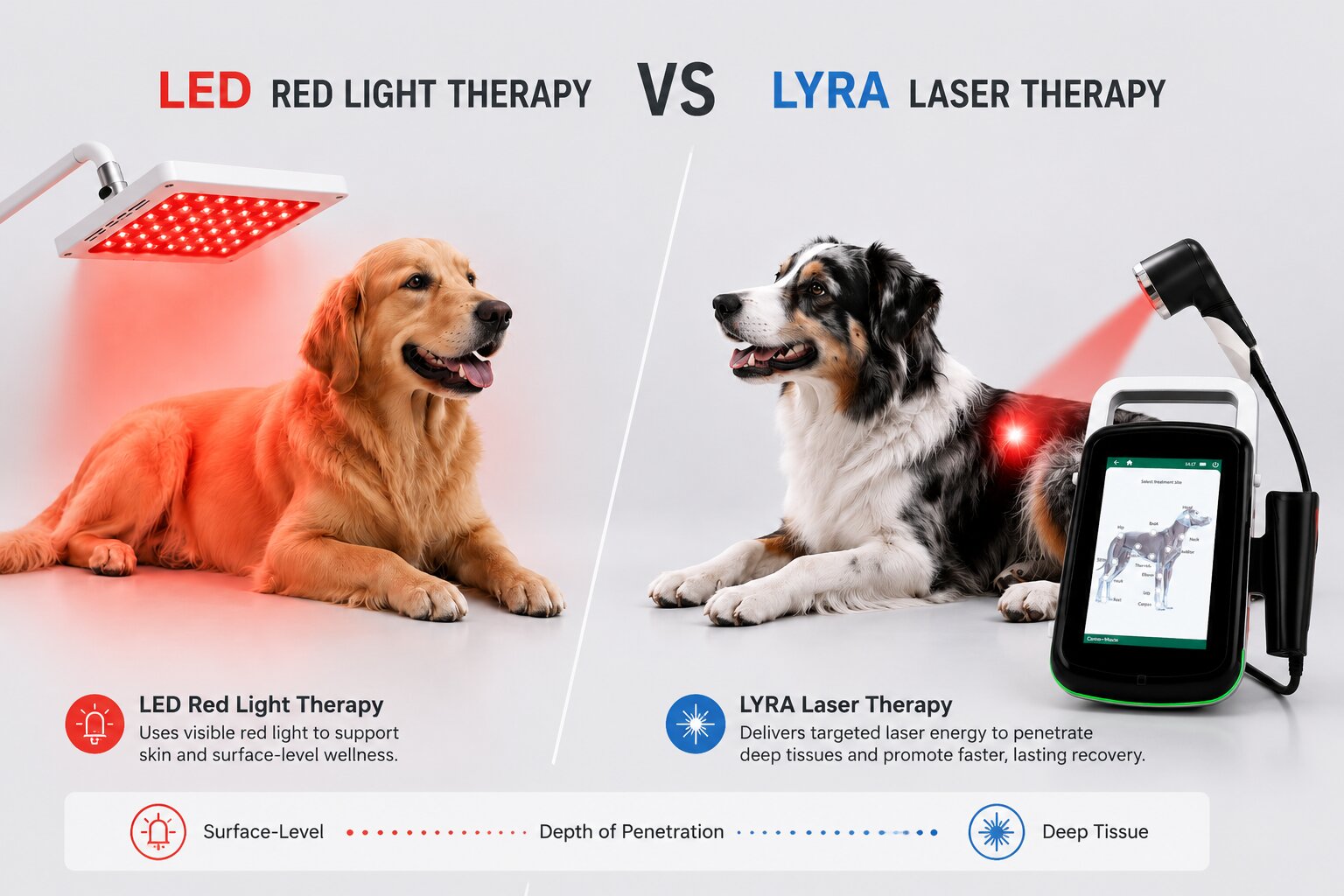
In recent years, Photobiomodulation (PBM) technology has become increasingly popular in veterinary medicine, rehabilitation therapy, and sports recovery. As more pet owners and veterinary professionals explore light-based therapies, one common question continues to arise:
What is the difference between LED therapy and laser therapy, and which treatment is better for pets?
In fact, both technologies belong to PBM (Photobiomodulation) and work by using specific wavelengths of light to stimulate cellular activity, increase ATP production, improve circulation, and accelerate tissue repair. However, there are significant differences between the two in terms of energy delivery, penetration depth, treatment efficiency, and clinical applications.
In this article, we’ll explore the key differences between LED therapy and laser therapy, and help you understand which option may be more suitable for different veterinary treatment needs.
What Is LED Therapy?
LED therapy (LED Light Therapy) typically uses:
630nm–660nm red light
810nm–850nm near-infrared light
to irradiate the skin and superficial tissues.
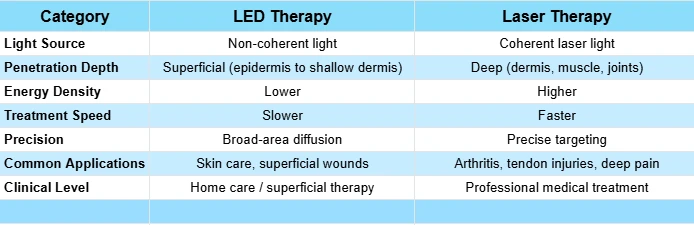
Because LED light is highly divergent, it can cover a larger treatment area. This makes LED therapy particularly suitable for superficial tissue care, including skin conditions, surface inflammation, small wounds, and post-surgical superficial recovery.
In pet care, LED therapy is commonly used for mild skin irritation, superficial wound healing, and general wellness or relaxation support.
Compared to laser therapy, LED devices usually operate at a lower power density. As a result, treatments tend to feel gentler, generate less heat, and offer a high level of safety. However, lower energy output also means that light energy is more easily scattered within superficial tissues, limiting its ability to reach deeper muscles, ligaments, or joints. Therefore, its effectiveness for deep pain or chronic musculoskeletal injuries is relatively limited.
For this reason, LED therapy is generally considered more suitable for superficial care and long-term maintenance, especially in mild or routine wellness applications.
What Is Laser Therapy?
Unlike LED therapy, laser therapy uses highly directional, high-energy-density laser beams to deliver light energy more precisely into deeper tissues.
Common wavelengths used in veterinary laser therapy include:
650nm / 810nm / 915nm / 980nm / 1064nm
Laser therapy is now widely used in veterinary clinics, rehabilitation centers, pain management programs, and equine therapy.
One of the biggest advantages of laser therapy is its superior tissue penetration. Laser energy can more effectively reach deep muscles, ligaments, tendons, joints, and nerve tissues.
Another major advantage is treatment efficiency. Laser systems can deliver higher doses of energy within a shorter period of time, resulting in faster therapeutic response and shorter treatment sessions. This is especially important in veterinary applications, as animals often struggle to remain still for long periods. Shorter treatment times can improve patient compliance and increase clinical efficiency.
In addition, laser therapy allows more precise targeting of affected areas, making it highly effective for conditions such as arthritis, hip dysplasia, tendon injuries, deep inflammation, and neuropathic pain.
How Should You Choose Between LED and Laser Therapy for Pets?
If a pet primarily suffers from superficial skin conditions, minor wounds, mild inflammation, or requires general wellness support, LED therapy is often sufficient.
However, for pets dealing with arthritis, muscle strain, ligament injuries, chronic pain, deep inflammation, or sports-related injuries, high-power laser therapy typically provides greater therapeutic advantages.
For large dogs, working dogs, senior pets, racehorses, and highly active animals, deeper penetration and higher treatment efficiency are often critical factors in achieving better recovery outcomes.
Conclusion
LED therapy and laser therapy are not competitors that replace one another — they simply serve different clinical purposes.
LED therapy is more suitable for superficial care and daily wellness support.
Laser therapy offers stronger advantages in deep tissue repair, chronic pain management, and professional veterinary rehabilitation.
Ultimately, the best treatment choice depends on the pet’s specific condition, tissue depth involved, and clinical goals. Veterinary evaluation and professional guidance should always be considered when selecting an appropriate photobiomodulation therapy approach.