
High-Intensity Laser Therapy for Cervical Radiculopathy
Bottom line
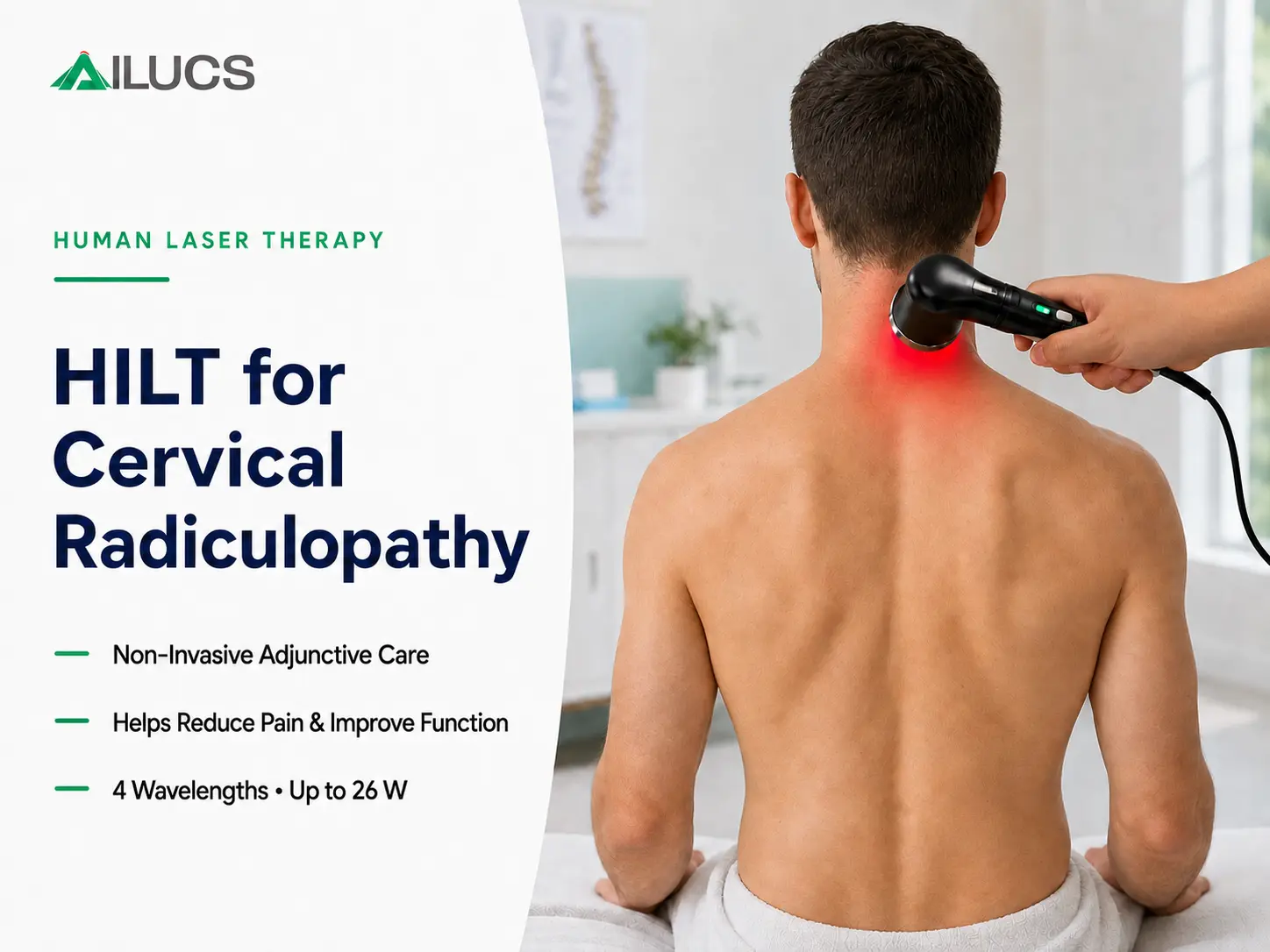
Current clinical evidence supports HILT as an adjunct to exercise-based rehabilitation or multimodal physical therapy to help improve pain and function in cervical radiculopathy. Its clinical value lies in providing a flexible tool for energy delivery, not in replacing appropriate diagnosis, neurologic assessment, or evaluation of surgical indications.
Key Takeaways
• Cervical radiculopathy involves irritation or compression of a cervical nerve root, often causing symptoms that radiate into the shoulder, arm, or hand.
• HILT appears most useful when combined with exercise or conventional physical therapy rather than used as a stand-alone intervention.
• LYRA combines 650, 810, 915, and 1064 nm wavelengths with up to 26 W maximum combined output, supporting flexible parameter selection across different treatment targets.
What Is Cervical Radiculopathy?
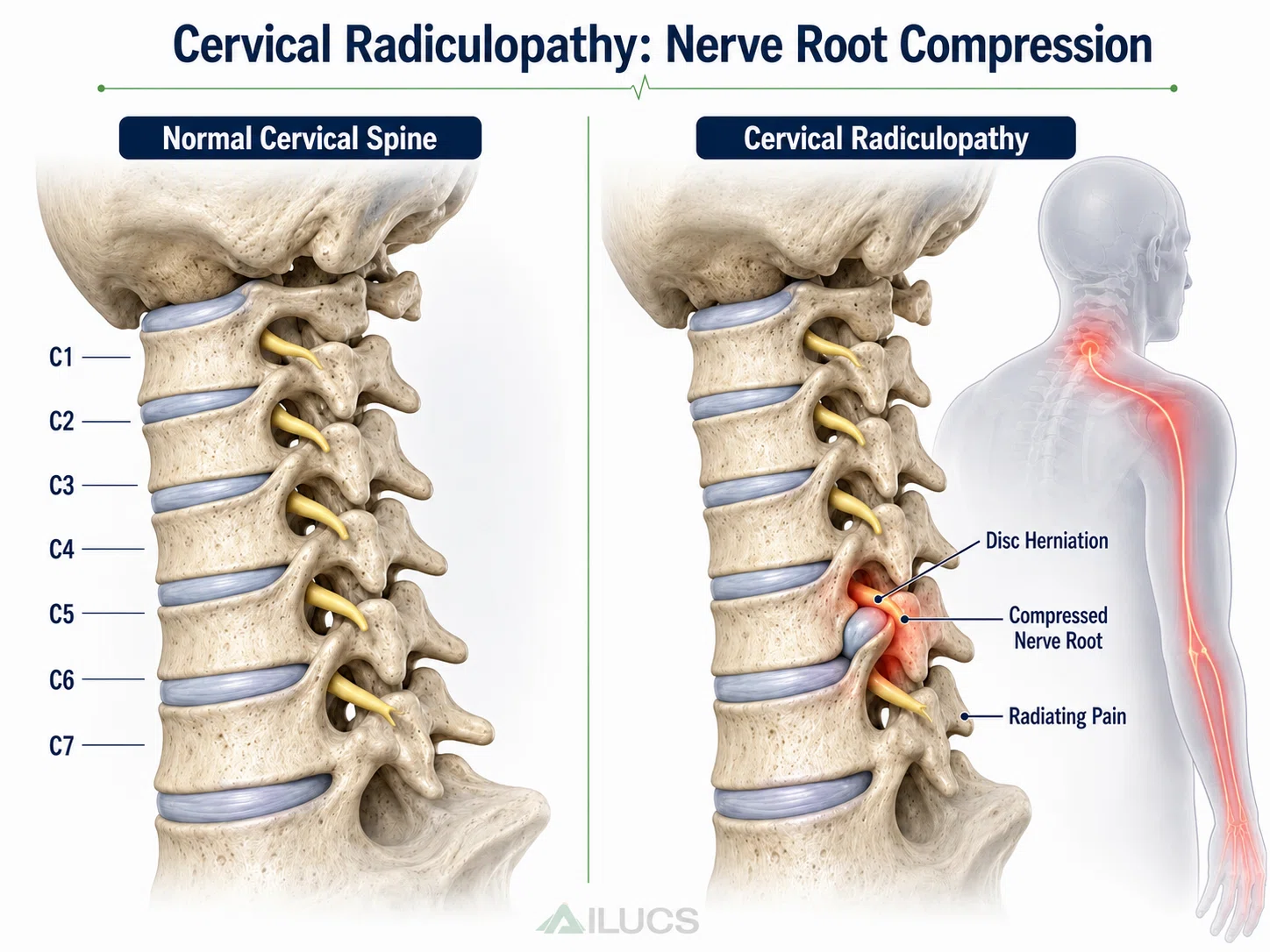
Cervical radiculopathy is a clinical syndrome caused by irritation or compression of a cervical nerve root. Common causes include cervical disc degeneration or herniation, osteophytes arising from the uncovertebral or facet joints, and narrowing of the neural foramen. Patients may experience neck, shoulder, or arm pain; numbness; sensory changes; or muscle weakness.
It differs from uncomplicated neck pain. When a nerve root is involved, symptoms typically radiate along a particular region of the upper limb and may be accompanied by changes in strength, sensation, or deep tendon reflexes. Central canal stenosis raises concern for spinal cord compression and should not be treated as synonymous with radiculopathy.
Common Causes and Contributing Factors
• Cervical disc degeneration or herniation: As a disc loses water content and elasticity, a bulge or herniation may irritate an adjacent nerve root.
• Neural foraminal stenosis: Osteophytes, degenerative joint changes, and loss of disc height can reduce the space available for a nerve root.
• Repetitive loading and postural factors: Prolonged neck flexion, sustained sitting, and limited endurance of the neck and shoulder-girdle muscles may increase mechanical load. However, posture alone is not sufficient to diagnose cervical radiculopathy.
• Trauma or acute injury: Motor vehicle collisions, falls, and sports injuries may cause disc injury, fracture, or soft-tissue damage. Assessment should reflect the mechanism of injury.
Typical Symptoms and Red Flags
• Neck pain, stiffness, or limited range of motion.
• Pain, numbness, tingling, or burning that radiates from the neck or scapular region into the arm, forearm, or fingers.
• Reduced grip strength, a sense of heaviness in the arm, or weakness in a specific muscle group.
• Radiating symptoms that worsen with coughing, sneezing, or certain neck positions.
Seek prompt medical attention
Patients with progressive muscle weakness, marked muscle atrophy, loss of hand dexterity, gait instability, bilateral lower-extremity symptoms, bowel or bladder dysfunction, severe pain after significant trauma, fever, or a history of cancer should receive further medical evaluation before proceeding with routine physical therapy.
How Is Cervical Radiculopathy Diagnosed?
Diagnosis requires a combination of medical history, symptom distribution, neurologic examination, and imaging when indicated. Clinicians typically assess muscle strength, sensation, deep tendon reflexes, and cervical range of motion. Provocative tests such as the Spurling test and upper limb neural tension tests may support clinical reasoning, but no single positive test can establish the diagnosis on its own.
Plain radiographs can show cervical alignment and obvious degenerative changes, while MRI is better suited to evaluating discs, nerve roots, and the spinal cord. Because imaging abnormalities may also occur in people without symptoms, findings must be correlated with the clinical pattern and neurologic signs. Electrodiagnostic testing or specialist evaluation may be considered when the diagnosis remains uncertain, symptoms persist, or neurologic impairment is present.
Common Nonsurgical Treatments
Most patients without progressive neurologic impairment can begin with individualized nonsurgical care. The goals are to control pain, restore movement, improve neck and shoulder-girdle endurance, and support a gradual return to work, exercise, and daily activities. Common components include:
• Activity and education: Avoid prolonged complete immobilization. Maintain daily activity as tolerated and reduce sustained neck flexion or fixed postures.
• Exercise-based rehabilitation: Use a staged program for the deep neck flexors, scapular stabilizers, thoracic mobility, and upper-extremity neural mobilization.
• Medication management: A physician may select short-term analgesic, anti-inflammatory, or other symptom-directed medication according to the clinical course and individual risk profile.
• Physical therapy: Depending on the assessment, options may include traction, manual therapy, neural mobilization, heat, electrotherapy, or HILT as adjunctive interventions.
• Cervical collar: A collar may be appropriate in selected acute or special situations, but long-term dependence is generally discouraged.
Patients with progressive motor impairment, signs of spinal cord compression, or severe and persistent pain and functional limitation despite structured conservative care should undergo further spine specialist evaluation rather than continue to accumulate passive treatments.
Clinical Evidence for HILT: What Conclusions Are Supported?
Current studies consistently support HILT as an adjunct to exercise or multimodal physical therapy for improving pain and function. However, devices, wavelengths, doses, and treatment schedules vary substantially across studies. The findings should not be generalized into claims that HILT alone can cure cervical radiculopathy or that it is appropriate for every patient.
| Year | Study design | Sample | Main findings and appropriate interpretation |
| 2024 | Randomized, placebo-controlled trial | 90 patients with cervical radiculopathy | showed greater improvement in selected pain, function, and quality-of-life measures at weeks 4 and 12. This supports the combined protocol; it does not establish HILT alone as superior to all other treatments. |
| 2024 | Systematic review and meta-analysis | 20 studies | At the end of treatment, pain improved by 14.1 mm, cervical extension by 3.9 degrees, and NDI by 8.3%. Only the pain result reached the reported minimal clinically important difference. Heterogeneity and risk of bias limit certainty. |
| 2025 | Systematic review and network meta-analysis | 34 RCTs; 2,141 patients with neck pain | HILT ranked highly among six biophysical agents for neck-pain intensity. The population included neck pain broadly, so the ranking should not be interpreted as a guideline-level first-line recommendation. |
| 2025 | Systematic review and meta-analysis of radiculopathy | 18 studies; 1,095 participants (6 cervical studies) | Pain improved by 1.4 cm when HILT was added to physical therapy and by 1.8 cm versus placebo; disability also improved. Certainty was low to very low, so HILT should remain positioned as an adjunct. |
Translating the evidence into clinical value
Current evidence supports HILT primarily as an adjunctive intervention in patients appropriate for nonsurgical care. When combined with exercise, neural mobilization, and other rehabilitation strategies, HILT may help reduce pain, improve movement and function, and provide clinicians with a flexible method of energy delivery.
How Might HILT Work?
HILT uses higher power to deliver the prescribed amount of energy to the target area. Its clinical effects may involve both photobiomodulation and a controlled photothermal component. Basic research and clinical observations primarily support the following potential mechanisms:
• Modulation of nociception and pain signaling: Light energy may influence the excitability of peripheral nociceptors and pain-related signal transmission, helping reduce pain sensitivity.
• Modulation of local inflammation and oxidative stress: Photobiomodulation may affect inflammatory mediators and cellular redox status, creating a tissue environment more favorable to symptom improvement.
• Support for cellular energy metabolism: Light at selected wavelengths can interact with intracellular photoreceptors and influence mitochondrial signaling and ATP-related processes.
• Improved local microcirculation and secondary muscle guarding: Changes in local blood flow, together with reduced pain, may help ease protective muscle spasm and improve tolerance for movement.
These mechanisms offer plausible pathways for improvements in pain and function, but they do not demonstrate that a disc herniation, osteophyte, or narrowed neural foramen has been structurally 'repaired.' Clinical studies have primarily measured pain, range of motion, disability, and quality of life rather than reversal of structural imaging findings.
Clinical Positioning of the LYRA Four-Wavelength 26 W Platform
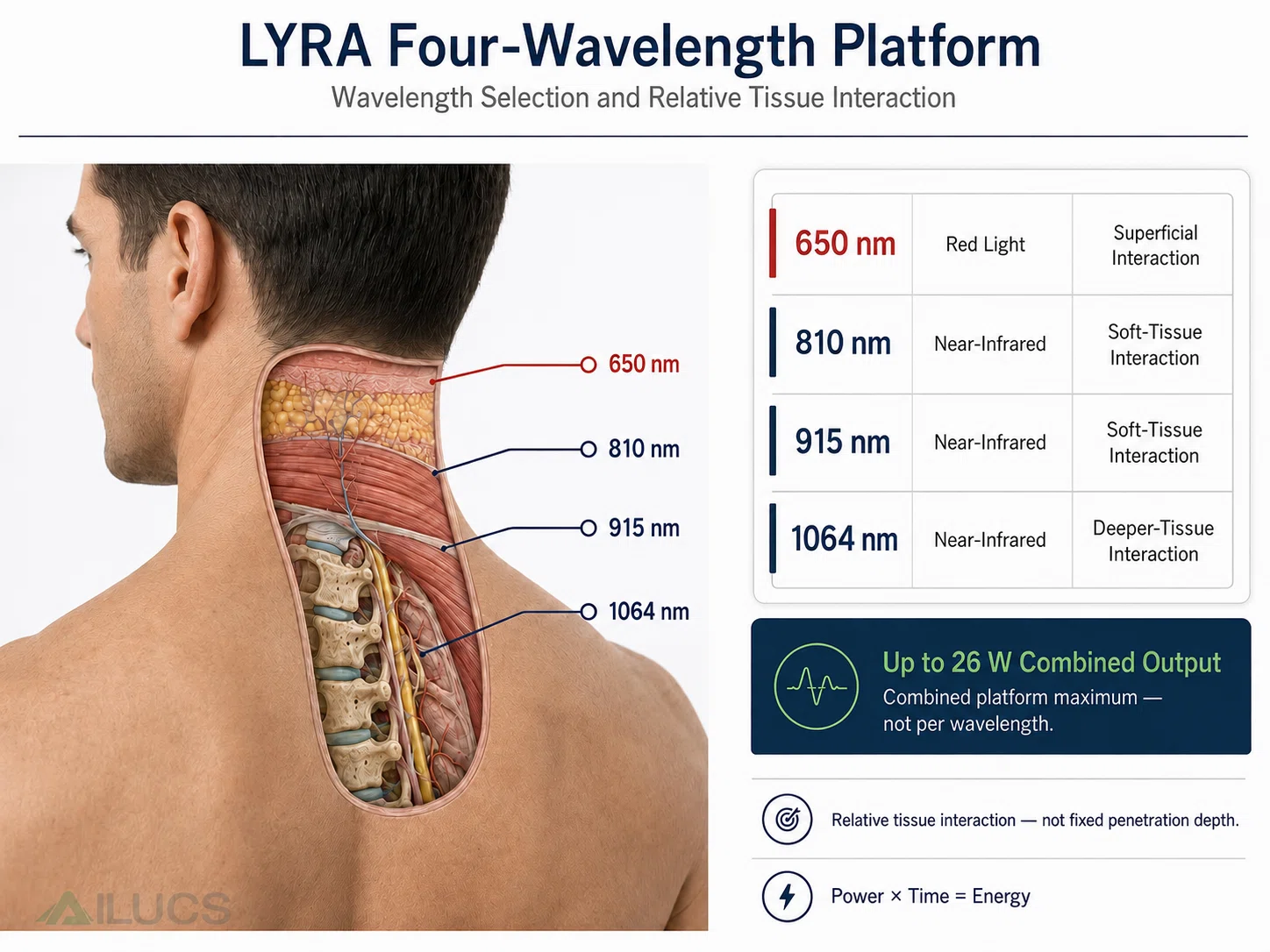
The LYRA medical high-intensity laser platform combines 650 nm red light with 810, 915, and 1064 nm near-infrared wavelengths and provides a maximum combined output of 26 W. By spanning the red and near-infrared ranges, the platform can use differences in tissue absorption and penetration to support more flexible energy delivery for superficial and deeper target tissues. The 26 W specification refers to the platform's maximum combined output, not to 26 W from each individual wavelength.
What four wavelengths and 26 W mean
LYRA combines 650 nm red light with 810, 915, and 1064 nm near-infrared wavelengths, providing clinicians with flexible wavelength combinations for different treatment targets. The 26 W rating refers to the platform’s maximum combined output, not the output of any single wavelength. Parameter selection should consider wavelength, total energy, energy density, treatment area, scanning speed, target depth, and heat tolerance.
HILT studies have used different wavelengths, output modes, total energy doses, and treatment schedules. Therefore, results from a single-wavelength study cannot be assumed to represent the LYRA four-wavelength combination, and the 26 W rating should not be interpreted as a direct measure of treatment effectiveness. A more accurate description is that LYRA's four-wavelength selection and combined 26 W power reserve support individualized energy delivery and staged parameter adjustment under professional assessment.
Who May Be a Candidate for HILT?
• Patients who have completed a clinical evaluation, have a confirmed diagnosis of cervical radiculopathy, and are appropriate candidates for nonsurgical care.
• Patients with neck, shoulder, or arm pain; radiating numbness; or secondary muscle tension who aim to improve movement and tolerance for rehabilitation.
• Patients already participating in exercise-based rehabilitation, neural mobilization, or other physical therapy who may benefit from an additional noninvasive option for pain modulation and tissue support.
• Patients who do not tolerate certain passive physical therapy modalities well but are considered suitable for HILT after professional evaluation.
Key Safety Considerations
• Assessment and treatment should be performed by a trained medical or rehabilitation professional in accordance with the device instructions and the locally authorized indications for use.
• Both clinician and patient must wear laser safety eyewear matched to the treatment wavelengths, and direct or reflected exposure to the eyes must be avoided.
• Parameters should be adjusted for skin pigmentation, sensory status, local circulation, treatment area, and heat tolerance. Scanning technique must be appropriate for the selected wavelength combination and output mode to avoid excessive energy concentration at a single point.
• During treatment, the clinician should ask about warmth, tingling, or discomfort and adjust the dose according to the immediate response and subsequent functional changes.
• Suspected myelopathy, progressive neurologic impairment, severe acute trauma, or another contraindication requires specialist assessment before treatment.
Frequently Asked Questions
How long does a HILT session take?
Treatment time depends on the prescribed power, target total energy, treatment area, and scanning method. A higher-power platform can deliver the prescribed energy more efficiently, but treatment time cannot be determined from power alone without considering dose and safety monitoring.
How many sessions are needed before a patient notices a change?
Research protocols typically use multiple sessions combined with exercise, but treatment schedules vary widely. In clinical practice, the course of care should be reassessed at intervals based on symptom duration, pain response, neurologic findings, and functional change. A fixed number of sessions should not be promised to every patient.
Can HILT make a herniated disc 'go back into place'?
Current evidence primarily supports improvements in pain, range of motion, and function. It does not establish that HILT directly reverses a disc herniation or bony stenosis. For patients with cervical radiculopathy, symptom control and functional recovery are clinically meaningful outcomes in their own right.
Does every LYRA treatment use 26 W?
No. The 26 W rating is the maximum combined output of the four-wavelength platform. It is neither the output of a single wavelength nor a fixed treatment setting. Actual output should be selected according to the wavelength or wavelength combination, target tissue, treatment area, total energy, scanning speed, and the patient's heat tolerance. Maximum power provides reserve capacity and treatment flexibility; it does not mean that every session should run at full power.
Does using HILT mean surgery is no longer necessary?
For patients who are appropriate for nonsurgical management, HILT may help control symptoms and improve function as part of a comprehensive rehabilitation program. It cannot replace surgical assessment when progressive weakness, spinal cord compression, or another clear surgical indication is present.
Conclusion
The central aim in treating cervical radiculopathy is not simply to use more power. It is to establish an accurate diagnosis, identify neurologic risk, and combine an appropriate energy dose with exercise-based rehabilitation, activity management, and scheduled reassessment. Randomized controlled trials and systematic reviews provide encouraging evidence that HILT can improve pain and function, with the most consistent findings reported when it is combined with exercise or physical therapy.
LYRA's 650, 810, 915, and 1064 nm four-wavelength platform provides a maximum combined output of 26 W. It uses the different tissue-interaction characteristics of red and near-infrared light to support more flexible parameter selection across tissue depths, treatment goals, and phases of rehabilitation. The 26 W rating describes the platform's combined power ceiling and energy-delivery capacity; it does not mean that each wavelength independently produces 26 W or that full power is required. With appropriate parameter selection, safety precautions, and outcome reassessment, HILT can serve as a practical noninvasive tool within comprehensive rehabilitation for cervical radiculopathy.
Medical notice This article is intended for professional medical education and discussion of device applications. It does not constitute an individual diagnosis or treatment prescription. Indications, parameters, and contraindications must be determined by a qualified professional based on the patient's condition, the device labeling, and the locally authorized scope of use.
References
1. İnce S, Eyvaz N, Dündar Ü, et al. Clinical Efficiency of High-Intensity Laser Therapy in Patients With Cervical Radiculopathy: A 12-Week Follow-up, Randomized, Placebo-Controlled Trial. Am J Phys Med Rehabil. 2024;103(1):3-12.
2. de la Barra Ortiz HA, Arias M, Liebano RE. A systematic review and meta-analysis of randomized controlled trials on the effectiveness of high-intensity laser therapy in the management of neck pain. Lasers Med Sci. 2024;39:124.
3. Hao J, He Z, Huang B, et al. Comparative effectiveness of six biophysical agents on neck pain rehabilitation: a systematic review and network meta-analysis. Eur Spine J. 2025;34(6):2183-2200.
4. de la Barra Ortiz HA, Parizotto NA, Liebano RE. Effectiveness of high-intensity laser therapy in patients with spinal radiculopathy: a systematic review with meta-analysis. Lasers Med Sci. 2025;40:328.
5. Arroyo-Fernández R, Aceituno-Gómez J, Serrano-Muñoz D, Avendaño-Coy J. High-Intensity Laser Therapy for Musculoskeletal Disorders: A Systematic Review and Meta-Analysis of Randomized Clinical Trials. J Clin Med. 2023;12(4):1479.
6. de Freitas LF, Hamblin MR. Proposed Mechanisms of Photobiomodulation or Low-Level Light Therapy. IEEE J Sel Top Quantum Electron. 2016;22(3):348-364.