
Can Laser Therapy Help Treat Ear Infections in Dogs and Cats? (Part 1)
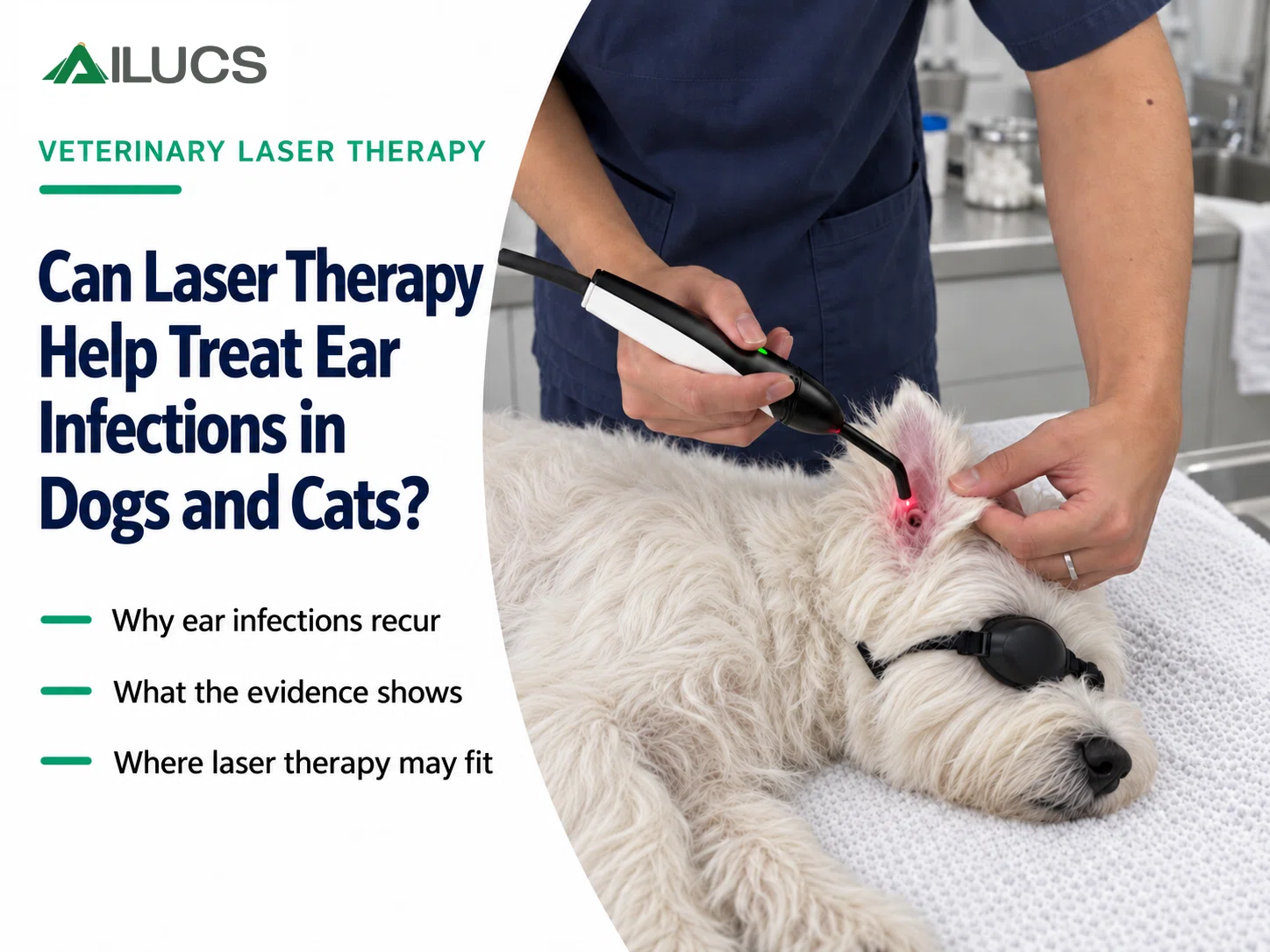
Ear infections in dogs and cats often return because the problem is more complex than bacteria or yeast alone. The external ear canal may be inflamed by allergy, parasites, a foreign body, or another underlying condition; microorganisms can then overgrow in the altered environment. Treatment works best when a veterinarian identifies and addresses those factors. Photobiomodulation (PBM), sometimes called therapeutic laser treatment, has a possible supportive role in selected cases, but direct evidence for treating canine or feline otitis with therapeutic lasers remains limited. [1–5]
Why ear infections keep coming back
Veterinarians commonly organize otitis externa, or inflammation of the external ear canal, into four interacting groups of factors.
Primary causes
These start inflammation in an otherwise healthy ear. They include allergic skin disease, ear mites and other parasites, foreign bodies, keratinization disorders, inflammatory polyps, and tumors. Treating an accompanying infection without managing its primary cause can allow the ear disease to return.
Predisposing factors
Narrow canals, ear conformation, moisture, and other conditions can make inflammation or microbial overgrowth more likely. They contribute to risk but do not necessarily cause otitis on their own.
Secondary microbial overgrowth
Bacteria and yeast may multiply once inflammation changes the ear canal. An ear sample examined under a microscope (cytology) helps the clinician interpret these organisms alongside symptoms and the physical examination.
Perpetuating changes
Longstanding inflammation can produce swelling, glandular enlargement, thickening, narrowing, or mineralization of the canal. Middle-ear disease may also complicate recurrent cases. These changes can make examination and topical treatment more difficult.
How canine and feline otitis can differ
In dogs, recurrent otitis externa commonly occurs alongside allergic skin disease. A dog with repeated ear flare-ups may therefore need a broader dermatologic assessment, even when the ear improves with initial treatment.
In cats, ear mites, inflammatory polyps, and possible middle-ear disease deserve particular attention. A persistent or one-sided problem may call for a closer examination or additional diagnostics; its cause should not be assumed from symptoms alone.
What the evidence says about laser therapy for otitis
PBM delivers light at settings intended to influence tissue responses without cutting or removing tissue. Laboratory and veterinary research describe plausible effects on cellular signaling and inflammation, but a plausible mechanism does not establish that a particular laser device improves outcomes in an infected ear. Evidence for veterinary PBM varies by condition, treatment settings, and study design.
One randomized study of dogs with otitis externa investigated a chromophore-containing gel illuminated by an LED device. It reported improvements in some clinical measures, but that treatment is different from direct therapeutic laser PBM; its results cannot be used as proof of efficacy for a Class IV laser or for cats. [6]
For dogs or cats with otitis, the most defensible position is that therapeutic PBM may be considered by a veterinarian as an adjunct for selected cases. Whether it improves ear pain, inflammation, healing, or recurrence compared with appropriate standard care remains insufficiently established for routine claims. PBM does not eliminate mites, remove a foreign body or polyp, treat an allergy, or replace indicated antimicrobial or other treatment.
For the underlying light-based mechanisms, see How Does Veterinary Laser Therapy Work? This general guide explains PBM; its other clinical examples should not be read as evidence specific to otitis.
What a veterinarian should assess first
A suitable plan begins with a diagnosis. Depending on the patient, examination may include:
· History, previous treatments, and a skin examination, especially for recurrent cases
· Otoscopy to inspect the canal and, when possible, the eardrum
· Cytology to assess yeast, bacteria, and inflammatory cells
· Evaluation for parasites, foreign material, polyps, or a mass
· Further assessment for middle-ear disease when signs or examination findings warrant it
A painful or severely narrowed ear may require a staged examination or additional measures selected by the veterinarian. Head tilt, loss of balance, marked pain, or worsening one-sided signs warrant prompt veterinary assessment.
Where PBM may fit into care
If a veterinarian chooses PBM, it should sit within a plan that addresses the primary disease, relevant microbial overgrowth, and any persistent canal changes. The clinician should consider the ear examination findings, whether the eardrum can be assessed, and the device instructions before deciding if light treatment is appropriate for that patient. Avoid treating an unexplained mass as routine otitis.
For a broader overview of veterinary laser therapy in multimodal care, see Veterinary Laser Therapy for Pain Management and Recovery.
Frequently asked questions
Is an ear infection in a dog or cat always caused by bacteria or yeast?
No. Otitis is inflammation with several possible underlying causes. Bacteria or yeast may overgrow secondarily and still require treatment when clinically relevant.
Can therapeutic laser treatment cure otitis?
There is no good basis for a cure claim. PBM does not address many underlying causes, and direct evidence for therapeutic laser treatment of canine and feline otitis remains limited.
Why does my pet keep getting ear infections?
An underlying condition may still be active, or chronic changes in the ear may make flare-ups more likely. A veterinarian can reassess the ear, examine a sample, and adjust the care plan.
Are cats and dogs evaluated in the same way?
Both need a cause-directed examination, but the likely causes and the need to investigate middle-ear disease can differ by species and individual patient.
Conclusion
Recurring ear disease calls for a diagnosis of the underlying cause and a plan tailored to the patient. PBM can be discussed as a possible adjunct, with its uncertain otitis-specific benefits explained plainly. It should not delay an ear examination or replace treatment chosen for the cause of disease.
References
1. Hoff S. Otitis Externa in Animals. Merck Veterinary Manual. Last updated April 2026.
2. Brame B, Cain C. Chronic Otitis in Cats: Clinical management of primary, predisposing and perpetuating factors. Journal of Feline Medicine and Surgery. 2021;23(5):433–446.
3. Torres SMF. Otitis Externa – Dogs and Cats. Small and Large Animal Dermatology Handbook, Vol. 1. University of Minnesota Libraries Publishing.
4. Hochman L. Photobiomodulation Therapy in Veterinary Medicine: A Review. Topics in Companion Animal Medicine. 2018;33(3):83–88.
5. Perego R, Mazzeo M, Spada E, Proverbio D. Critically Appraised Topic on Low-Level Laser Therapy in Dogs: An Advisable Treatment for Skin Diseases? Veterinary Sciences. 2022;9(9):505.
6. Tambella AM, et al. Management of otitis externa with an LED-illuminated gel: A randomized controlled clinical trial in dogs. BMC Veterinary Research. 2020;16:91.
Meta description for website CMS
Learn why ear infections recur in dogs and cats, what a veterinarian should assess, and where laser therapy may fit as an adjunct to care.