
Continuous Wave vs Pulsed vs Super Pulsed Laser Therapy
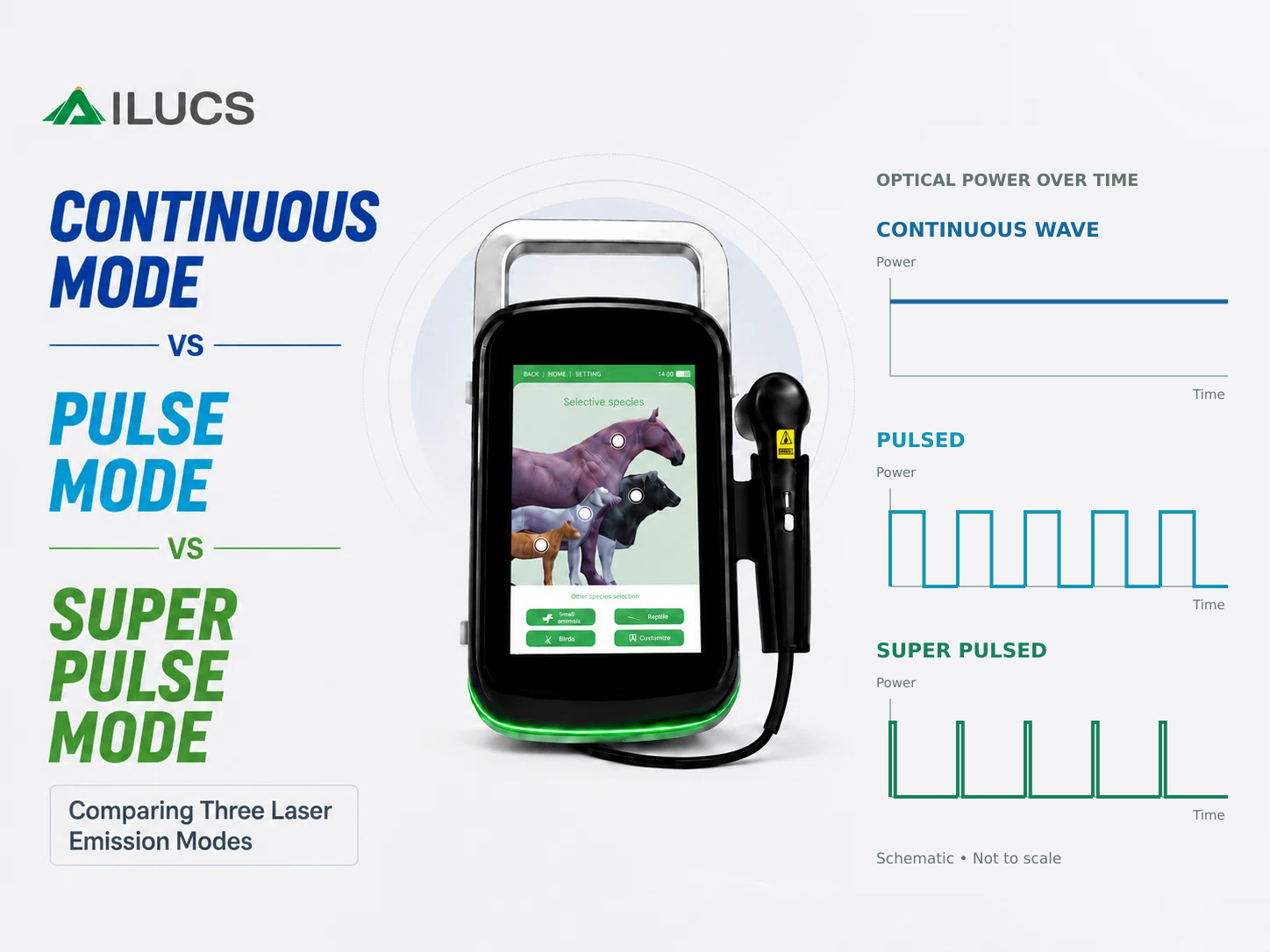
Continuous wave, pulsed and super pulsed describe how laser output changes over time. For veterinarians comparing systems, the key distinction is between instantaneous peak power and average power, which determines how quickly energy is delivered.
No emission mode is universally best. A useful comparison considers the waveform together with wavelength, treatment area, exposure time and the patient’s response. This guide explains the differences, demonstrates a basic energy calculation and outlines what to check before choosing a protocol.
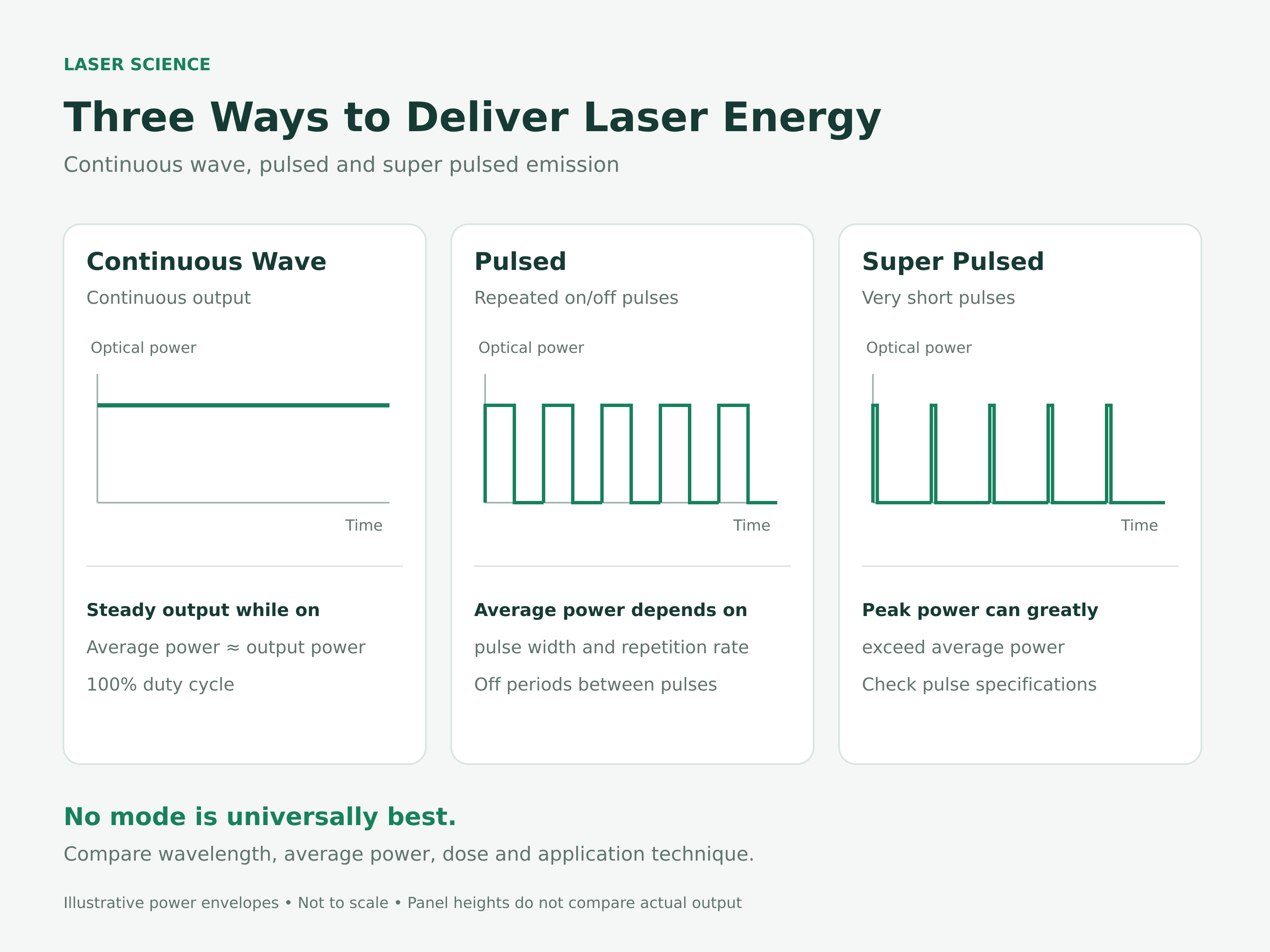
What Is Continuous Wave Laser Therapy
Continuous Wave (CW) delivers light without intentional off periods while the laser is activated. At a stable output setting, its optical power plotted against time is approximately a horizontal line.
At constant output, emitted energy is calculated as Energy (J) = Power (W) × Time (s). This describes energy at the stated output measurement point, not the amount absorbed by a deeper target. Reflection, absorption and scattering affect how light travels through tissue.
CW provides a straightforward way to deliver energy, but it is not automatically the right choice for every chronic condition. Output, spot size, application technique and patient tolerance remain important.
What Is Pulsed Laser Therapy
Pulsed operation delivers light in a sequence of pulses. One common implementation gates a continuous output on and off. Duty cycle is the fraction of each cycle for which the output is on: a 50% duty cycle means emission occurs for half the cycle.
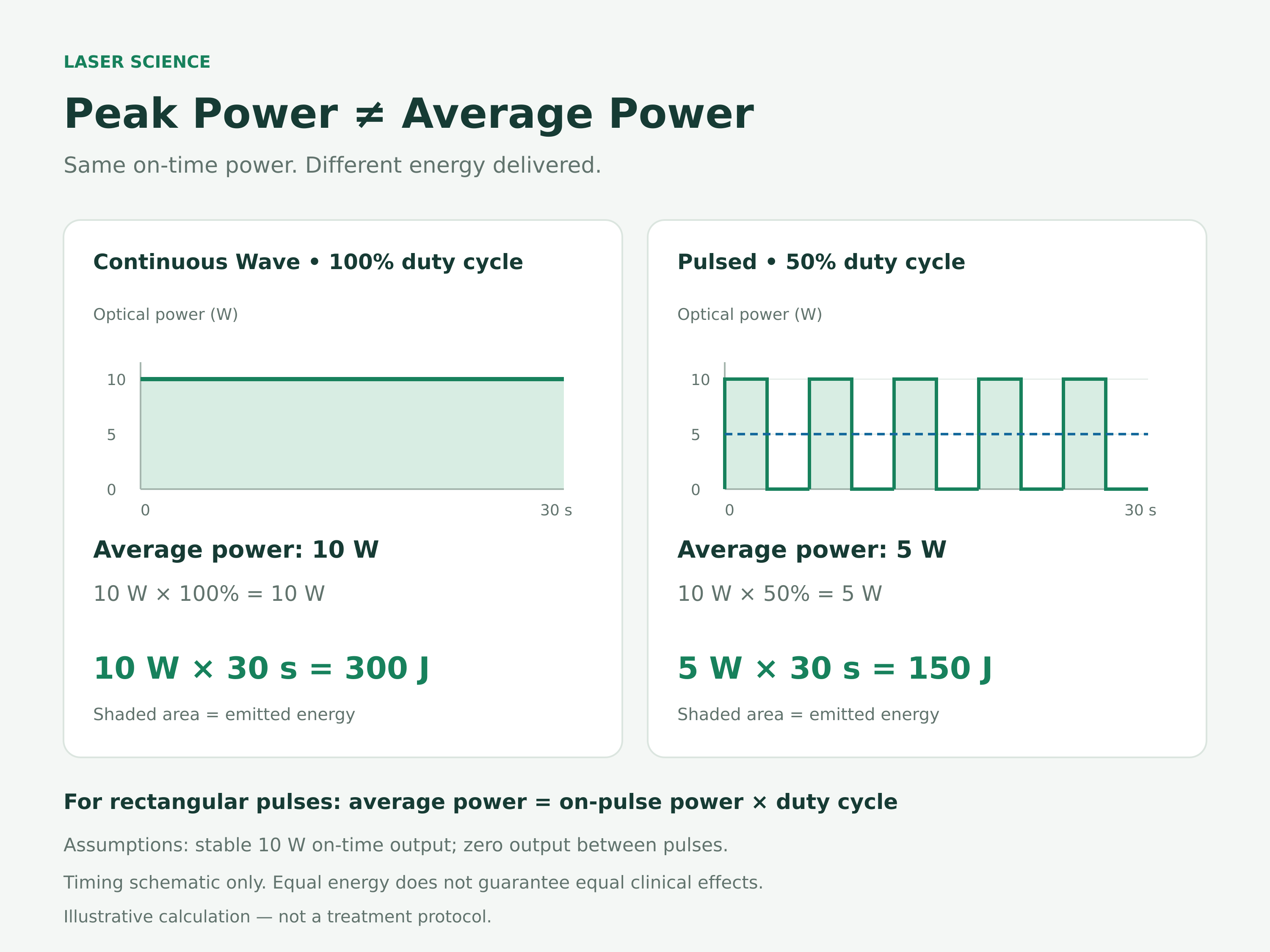
For identical rectangular pulses with zero output between them, average power equals on-pulse power multiplied by duty cycle. Frequency alone does not establish average power: pulse duration and amplitude must also be known. For more complex waveforms, use measured average power or the manufacturer’s calculation.
Reducing duty cycle while keeping on-pulse power unchanged lowers average power. If a device instead maintains the same average power, it may compensate by changing other output parameters. Check which value the screen displays.
What Is Super Pulsed Laser Therapy
Super pulsed commonly describes very short pulses with peak power substantially above time-averaged power. The term should be checked against the device’s actual pulse duration, repetition rate, pulse energy and average output; a mode label alone is not enough to compare systems.
A high peak value exists only during a small portion of the exposure. It does not, by itself, establish total energy, greater penetration or better outcomes. Nor does a super pulsed label establish a laser safety class. Emission mode and safety classification describe different properties.
Comparison of the Three Emission Modes
| Parameter | Continuous wave | Pulsed | Super pulsed |
| Output over time | Continuous | Repeated pulses | Very short pulses |
| Average power | Approximately the stable output | Depends on the pulse pattern | May be far below peak power |
| Key specification | Operating power | Pulse width and duty cycle | Pulse energy, width and peak power |
| Heating | Depends on exposure and tissue | Not necessarily lower | Not necessarily negligible |
| Clinical interpretation | Evaluate the complete protocol | Evaluate the complete protocol | Evaluate the complete protocol |
The table describes emission patterns, not a ranking of clinical effectiveness. Settings and measurement methods must be comparable before drawing conclusions about different systems.
Peak Power and Average Power in a Worked Example
The following example uses ideal rectangular pulses, zero output during off periods and constant settings. It demonstrates arithmetic only; these values are not a veterinary treatment prescription.
| Setting | CW | Pulsed |
| On-time output | 10 W | 10 W |
| Duty cycle | 100% | 50% |
| Average power | 10 W | 5 W |
| Exposure time | 30 s | 30 s |
| Total emitted energy | 300 J | 150 J |
In this example, the pulsed exposure would need 60 seconds to deliver 300 J. Alternatively, a 20 W on-pulse output at 50% duty cycle would average 10 W. Equal total energy still does not prove equal tissue heating or biological effects.
For a repeating train of identical pulses, average power can also be calculated as pulse energy multiplied by repetition frequency. This is useful when a device reports pulse energy rather than an easily interpreted duty cycle.
Does Pulsed Laser Therapy Produce Less Heat
Not necessarily. Off periods change the timing of energy delivery, but their effect on heat accumulation depends on the pulse schedule and tissue cooling. A lower duty cycle can reduce average output if on-pulse power is unchanged; that does not establish that all pulsed treatments are cooler than all CW treatments.
Thermal response also depends on wavelength, average irradiance, exposure duration, pigmentation, coat, tissue properties and how the applicator moves. A pulsed or super pulsed label should never be treated as a guarantee against excessive heating. Follow the device instructions, use appropriate eye protection and monitor the patient throughout treatment.
How Emission Mode Fits Into Laser Dosage
Dosage requires more than selecting CW or pulsed operation. Average power describes energy delivery per second. Irradiance is power per unit area, usually W/cm², while radiant exposure, often called fluence in clinical usage, is energy per unit area, usually J/cm².
Area must be defined carefully. The optical spot at the skin and the entire scanned treatment field are different quantities. Dividing total energy by field area gives a field-average value; it does not show whether every point received the same exposure. Contact distance and applicator geometry may also affect spot size.
Record wavelength, average power, exposure time, spot or field area, pulse settings and application technique. This makes a protocol more interpretable than recording frequency or peak power alone. The parameter review by Zein and colleagues discusses why interacting light parameters complicate comparisons between studies.
Choosing a Mode for Veterinary Rehabilitation
Begin with the clinical objective and a protocol appropriate to the species, condition and device. Acute versus chronic is not a sufficient selection rule: tissue sensitivity, surgical-site status, coat, pigmentation and treatment area can differ substantially between patients with the same diagnosis.
Define the treatment area, review tissue sensitivity and select the applicable device protocol. Record the settings and reassess patient comfort and function over time. Any adjustment should account for average power and total energy, as well as the selected mode.
The systematic review by Millis and Bergh examines laser therapy across veterinary applications. When applying this evidence, check the species, condition and treatment protocol studied before drawing conclusions for a patient or a different device.
Laser therapy can form part of an individual veterinary rehabilitation plan, alongside other care selected by the veterinarian.
Evaluating a Laser System With Multiple Modes
Multiple modes can offer flexibility, but the useful question is whether output is clearly specified and the required protocol can be delivered reproducibly. Check which modes are available for the particular model and wavelength configuration, how average power is displayed, and what happens when frequency or duty cycle changes.
When evaluating the AILUCS LYRA veterinary laser, compare the selected configuration’s documented wavelengths, output ranges and pulse specifications with the intended clinical application. Use the model-specific instructions for treatment settings and safety requirements.
Frequently Asked Questions
Does super pulsed light necessarily penetrate deeper?
No. The emission-mode label alone cannot establish penetration. Wavelength and tissue absorption and scattering are central, while application geometry and incident output also influence light distribution.
Is CW always preferable for chronic problems?
No. Diagnosis and rehabilitation stage are only part of the decision. Use an appropriate complete protocol rather than assigning a mode solely from the words acute or chronic.
Can I compare devices using their advertised peak wattage?
Not meaningfully on that number alone. Ask for average power, pulse duration, repetition rate and delivered energy, together with wavelength and application area.
Does the same energy guarantee the same result?
No. Equal joules do not establish equal spatial distribution, temperature change or biological response. The complete exposure and patient context still matter.
Conclusion
CW, pulsed and super pulsed are different ways to deliver light over time. Average power and treatment duration explain total energy more clearly than peak power alone. Compare modes using documented output and a complete protocol, then adapt treatment to the patient and the clinical objective.
References
1. Zein R, Selting W, Hamblin MR. Review of light parameters and photobiomodulation efficacy: dive into complexity. Journal of Biomedical Optics. 2018;23(12):120901. Read source
2. Millis DL, Bergh A. A Systematic Literature Review of Complementary and Alternative Veterinary Medicine: Laser Therapy. Animals. 2023;13(4):667. Read source