
High-Intensity Laser Therapy for Equine Rehabilitation
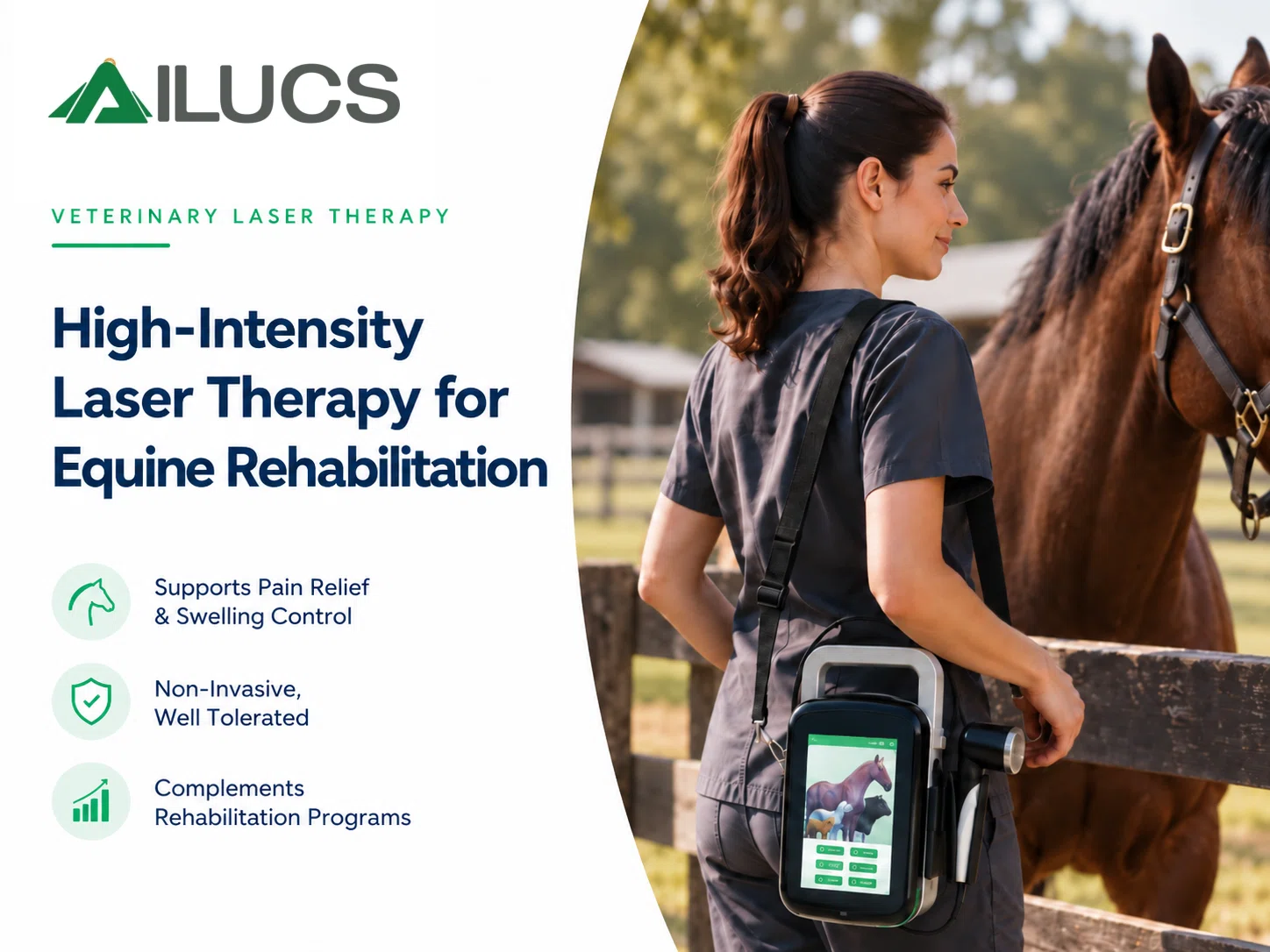
High-intensity laser therapy (HILT) is used as an adjunctive modality in equine rehabilitation for selected tendon, ligament, muscle, and other musculoskeletal conditions. Controlled and observational studies have reported improvements in pain, swelling, lameness, and selected imaging measures, but the current evidence is not strong enough to conclude that HILT reliably shortens the time required for a horse to return to full athletic performance.
In practice, the value of laser therapy depends on how it is integrated into a structured rehabilitation plan. Treatment parameters, the anatomical target, exercise progression, clinical monitoring, and imaging when indicated all matter. Published protocols should therefore be interpreted as study-specific treatment methods rather than universal prescriptions.
Key Takeaways
· HILT should complement, not replace, controlled exercise, load management, veterinary assessment, and other indicated care.
· Improvement in pain or lameness does not by itself prove that a tendon or ligament has regained sufficient mechanical strength.
· Wavelength, power, energy density, treatment area, technique, and treatment schedule should be considered together rather than as isolated numbers.
· Published equine protocols provide useful reference points, but they should not be copied as universal treatment recommendations.
Where HILT May Fit in Equine Rehabilitation
Performance horses are exposed to repeated loading of structures such as the superficial digital flexor tendon, deep digital flexor tendon, suspensory ligament, and suspensory branches. Rehabilitation typically requires protection of the injured tissue followed by progressive loading, clinical assessment, and appropriate monitoring.
Laser therapy may be incorporated alongside controlled exercise, load management, diagnostic imaging, and other veterinary interventions. Its role is supportive. The treatment target also matters: superficial soft-tissue conditions and deeper musculoskeletal lesions may require different approaches, with parameters selected according to the anatomical target, treatment area, device characteristics, and clinical objective.
During Active Rehabilitation
During active rehabilitation, HILT may be used to support pain management, swelling control, and soft-tissue recovery while the horse follows a controlled exercise program.
During a Gradual Return to Work
As activity increases, laser therapy may remain part of the broader recovery plan. Improved comfort, however, does not demonstrate that an injured tendon or ligament has regained sufficient mechanical strength for unrestricted athletic activity. Progression should therefore consider clinical findings, exercise tolerance, tissue status, and diagnostic imaging when indicated.
What Does the Equine Evidence Show?
Published equine research provides encouraging but still limited evidence for high-intensity and high-power laser therapy. Terminology and treatment methods vary among studies, so the findings should be interpreted in the context of each protocol rather than treated as evidence for every laser system or dosing strategy.
| Study | Design | Main findings | Important limitation / interpretatio |
| Zielińska et al., 2020 | Controlled clinical study; 26 horses with tendon or ligament injuries; 15 HILT sessions | Greater improvements in pain, swelling, lameness, and lesion percentage versus the non-treated group; no significant difference in lesion echogenicity | Supports potential clinical benefit, but does not establish that HILT alone accelerates complete tissue healing or return to performance. |
| Pluim et al., 2020 | Controlled standardized suspensory branch lesion model; 12 Warmblood horses | Selected ultrasound and MRI findings improved in treated lesions versus controls | Further histological and biomechanical evaluation was needed to define structural and functional repair quality. |
| Pluim et al., 2018 | Observational follow-up; 150 sport horses with tendinopathy or desmopathy | Clinical and ultrasonographic improvements were reported after high-power laser therapy | Without a randomized untreated comparator, the study cannot establish treatment efficacy on its own. |
| Rushing, 2023 | Critical appraisal of available evidence for suspensory ligament desmopathy | Evidence was judged weak for determining whether HILT plus conservative management speeds return to primary function | Return-to-performance benefits remain uncertain. |
| Pluim et al., 2025 | Review of adjunct therapies for tendon and ligament healing | Described potential benefits of high-power laser therapy | Highlighted the need for additional research on dosage, protocols, and clinically relevant long-term outcomes. |
Clinical Improvement Is Not the Same as Complete Tissue Recovery
Pain, swelling, and lameness may improve before an injured tendon or ligament has regained sufficient mechanical strength. Likewise, changes on ultrasound or MRI do not automatically indicate readiness for unrestricted athletic activity. This distinction is particularly important in performance horses, where a premature increase in workload can place recovering tissue under substantial mechanical demand.
The available evidence therefore supports a cautious interpretation: HILT may contribute to symptom management and selected healing measures, but return-to-work decisions should remain based on the horse’s clinical status, exercise tolerance, tissue assessment, and imaging when appropriate. 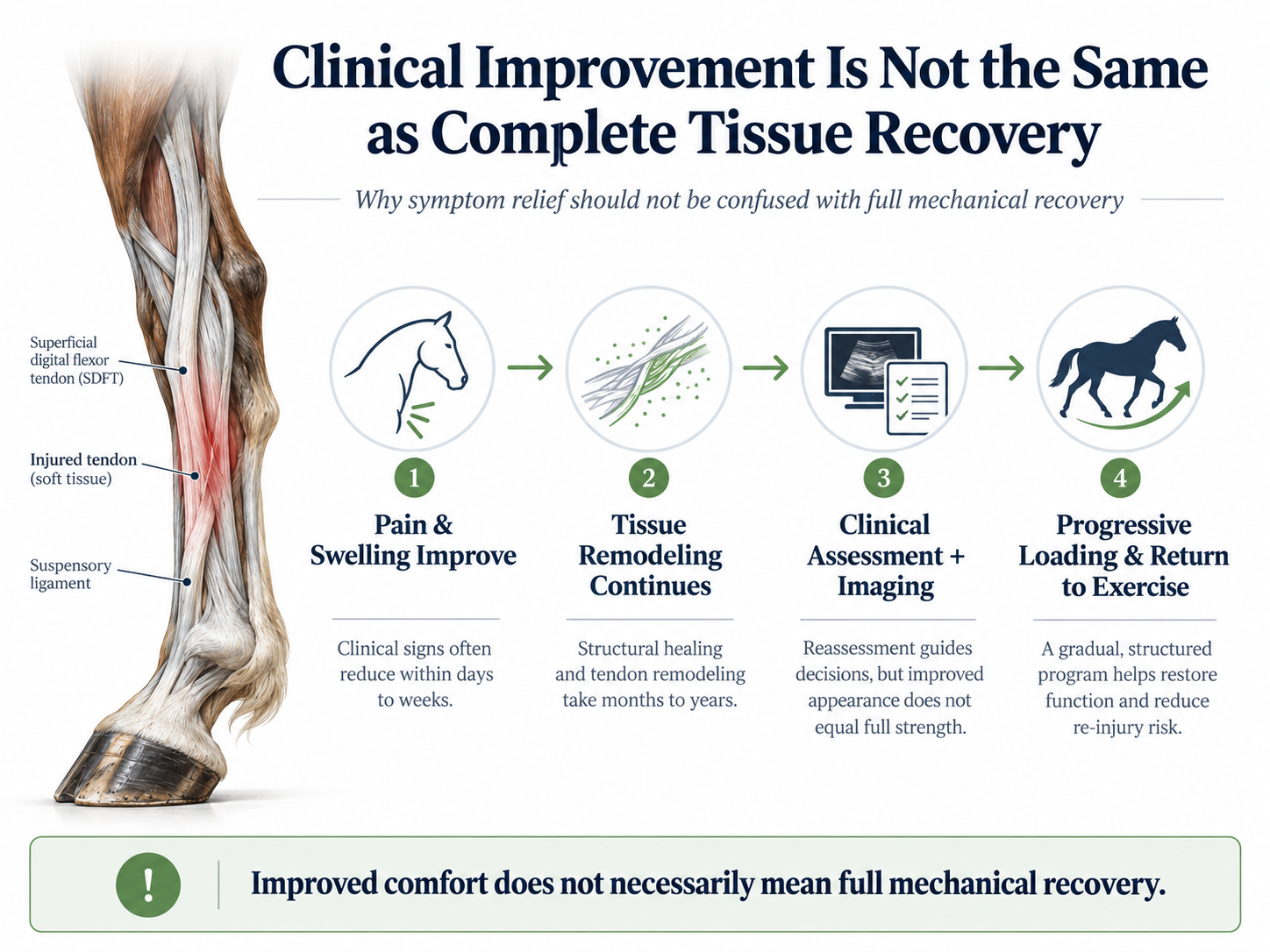
Treatment Parameters: What Matters?
Laser treatment is parameter-dependent. A reported wavelength or wattage does not describe the complete treatment. Clinical interpretation requires the full method, including the treatment field, energy delivery, application technique, and treatment schedule.
| Parameter | Why it matters clinically |
| Wavelength | Influences how laser energy interacts with biological tissue. |
| Power | Determines the rate at which energy is delivered. |
| Energy density / dose | Describes energy delivered per unit area, commonly expressed as J/cm². |
| Treatment area | Influences total energy requirements and treatment time. |
| Application technique | Affects how consistently energy is delivered across the intended treatment field. |
| Treatment schedule | Describes how sessions are distributed across the rehabilitation period. |
Related reading: Power, Wavelength, and Dose in Class IV Veterinary Laser Therapy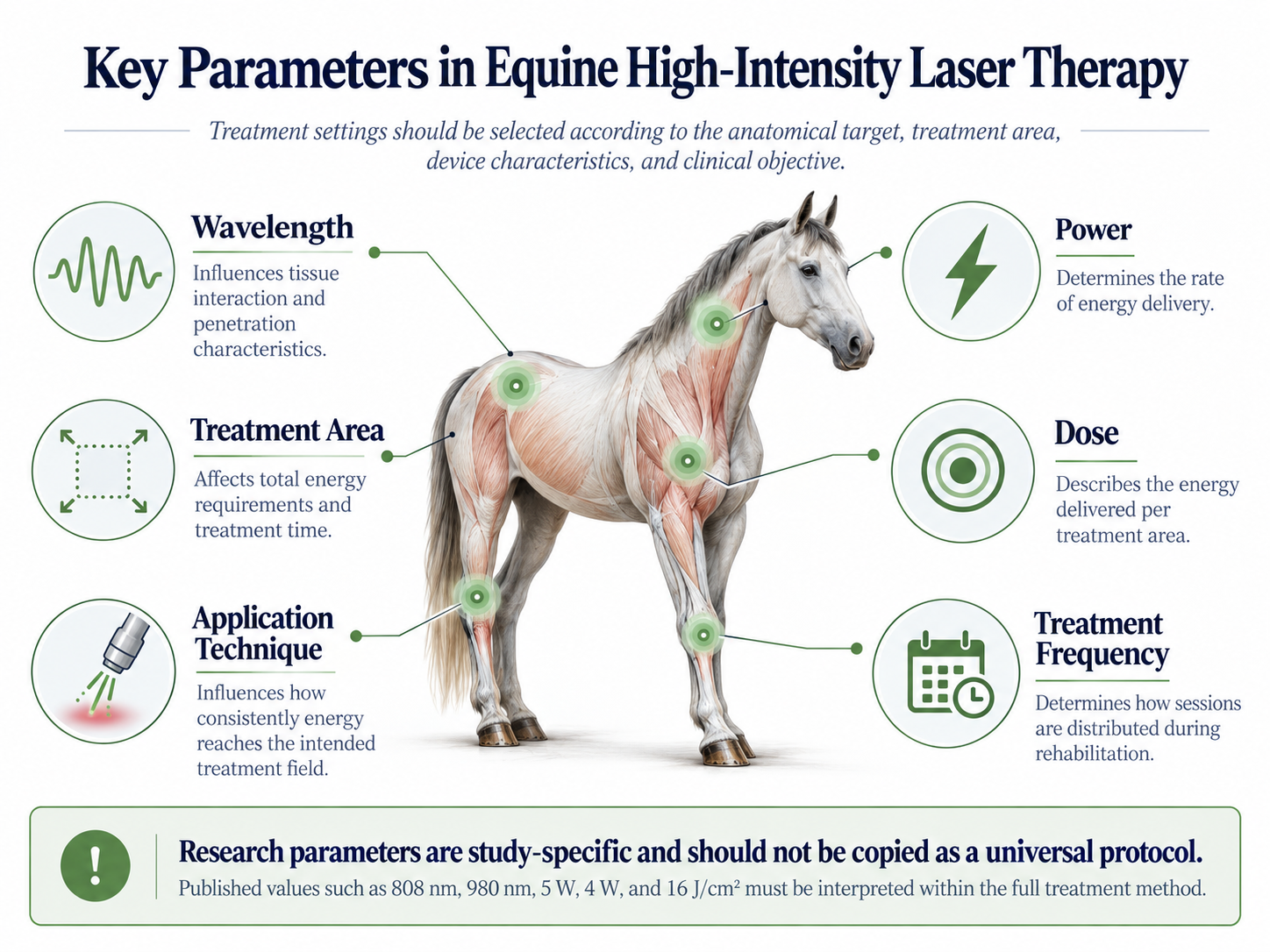
Parameters Reported in a Controlled Equine Study
The 2020 controlled clinical study used two infrared wavelengths delivered simultaneously.
| Wavelength | Power | Pulse frequency | Energy density |
| 808 nm | 5 W | 700 Hz | 16 J/cm² |
| 980 nm | 4 W | 1,000 Hz | 16 J/cm² |
The study used 15 HILT sessions: four treatments at 24-hour intervals, followed by four at 48-hour intervals, four at 72-hour intervals, and three at 96-hour intervals. These settings represent the conditions used in that study and should not be treated as a universal protocol. The authors used lower power settings than the device’s maximum output to reduce thermal effects and avoid skin burns.
It is also important to distinguish a reported surface energy density from the energy that ultimately reaches a deeper tendon or ligament. Reflection, absorption, and scattering affect energy delivery below the skin. For that reason, a published J/cm² value should be interpreted within the complete treatment method rather than treated as a numerical deep-tissue dose.
A Practical Note on Device Selection for Equine Work
For equine rehabilitation, maximum wattage alone is not a sufficient basis for device selection. A practical veterinary system should support appropriate parameter adjustment, repeatable treatment settings, suitable treatment-head options, and a workflow that can move between clinic and field environments. Portable AILUCS veterinary platforms such as LYRA and REX are designed for this type of veterinary workflow. Product capability does not replace clinical judgment: treatment parameters should still be selected according to the injured tissue, treatment area, clinical objective, and the veterinarian’s rehabilitation plan.
Using HILT Within a Broader Equine Rehabilitation Plan
Tendon and Ligament Injuries
Tendon and ligament injuries often require prolonged rehabilitation because tissue remodeling continues after clinical signs begin to improve. Laser therapy may be considered alongside controlled loading and veterinary monitoring. Follow-up may include lameness, pain, swelling, exercise tolerance, and ultrasonographic or other imaging findings when appropriate.
Muscle and Other Soft-Tissue Conditions
HILT may also be considered for selected muscle and other soft-tissue conditions during rehabilitation. Treatment should be directed toward the affected tissues, with parameters selected according to the clinical objective, anatomical location, and treatment area.
In horses, laser therapy for equine back pain provides an example of how HILT may be incorporated into the management of musculoskeletal discomfort. Similarly, laser therapy for muscle strains in dogs and horses may be considered as part of a broader rehabilitation approach that includes appropriate activity modification, therapeutic exercise, and ongoing clinical assessment.
Progressive Return to Exercise
The progression from rest to controlled exercise and then to more demanding activity should be based on the horse’s clinical condition and the status of the injured tissue. A reduction in pain or lameness can be clinically useful, but it should not be used as the sole criterion for returning a horse to unrestricted work.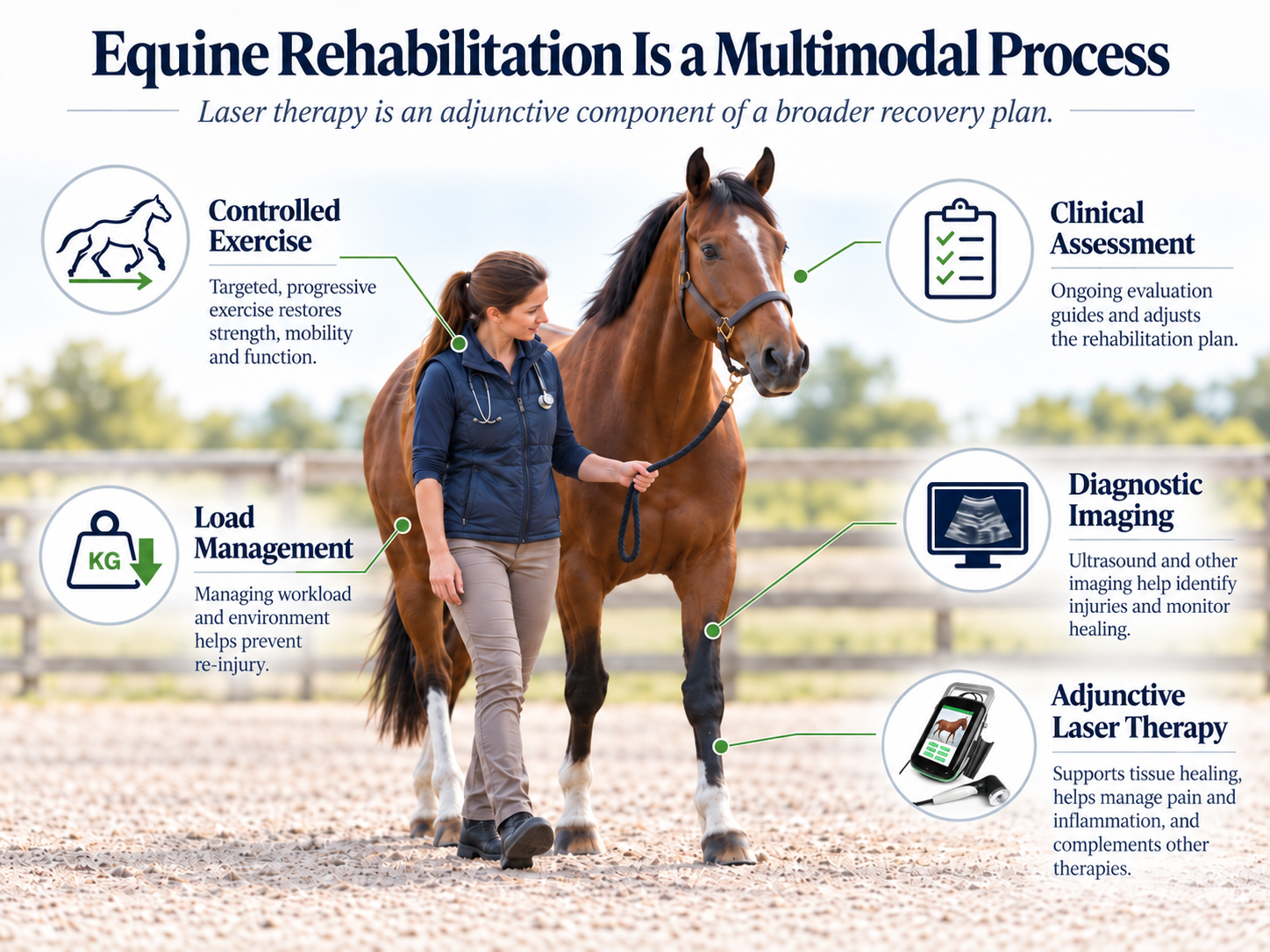
Frequently Asked Questions
How many laser treatments does a horse need?
There is no universal number of treatments. One controlled study used 15 HILT sessions under a specific research protocol, but that schedule should not be interpreted as a general recommendation for every horse or condition.
Can laser therapy replace equine rehabilitation?
No. Laser therapy is an adjunctive treatment and should be incorporated alongside appropriate exercise, load management, clinical monitoring, and other veterinary care when indicated.
Can HILT speed a horse’s return to performance?
Current evidence does not establish this conclusively. A 2023 critical appraisal found only weak evidence that HILT combined with conservative management leads to a faster return to primary function in horses with suspensory ligament desmopathy.
What laser parameters have been studied in horses?
Published research has investigated different combinations of wavelength, power, frequency, dose, treatment area, technique, and treatment schedule. In one controlled study, 808 nm at 5 W and 700 Hz and 980 nm at 4 W and 1,000 Hz were delivered simultaneously at a reported energy density of 16 J/cm² for each wavelength. These were study-specific conditions rather than a universal protocol.
Should a published J/cm² value be copied directly into clinical practice?
No single J/cm² value should be separated from the rest of the treatment method. Surface energy density does not directly equal the dose reaching a deeper tendon or ligament, and the interpretation of a protocol also depends on wavelength, power, treatment area, application technique, and tissue characteristics.
Conclusion
High-intensity laser therapy may be a useful adjunct within equine rehabilitation for selected tendon, ligament, muscle, and other musculoskeletal conditions. Controlled, experimental, and observational studies have reported potential improvements in pain, swelling, lameness, and selected measures of lesion healing.
At the same time, the evidence base remains limited, and it has not been established that HILT reliably shortens the time required for a horse to return to full athletic performance. The most defensible clinical approach is therefore to use laser therapy as one component of a broader rehabilitation plan, with treatment parameters selected for the target tissue and clinical objective and progress assessed through clinical findings, exercise tolerance, and imaging when indicated.
References
1. Zielińska P, Nicpoń J, Kiełbowicz Z, Soroko M, Dudek K, Zaborski D. Effects of High Intensity Laser Therapy in the Treatment of Tendon and Ligament Injuries in Performance Horses. Animals. 2020;10(8):1327.
2. Pluim M, Martens A, Vanderperren K, Sarrazin S, Koene M, Luciani A, van Weeren PR, Delesalle C. Short- and long-term follow-up of 150 sports horses diagnosed with tendinopathy or desmopathy by ultrasonographic examination and treated with high-power laser therapy. Research in Veterinary Science. 2018;119:232–238.
3. Pluim M, Martens A, Vanderperren K, van Weeren PR, Oosterlinck M, Dewulf J, Kichouh M, Van Thielen B, Koene MHW, Luciani A, Plancke L, Delesalle C. High-Power Laser Therapy Improves Healing of the Equine Suspensory Branch in a Standardized Lesion Model. Frontiers in Veterinary Science. 2020;7:600.
4. Rushing J. Does high-intensity laser therapy speed return to primary function in horses with suspensory ligament desmopathy? Veterinary Evidence. 2023;8(1).
5. Pluim M, Reynolds A, McClure S. Adjunct Therapies for Tendon/Ligament Healing: Therapeutic Laser and Extracorporeal Shockwave Therapy. Veterinary Clinics of North America: Equine Practice. 2025;41(2):391–401.