
Can Laser Therapy Help Treat Ear Infections in Dogs and Cats? (Part 2)
Photobiomodulation (PBM) may have an adjunctive role in selected cases of canine otitis externa, but the clinical evidence remains preliminary. This article focuses on what the current study evidence actually shows, the treatment parameters that have been published, and how those findings should be interpreted in practice.
Key clinical takeaways
• Direct clinical evidence is currently strongest for canine otitis externa, not feline otitis.
• A 2026 prospective multicenter pilot study reported improvements in several clinical and cytological measures, while microbiological culture results did not change significantly.
• The reported wavelengths, fluence, schedule, and application technique describe one study protocol and should not be treated as a universal prescription.
What This Article Covers — and What It Does Not
Otitis management starts with diagnosis. Primary disease, secondary microbial overgrowth, ear canal changes, and the condition of the tympanic membrane all influence treatment decisions. PBM should not replace diagnostic work-up or treatment directed at the underlying cause.
For a broader discussion of recurrent ear disease, common underlying causes, and the role of laser therapy in dogs and cats, see Can Laser Therapy Help Treat Ear Infections in Dogs and Cats? (Part 1). This article narrows the focus to clinical evidence, published treatment parameters, and interpretation of PBM protocols for canine otitis externa.
What Does the Current Clinical Evidence Show?
Direct clinical research on PBM for canine otitis externa remains limited. A 2026 prospective multicenter pilot study evaluated dual-near-infrared-wavelength PBM in 22 dogs with 38 affected ears. Each patient received five PBM sessions, and investigators assessed clinical signs, cytology, and microbiological culture during treatment and follow-up .
Clinical findings reported in the 2026 pilot study
• Median pruritus scores decreased from 5.5 cm at baseline to 2 cm.
• The proportion of ears with malodour decreased from 94% to 54%.
• Cytological evaluation showed reductions in yeast and keratinocyte scores.
• Microbiological culture results did not change significantly over time.
• No adverse events were reported during the study.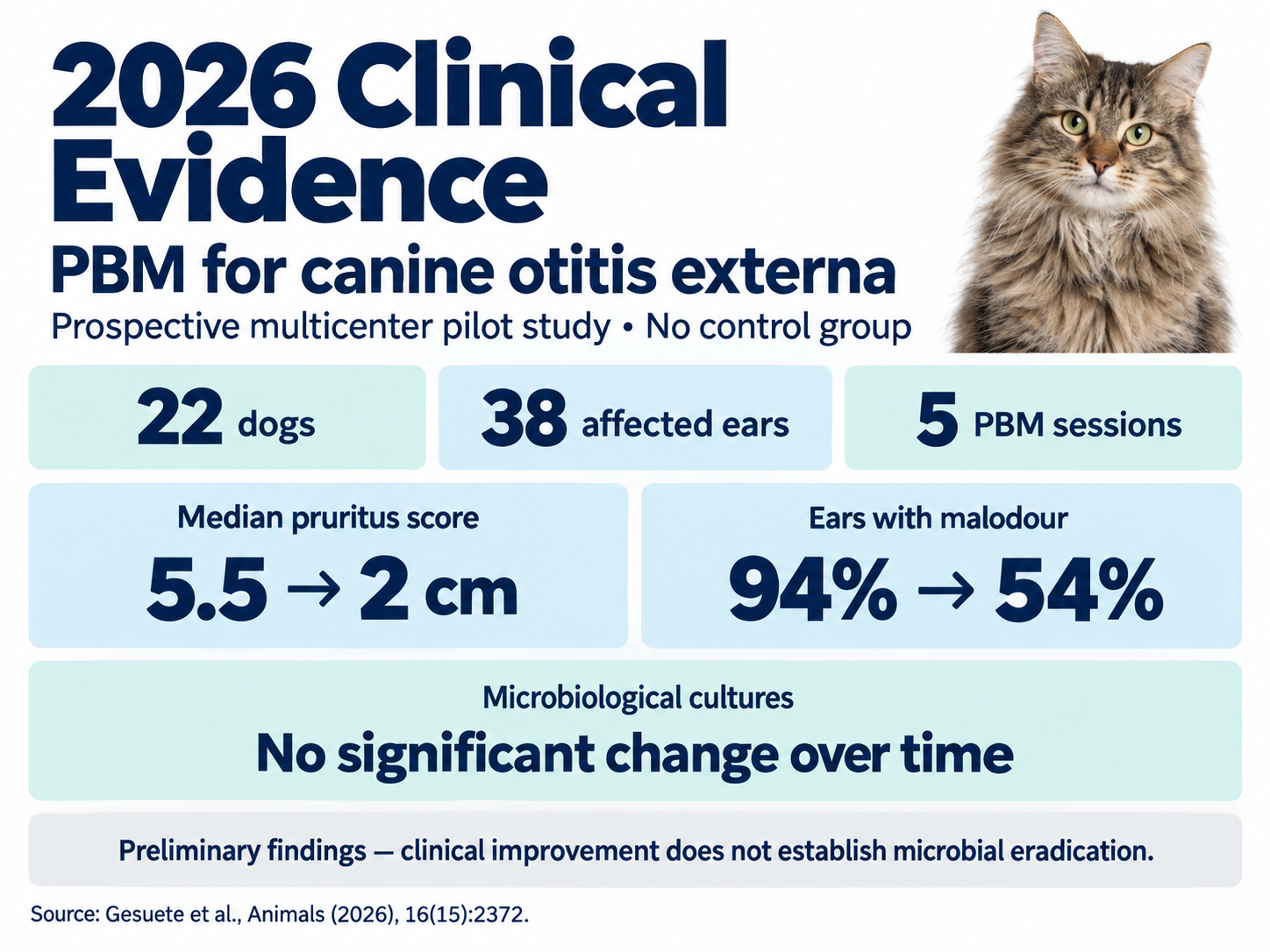
Taken together, these results suggest a possible supportive role for PBM in inflammatory and symptomatic components of canine otitis externa. They do not establish PBM as a method of microbial eradication, nor do they show that PBM can replace conventional management of the underlying disease.
How Should the Evidence Be Interpreted?
The 2026 study was a prospective multicenter pilot study without a control group. That design is useful for generating clinical signals, but it does not provide the same level of certainty as a randomized controlled trial. The findings should therefore be viewed as preliminary rather than definitive evidence of treatment efficacy.
The distinction between clinical improvement and microbiological eradication is especially important. In the study, several signs and cytological measures improved, but culture results did not change significantly. This supports a cautious interpretation: PBM may contribute to symptom and inflammation management in selected cases, while antimicrobial or other disease-specific treatment still needs to be guided by the underlying diagnosis and clinical findings.
Further controlled studies are needed to compare PBM with standard care, clarify which patients are most likely to benefit, and evaluate longer-term outcomes and recurrence.
Published Treatment Parameters: What the 2026 Study Actually Used
The protocol below describes the parameters investigated in the 2026 canine otitis externa pilot study [1]. It should be read as a study-specific protocol, not as a universal treatment recommendation.
| Treatment component | Parameters reported in the 2026 study |
| Wavelengths | 808 ± 10 nm + 905 ± 10 nm |
| Ear canal | 4.5 J/cm² |
| Pinna | 0.2 J/cm² per irradiation point |
| Treatment sessions | 5 sessions |
| Schedule | Second session 24 hours after baseline; subsequent sessions at 48–72-hour intervals |
| Follow-up | 24–48 hours after the final session |
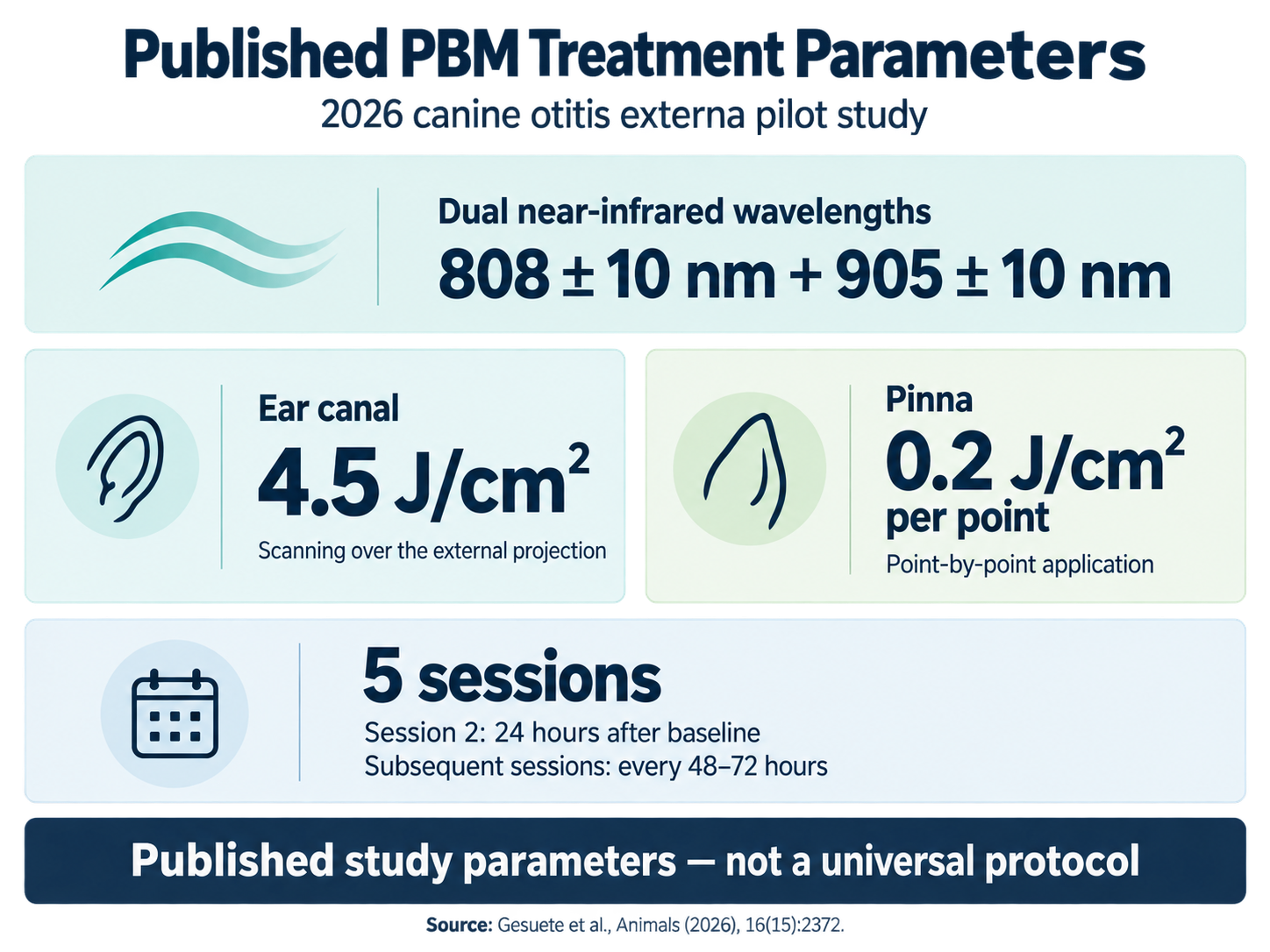
Application technique also matters. In the study, treatment included scanning over the external projection of the vertical and horizontal ear canal and point-by-point application to the pinna. Frequency and intensity settings varied by treatment site. These details are part of the protocol and help explain why a published dose cannot be separated from the device, wavelength, technique, and clinical population in which it was studied.
Why There Is No Single “Laser Dose” for Otitis
A numerical fluence value does not define a complete PBM treatment plan. Clinically relevant parameters include:
Treatment objective and target tissue
Treatment area and tissue characteristics
Application technique and treatment geometry
Patient size, anatomy, and tolerance
The specific laser system used
The strength and relevance of the available evidence
For that reason, the 4.5 J/cm² value reported for the ear canal in the 2026 study should not automatically be transferred to a different device, wavelength combination, anatomical site, or patient population. Veterinary laser literature more broadly also shows substantial variation in treatment parameters and no single consensus protocol across indications .
How PBM Fits Into Clinical Management
PBM is best considered after the ear has been appropriately assessed and the primary disease and clinically relevant secondary infection or overgrowth are being addressed. In practice, the sequence is straightforward:
1. Confirm the clinical problem. History, otoscopic examination, cytology, and additional diagnostics should be used when indicated.
2. Treat the underlying and secondary disease. Management should be based on the cause of otitis and the clinical findings, rather than on laser therapy alone.
3. Consider PBM for selected inflammatory or painful components. The role of PBM is adjunctive, not substitutive.
4. Reassess the response. Clinical signs, cytology, ear canal condition, and the underlying disease should be monitored according to the individual case.
Before treatment, review veterinary laser therapy safety, including appropriate eye protection, device-specific precautions, and patient monitoring.
What About Feline Otitis?
Direct clinical evidence for PBM in feline otitis is currently more limited than the evidence available for canine otitis externa. The canine protocol summarized above should therefore not be treated as a validated feline protocol. Cats require case-specific assessment, and treatment parameters should be selected only within an appropriate clinical context.
PBM and Surgical Laser Are Not the Same Treatment
Photobiomodulation uses non-ablative light to influence biological responses in tissue. Surgical laser procedures use laser energy for applications such as cutting, ablation, vaporization, or coagulation, depending on the laser system and procedure. These approaches have different treatment objectives, techniques, and safety considerations and should not be presented as interchangeable forms of “laser therapy.”
Frequently Asked Questions
What wavelengths were used in the 2026 canine otitis study?
The study used dual-near-infrared PBM at 808 ± 10 nm and 905 ± 10 nm [1].
Is 4.5 J/cm² a universal recommended dose for canine otitis externa?
No. That value describes the ear-canal component of one published study protocol. It should be interpreted together with the wavelength, device, application method, schedule, and study population.
Did PBM eliminate bacteria or yeast in the study?
The study reported improvements in several clinical and cytological measures, but microbiological culture results did not change significantly. Current evidence therefore does not establish PBM as a method of microbial eradication.
Can the canine protocol be applied directly to cats?
It should not be assumed. Direct clinical evidence in feline otitis remains limited, and canine study parameters should not be treated as validated feline treatment parameters.
Can PBM replace medication or diagnosis?
No. PBM is an adjunctive modality. Treatment still needs to address the underlying cause and clinically relevant secondary disease according to the individual patient.
Conclusion
The current evidence supports a cautious, adjunctive view of PBM in canine otitis externa. A 2026 prospective multicenter pilot study reported improvements in several clinical and cytological measures after five PBM sessions, but the study was uncontrolled and microbiological culture results did not change significantly. The findings are therefore promising but preliminary.
Published parameters such as 808 ± 10 nm plus 905 ± 10 nm, 4.5 J/cm² for the ear canal, and the reported treatment schedule should be understood as components of a specific research protocol rather than a universal prescription. Patient selection, diagnosis, treatment objectives, anatomy, device characteristics, and follow-up remain essential to responsible clinical use.
References
1. Gesuete F, Luciani L, Crotti S, Papa P, Muñoz Declara S, Contiero B, Zini E, Travalin D, Spina S, Zanna G. Evaluation of Dual-Near-Infrared-Wavelength Photobiomodulation Therapy for the Treatment of Canine Otitis Externa: A Prospective Multicenter Pilot Study. Animals. 2026;16(15):2372. doi:10.3390/ani16152372.
2. Bunch J. Photobiomodulation (Therapeutic Lasers): An Update and Review of Current Literature. Veterinary Clinics of North America: Small Animal Practice. 2023;53(4):783–799. doi:10.1016/j.cvsm.2023.02.010.
3. Millis DL, Bergh A. A Systematic Literature Review of Complementary and Alternative Veterinary Medicine: Laser Therapy. Animals. 2023;13(4):620.
4. Pryor B, Millis DL. Therapeutic Laser in Veterinary Medicine. Veterinary Clinics of North America: Small Animal Practice. 2015;45(1):45–56. doi:10.1016/j.cvsm.2014.09.003.
5. Hochman L. Photobiomodulation Therapy in Veterinary Medicine: A Review. Topics in Companion Animal Medicine. 2018;33(3):83–88. doi:10.1053/j.tcam.2018.06.004.